

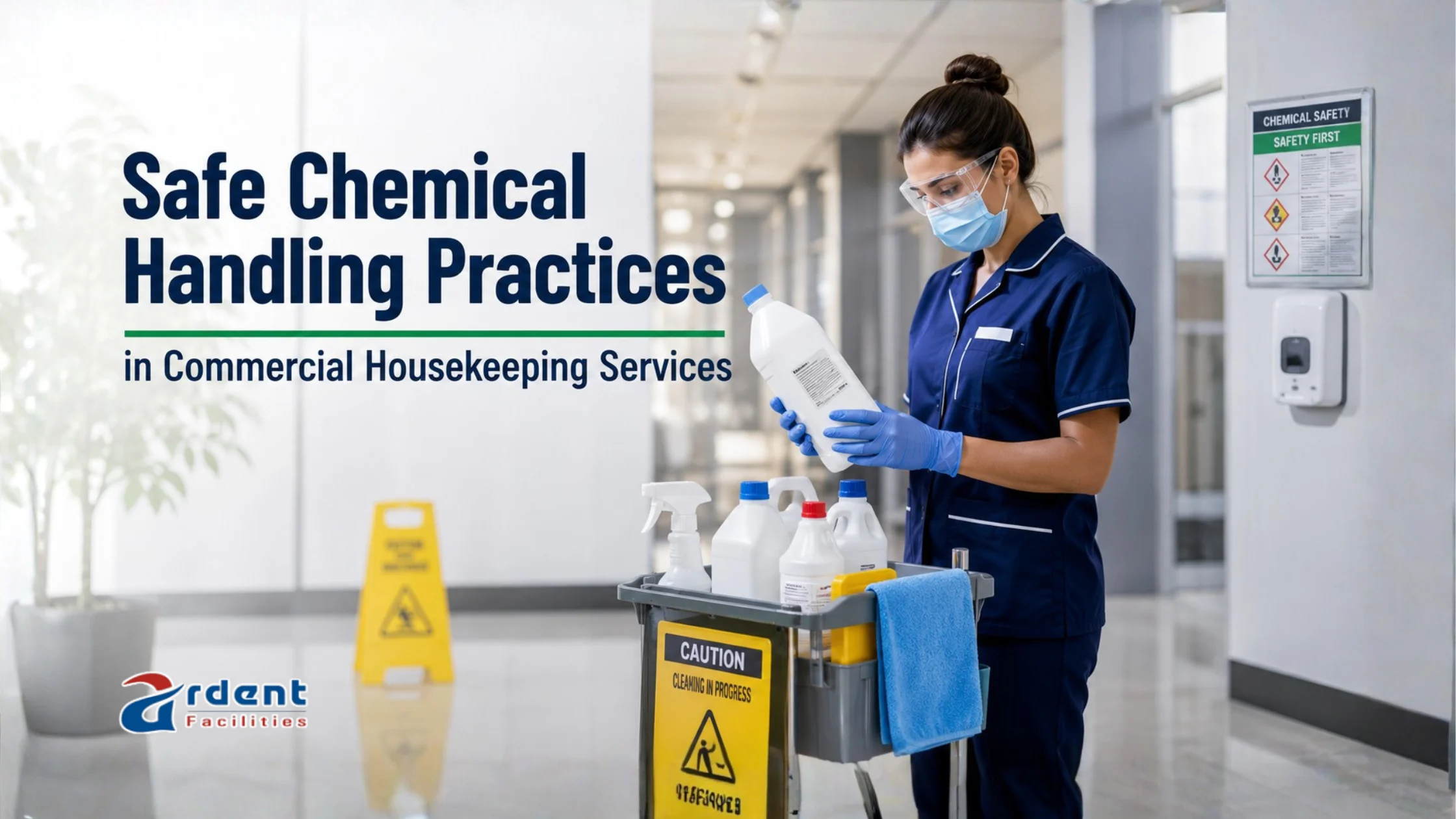
A housekeeping worker enters a corporate washroom after office hours. The floor smells stronger than usual. Ten minutes earlier, someone had mixed a toilet cleaner with a bleach-based disinfectant inside the same bucket. Within minutes, the worker complained of burning eyes and a tight chest. Nobody knew exactly which products had been mixed.
We see versions of this incident repeatedly across commercial buildings, hospitals, factories, and warehouses in Gujarat. Most chemical injuries in housekeeping are not major spills. They start with routine cleaning tasks carried out without proper chemical control, training, or supervision.
Quick Answer
Safe chemical handling in commercial housekeeping requires proper chemical labeling, SDS/MSDS availability, PPE usage, worker training, safe storage practices, and strict control of incompatible chemical mixing. In 2026, facility managers should also verify contractor chemical safety compliance under ISO 45001 requirements and maintain documented chemical handling procedures across all workplaces.
Safe Chemical Handling in Commercial Housekeeping: Key Requirements
| Safety Area | What Facilities Must Do | Risk if Ignored |
|---|---|---|
| SDS / MSDS Availability | Keep updated SDS for every cleaning chemical on-site | Delayed emergency response and audit non-compliance |
| Chemical Labeling | Ensure all containers are properly labeled | Accidental misuse and exposure incidents |
| PPE Usage | Provide gloves, goggles, masks, and protective clothing where required | Chemical burns, eye injuries, respiratory issues |
| Chemical Storage | Store acids, disinfectants, and other chemicals separately | Dangerous chemical reactions and contamination |
| Staff Training | Conduct regular chemical safety and GHS training | Improper handling and increased accident rates |
| Spill Response | Maintain spill kits and documented response procedures | Workplace contamination and regulatory issues |
| Contractor Compliance | Verify housekeeping vendor safety systems and records | Shared liability for workplace incidents |
| GHS Hazard Labels | Train staff to understand hazard pictograms | Incorrect chemical usage and exposure risks |
| Emergency Preparedness | Establish eyewash, first-aid, and reporting procedures | Delayed medical treatment during incidents |
| ISO 45001 Requirements | Include contractor chemical safety management in audits | Certification findings and compliance gaps |
Key Takeaway
Most housekeeping chemical incidents are not caused by major spills. They occur because workers use unlabeled containers, mix incompatible products, ignore SDS instructions, or receive inadequate training. Facilities that implement chemical control procedures, PPE compliance, and contractor safety audits significantly reduce workplace exposure risks and improve housekeeping vendor compliance.
The Principal Employer’s Liability Most Facility Managers Do Not Know About
If a contract housekeeping worker suffers chemical exposure inside your facility Management, liability does not automatically stop with the housekeeping vendor. The principal employer can also face legal and compliance consequences.
Many facility managers assume contractor workers are solely the vendor’s responsibility. Auditors, labour authorities, and investigators rarely view incidents that way.
Under Indian labour and workplace safety requirements, the principal employer has a duty to provide a reasonably safe working environment for all personnel working on the premises, including contract workers. If a worker suffers injury because hazardous chemicals were improperly stored, unlabeled, undocumented, or used without adequate controls, investigators typically examine both the vendor and the client facility.
ISO 45001:2018 strengthened this expectation. Contractor safety management is no longer treated as a separate activity. Certified organizations must identify risks arising from contractor work and demonstrate effective controls.
One change becoming common across ISO-certified facilities in Ahmedabad and Surat is the inclusion of chemical safety documentation clauses within housekeeping vendor agreements. Facilities increasingly require documented SDS records, chemical inventories, training logs, and incident reporting procedures before contractors begin work.
The audit finding that triggers corrective actions more than almost any other housekeeping issue is surprisingly simple: chemicals are actively being used, but no SDS or MSDS documentation is available on-site.
That happens more often than managers expect.
During facility audits across Gujarat, I have repeatedly found chemical storage rooms containing fifteen or twenty cleaning products while supervisors could only produce documentation for three or four. The products were approved. The paperwork was not.
Another operational observation stands out. The most common chemical incident is not a major spill. It is a worker refilling a spray bottle from a bulk container after the original label has faded or disappeared.
ISO 45001 Contractor Chemical Safety: What Your Facility Audit Will Check
A competent auditor will typically verify:
- Availability of SDS/MSDS for every chemical in use
- Chemical risk assessments
- Contractor chemical handling procedures
- PPE compliance records
- Emergency response arrangements
- Spill control readiness
- Worker training documentation
- Vendor chemical approval process
Chemical Combinations That Cause Incidents — The Ones Already in Your Facility Right Now
Several dangerous chemical combinations already exist in most commercial facilities. Workers are often injured because they recognize the product name but not the active ingredient.
The problem starts inside cleaning cupboards, not laboratories.
Most incidents occur because staff believe combining products will improve cleaning performance. It does not. It creates exposure risks.
Common dangerous combinations found in Gujarat facility cleaning cupboards:
- Sodium Hypochlorite (Bleach) + Hydrochloric Acid → Chlorine Gas
Common products: Bleach solutions, toilet bowl cleaners
Symptom timeline: Eye irritation within seconds, coughing within minutes, breathing difficulty shortly after exposure - Bleach + Ammonia-Based Cleaners → Chloramine Gas
Common products: Glass cleaners, multipurpose cleaners, disinfectants
Symptom timeline: Burning throat, chest tightness, watering eyes, nausea - Hydrogen Peroxide + Vinegar → Peracetic Acid
Common products: Surface disinfectants and improvised cleaning mixtures
Symptom timeline: Respiratory irritation and skin discomfort - Drain Cleaning Alkalis + Acid Cleaners → Violent Heat Reaction
Common products: Drain openers and toilet cleaning chemicals
Symptom timeline: Splash burns, chemical burns, fume generation
Many Indian toilet cleaners contain hydrochloric acid. Many disinfectants contain sodium hypochlorite. Workers often do not know that those names matter more than the brand name.
An unexpected risk appears during night shifts. Cleaning teams frequently transfer leftover chemicals into unmarked beverage bottles because the original container is damaged. Auditors rarely find this during scheduled inspections because the bottles are discarded before morning.
Another issue hides inside housekeeping stores. Strong fragrances often mask warning odours generated by chemical reactions, delaying worker recognition of exposure.
4 Cleaning Chemical Combinations Found in Gujarat Offices That Injure Housekeeping Staff
Facilities should prohibit all chemical mixing unless specifically authorised by the manufacturer. Every approved product already contains a formulated concentration. Adding another chemical rarely improves performance and frequently increases risk.
Reading GHS Labels — What Your Housekeeping Staff Currently Cannot Do
Most housekeeping workers cannot correctly interpret GHS hazard pictograms without training. That gap directly increases chemical handling risk.
Reading a label is not the same as understanding a label.
India’s adoption of Globally Harmonized System (GHS) requirements changed how chemical hazards are communicated. Modern chemical containers increasingly display standardized hazard pictograms, signal words, precautionary statements, and classification details.
The four pictograms housekeeping personnel encounter most frequently are:
- Corrosion
- Exclamation Mark
- Health Hazard
- Environment Hazard
A corrosion symbol indicates chemicals capable of damaging skin, eyes, or metals. Workers handling toilet cleaners encounter this regularly.
The exclamation mark symbol typically indicates irritants that can affect eyes, skin, or the respiratory system.
The health hazard symbol warns of longer-term exposure concerns.
Environmental hazard symbols identify products that require controlled disposal procedures.
Many workers across Gujarat receive product demonstrations but never receive actual GHS hazard classification training. The difference matters. Demonstrations show what to do. Hazard communication explains why.
Bilingual training produces the best results. Training delivered in Gujarati alongside visual symbols consistently improves retention among frontline housekeeping teams.
Minimum GHS knowledge every housekeeping staff member needs before chemical handling:
- Identify major hazard pictograms without assistance
- Locate SDS information quickly
- Understand dilution instructions
- Recognize incompatible chemical combinations
- Know emergency eyewash and first-aid procedures
- Report damaged labels immediately
Gujarat’s Industrial Facilities — Why Standard Housekeeping Chemical Training Is Not Enough
Industrial facilities face chemical exposure scenarios that ordinary office cleaning programs do not cover. Site-specific training is essential.
A generic housekeeping induction is rarely sufficient in Gujarat’s industrial environment.
Ahmedabad
Housekeeping Services in Ahmedabad frequently support pharmaceutical manufacturing environments around Naroda GIDC and Vatva GIDC where GMP cleaning requirements influence housekeeping procedures.
Cleaning teams operating in pharmaceutical areas often work around validated cleaning programs, controlled chemical inventories, and contamination control requirements. A worker trained only for office cleaning may unintentionally compromise compliance.
Facilities seeking professional housekeeping services across Ahmedabad’s corporate and industrial facilities (/housekeeping-services-in-ahmedabad/) typically require stronger documentation, chemical traceability, and supervisor competency than standard commercial sites.
Vadodara
Housekeeping Services in Vadodara often operate within chemical and petrochemical environments around Savli GIDC and surrounding industrial corridors.
Spill response becomes a critical skill here. Staff must understand absorbents, neutralisation requirements, segregation procedures, and hazardous waste handling expectations. Improper cleanup can transform a small incident into a reportable event.
Organizations requiring specialized housekeeping support for Vadodara manufacturing and industrial operations (/housekeeping-services-vadodara/) increasingly evaluate housekeeping vendor compliance before awarding contracts.
Surat
Housekeeping Services in Surat encounter different risks. Textile processing facilities generate dye residues, while diamond processing operations create fine particulate exposure concerns.
Cleaning methods suitable for office spaces may spread contaminants inside industrial environments. Vacuum selection, containment practices, and waste handling procedures become important operational controls.
Facilities looking for industrial and commercial housekeeping expertise across Surat facilities (/housekeeping-services-in-surat/) often require workers trained on chemical residue management and controlled disposal practices.
Gandhidham
Housekeeping Services in Gandhidham face challenges linked to warehousing, logistics operations, and port-linked storage facilities.
Humidity affects chemical storage conditions. Product degradation, damaged packaging, and cross-contamination risks become more common near bulk storage operations. Cleaning crews working around cargo movement areas require stronger chemical segregation awareness.
Businesses seeking housekeeping support for warehouses and industrial facilities in Gandhidham (/housekeeping-services-gandhidham/) generally place greater emphasis on storage inspections and contamination prevention controls.
What Separates a Compliant Housekeeping Vendor from a Basic Cleaning Contractor
A compliant vendor manages chemical risk systematically. A basic contractor focuses mainly on manpower deployment.
The difference becomes obvious during an incident investigation.
Most procurement teams compare staffing numbers, attendance systems, and commercial terms. Chemical safety capability receives far less attention than it should.
A professional provider of Corporate Housekeeping Services maintains documented chemical control systems. A basic contractor often depends on verbal instructions and supervisor experience.
The gap becomes visible the moment an auditor asks for training records, SDS documentation, chemical inventories, exposure response procedures, or PPE compliance evidence.
What to verify from any housekeeping vendor before signing a contract in 2026:
- Ask for SDS management procedures
Good answer: Documented chemical inventory linked to SDS records - Ask how workers receive chemical safety training
Good answer: Induction plus periodic refresher training with attendance records - Ask how chemical compatibility is controlled
Good answer: Written segregation and storage procedures - Ask for PPE compliance evidence
Good answer: Issue registers and replacement schedules - Ask about spill response capability
Good answer: Documented response process and trained supervisors - Ask for incident reporting procedures
Good answer: Formal investigation and corrective action system - Ask how contractor compliance is audited
Good answer: Scheduled inspections and documented findings
Corporate Housekeeping Vendor Chemical Safety Audit Checklist
If a vendor cannot produce documentation within minutes, assume the system does not exist. Well-managed vendors keep records ready because clients, auditors, and regulators regularly request them.
Ardent Facilities — Chemical-Safe Housekeeping Services Across Gujarat
Ardent Facilities Private Limited delivers Housekeeping Services (/housekeeping-services/) and Corporate Housekeeping Services through structured operational processes supported by ISO 9001:2015 standards.
The company deploys chemical-trained housekeeping personnel, maintains SDS documentation practices, supports chemical safety in housekeeping programs, and emphasizes housekeeping vendor compliance across client facilities. Services are available across Ahmedabad, Vadodara, Surat, and Gandhidham for corporate offices, hospitals, warehouses, manufacturing plants, and industrial operations.
To request a chemical safety review of your current housekeeping setup, call +91 98254 00349 or email info@ardentfacilities.com.
Conclusion
Chemical safety in housekeeping is moving beyond basic PPE and warning labels. Facilities are increasingly expected to maintain digital chemical inventories, stronger contractor oversight, and verifiable SDS controls aligned with ISO 45001 facility management requirements. Enforcement around chemical documentation continues to tighten. Facility managers can either build these systems now or build them after an incident investigation forces the issue. For expert support across Gujarat, contact Ardent Facilities and review your chemical handling controls before they become a liability.
FAQs
Q1. Who is liable if a housekeeping worker is injured by chemicals in a company premises in India?
The principal employer can share liability when a housekeeping worker is injured by chemical exposure on company premises. Authorities typically review both the client facility and the contractor’s safety management systems, training records, hazard controls, and documentation before determining responsibility.
Q2. What is an MSDS and is a housekeeping vendor required to provide it in India?
An MSDS or SDS is a document that explains chemical hazards, safe handling procedures, emergency response actions, and protective measures. Housekeeping vendors should maintain accessible SDS records for every chemical they use and provide them when requested by clients or auditors.
Q3. Which cleaning chemicals should never be mixed in commercial facilities?
Bleach should never be mixed with acids, ammonia-based cleaners, or other incompatible chemicals. These combinations can generate toxic gases, respiratory irritation, chemical burns, and emergency situations that place housekeeping staff and building occupants at risk.
Q4. What PPE is required for housekeeping staff handling cleaning chemicals?
The required PPE depends on the chemical being used, but commonly includes chemical-resistant gloves, eye protection, masks or respirators where appropriate, safety footwear, and protective clothing. PPE selection should always follow SDS recommendations and workplace risk assessments.
Q5. How do I know if my housekeeping vendor is following chemical safety standards?
A compliant vendor can immediately provide SDS records, training logs, PPE issue records, chemical inventories, spill response procedures, and incident reporting documentation. Consistent records and documented systems are usually stronger indicators than verbal assurances.