
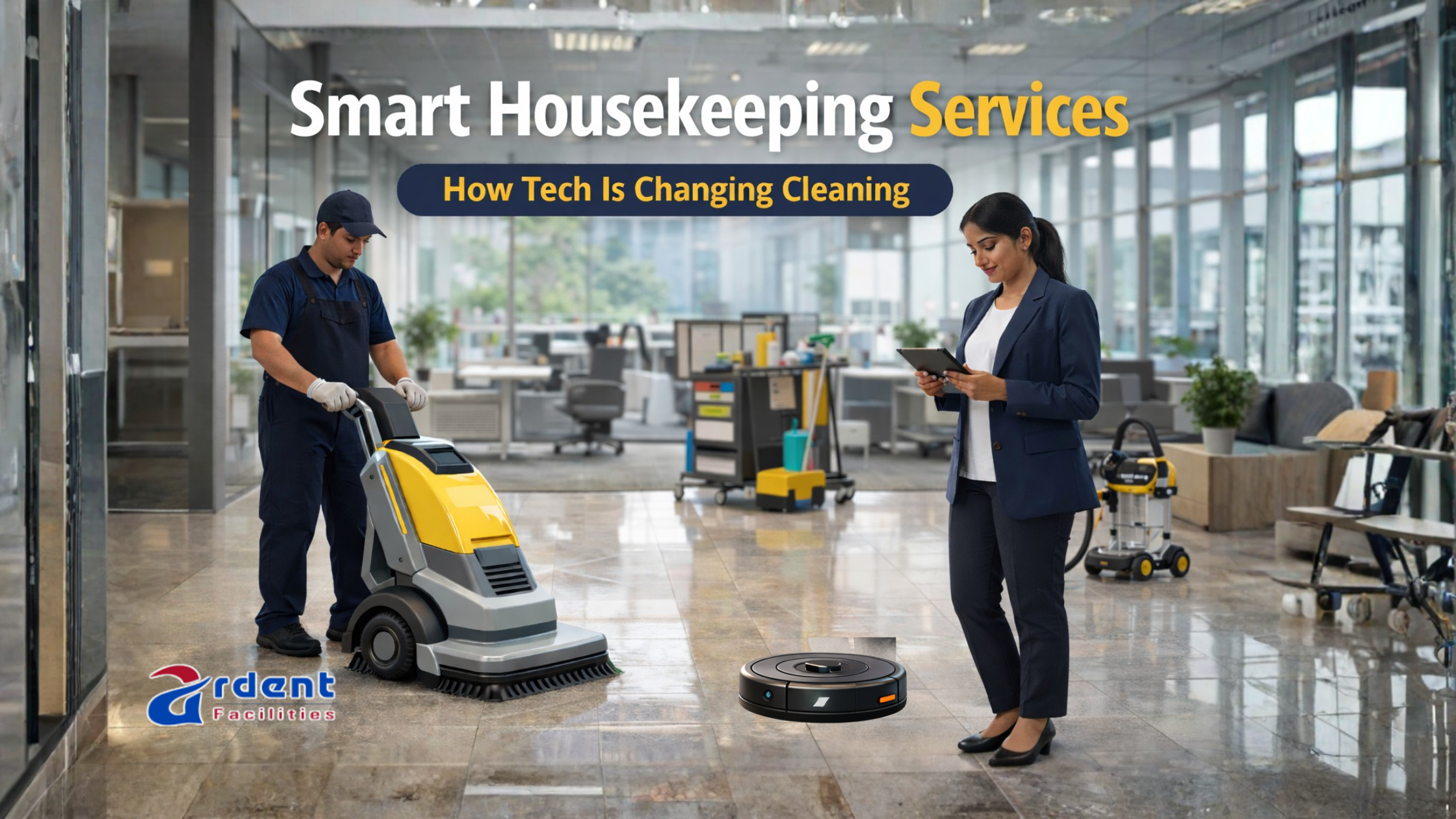
If you manage an office, factory, hospital, residential society, or retail space, you already know one simple truth—cleaning is no longer just about brooms and buckets.
Today, people notice dust-free floors, fresh-smelling washrooms, sanitised touchpoints, and organised workspaces instantly. They also notice when these things are missing. In many Indian workplaces, especially across Gujarat, expectations around cleanliness have changed fast. And the biggest reason behind this shift is technology.
This Article is written from a practical, user-first perspective—just like a facility manager, business owner, or society committee member would think. No technical jargon. No sales pressure. Just a clear explanation of how smart housekeeping services are transforming cleaning, why it matters, and how businesses in cities like Ahmedabad, Vadodara, Surat, and Gandhidham can benefit from it.
Why Traditional Housekeeping Is No Longer Enough
For years, housekeeping services worked on a simple formula:
- Fixed number of cleaners
- Manual supervision
- End-of-day cleaning
- Paper-based attendance
This approach worked when expectations were low. But today, things are different.
Think about:
- Corporate offices with glass cabins and high footfall
- Hospitals where hygiene impacts health directly
- IT parks running 24/7
- Warehouses handling sensitive goods
- Residential societies expecting hotel-like cleanliness
Manual systems struggle to keep up. Missed areas, inconsistent quality, absenteeism, and lack of accountability become common issues.
That’s where technology-driven housekeeping services step in.
What Are Smart Housekeeping Services?
Smart housekeeping services combine trained manpower with technology tools to improve efficiency, hygiene, transparency, and control.
It is not about replacing people with machines. It is about supporting people with systems.
Smart housekeeping usually includes:
- Mechanised cleaning equipment
- App-based task tracking
- Digital attendance and supervision
- Chemical dosing systems
- Real-time reporting
- Data-based cleaning schedules
This shift is already visible across housekeeping services in Ahmedabad, especially in industrial zones, corporate parks, and hospitals.
How Technology Is Changing Cleaning on the Ground
Let’s break this down in a very real, practical way.
1. Mechanised Cleaning for Consistent Results
Manual mopping depends on individual effort. One person may clean better than another. Machines don’t have that problem.
Modern housekeeping uses:
- Auto scrubber dryers for large floors
- Vacuum cleaners with HEPA filters
- High-pressure jet cleaners
- Ride-on machines for warehouses and malls
Real example:
A corporate office in Ahmedabad earlier needed 6 people to manually clean 3 floors every morning. With scrubber machines, the same work is now done by 2 trained staff in less time, with visibly better shine.
This is why corporate housekeeping services are rapidly adopting mechanised cleaning.
2. App-Based Task Monitoring (No More Guesswork)
One of the biggest pain points for clients is not knowing:
- Who cleaned what
- When it was done
- Whether it was done properly
Smart housekeeping solves this with digital task allocation.
Each cleaner gets:
- Assigned zones
- Fixed cleaning frequency
- Time-bound tasks
- Supervisors track everything through mobile apps.
Result:
No excuses. No “it was already cleaned” arguments. Complete visibility.
This model is now common in housekeeping services in Vadodara for corporate offices and hospitals.
3. Digital Attendance & Manpower Transparency
Absenteeism is a silent problem in housekeeping.
With biometric or app-based attendance:
- You know exactly who reported
- You know shift timings
- You avoid ghost employees
For businesses using housekeeping services in Gandhidham, where manpower availability can be unpredictable, this technology ensures stability and continuity.
4. Smart Chemical Usage = Better Hygiene + Lower Cost
Traditional cleaning often wastes chemicals:
- Too much chemical damages floors
- Too little chemical fails to disinfect
Smart housekeeping uses:
- Measured dilution systems
- Surface-specific chemicals
- Colour-coded tools
This improves hygiene while protecting flooring and furniture.
In sectors like pharma units and food processing units near Ahmedabad and Surat, this approach is now standard practice.
5. Data-Driven Cleaning Schedules
Not all areas need the same level of cleaning.
Smart systems analyse:
- Footfall patterns
- Usage timings
- Area sensitivity
Washrooms, lifts, reception areas, and cafeterias are cleaned more frequently than low-traffic zones.
This is especially useful for Housekeeping Services in Surat, where malls and textile offices see fluctuating crowd patterns.
Smart Housekeeping vs Traditional Housekeeping (Quick Comparison)
| Aspect | Traditional Housekeeping | Smart Housekeeping |
|---|---|---|
| Supervision | Manual & reactive | Digital & proactive |
| Cleaning Tools | Mop, broom | Machines + tools |
| Attendance | Register-based | App/Biometric |
| Reporting | Verbal | Real-time digital |
| Quality Consistency | Depends on staff | Standardised |
| Cost Control | Unpredictable | Optimised |
| Client Visibility | Low | High |
Why Businesses in Gujarat Are Adopting Smart Housekeeping Faster
Gujarat has a strong mix of:
- Manufacturing units
- Corporate offices
- Warehousing hubs
- Hospitals and educational institutes
Cities like Ahmedabad, Vadodara, Surat, and Gandhidham are growing rapidly. With growth comes competition—and cleanliness is now a brand image factor.
A clean workplace:
- Improves employee productivity
- Builds client trust
- Reduces maintenance cost
- Supports compliance and audits
That’s why demand for professional housekeeping services is shifting toward smart, tech-enabled providers.
Real-World Use Case: Office to Industrial Transition
A mid-sized corporate client in Ahmedabad started with basic housekeeping. As the office expanded into a warehouse setup, cleaning needs changed completely.
Challenges faced:
- Oil stains on floors
- Dust accumulation
- Safety compliance issues
Smart housekeeping introduced:
- Industrial scrubber machines
- Zone-based cleaning
- Trained supervisors
- Digital audits
Within three months:
- Safety complaints reduced
- Floor maintenance cost dropped
- Inspection scores improved
This transition is now common among growing businesses.
What to Look for When Choosing Smart Housekeeping Services
If you are planning to upgrade or hire a housekeeping provider, ask these questions:
- Do they use mechanised equipment?
- Is manpower trained for machines and chemicals?
- Do they provide supervisors with digital reporting?
- Can they scale services as your space grows?
- Do they understand local working conditions?
A reliable provider will always explain how they clean, not just what they clean.
Pricing Logic: What Changes with Smart Housekeeping?
Smart housekeeping is not necessarily expensive.
While machine-based services may look costly initially, they often:
- Reduce manpower dependency
- Lower rework and damage
- Improve asset life
- Save long-term costs
For example:
- A warehouse may need fewer cleaners
- Office flooring lasts longer
- Washroom maintenance cost reduces
Pricing usually depends on:
- Area size
- Type of premises
- Footfall
- Cleaning frequency
This logic applies equally across housekeeping services in Ahmedabad, Vadodara, Surat, and Gandhidham.
Corporate Housekeeping Is No Longer Optional
Corporate spaces today are judged instantly—by clients, employees, auditors, and partners.
Smart corporate housekeeping services ensure:
- Consistent hygiene
- Professional appearance
- Compliance readiness
- Peace of mind
It’s not about luxury. It’s about standards.
How Ardent Facilities Fits into This Change
Companies looking for reliable, technology-driven housekeeping solutions often prefer partners who understand both ground reality and modern systems.
Ardent Facilities operates from Odhav, Ahmedabad, and works across Gujarat and other parts of India. With experience in industrial, corporate, and commercial environments, the focus remains on structured cleaning, trained manpower, and practical solutions—not just promises.
Located near 509, Girivar Glean Odhav Ring Road Circle, Nikol Gam Road, next to Hotel Palm, Odhav, Ahmedabad, the team understands local challenges while delivering professional standards.
The Future of Housekeeping Services in India
The future is clear:
- More automation
- Better reporting
- Higher hygiene expectations
- Smarter manpower deployment
Businesses that adopt smart housekeeping early will always stay ahead—both operationally and visually.
Whether you are managing:
- An office in Ahmedabad
- A factory in Vadodara
- A warehouse in Gandhidham
- A commercial space in Surat
Technology-driven housekeeping is no longer a “nice to have”. It’s the new normal.
Final Thoughts (From a User’s Perspective)
Clean spaces don’t happen by accident. They happen by design.
Smart housekeeping services bring structure, accountability, and consistency to something that was once ignored until complaints came in.
If you are already investing in your business, your people, and your infrastructure, investing in modern housekeeping services simply makes sense.