
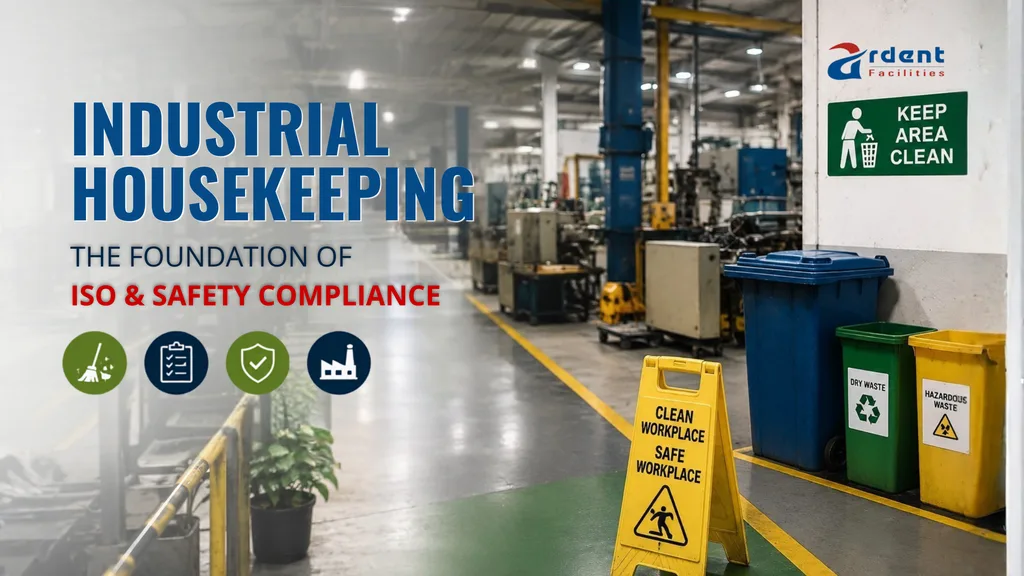
Most ISO non-conformities raised against manufacturing facilities in Gujarat’s GIDC zones are not about documentation gaps or process failures. They are about housekeeping. Blocked emergency exits, unlabelled chemical storage areas, overflowing waste bins in production zones, and oil spill residue on walkways are among the most commonly cited observations in ISO 9001 and ISO 45001 audits across Ahmedabad and Vadodara industrial housekeeping units. None of them are difficult to fix — but all of them reflect a systemic failure in how housekeeping is planned, assigned, and verified.
Why Housekeeping Is an ISO Audit Risk — Not Just a Cleanliness Standard
Housekeeping is treated by ISO auditors as a controlled process environment and a hazard elimination method, not a visual cleanliness factor. Under ISO 9001:2015 Clause 7.1.4, the environment for operation of processes explicitly includes cleanliness, orderliness, and contamination control as part of the quality management system.
ISO 45001:2018 Clause 8.1.2 places housekeeping directly under the hazard elimination hierarchy for slip, trip, fire, and chemical exposure risks. This means poor housekeeping is read as poor safety control — not a maintenance lapse.
2026 update: ISO 9001 Clause 6.1 (risk-based thinking) now requires housekeeping failures to be documented in the risk register as organisational risks. Auditors in Gujarat are now asking: “Where is housekeeping failure identified in your risk register?” Facilities unable to show this mapping receive a major non-conformity.
The shift from OHSAS 18001 to ISO 45001:2018 is also creating documentation non-conformities. Many factories still use housekeeping SOPs written under OHSAS frameworks where hazard identification logic does not meet ISO 45001 expectations.
Operational insight: In ISO 9001 surveillance audits at Vatva GIDC pharmaceutical units, auditors have specifically asked facility managers to produce housekeeping frequency records for production area floors and washrooms — not just cleaning checklists, but signed and dated completion records showing who cleaned what, when, and what was verified. Units that only have a printed checklist without completion records receive an observation at minimum, and a non-conformity if the gap is in a critical production zone.
The 7 Most Common Housekeeping Non-Conformities Found in Gujarat Industrial Audits
Across Vatva, Naroda, Savli, Hazira, Odhav, and Pandesara, these seven housekeeping observations repeatedly trigger ISO non-conformities. The issue is rarely dirt — it is the absence of a verifiable system.
- Blocked or partially obstructed emergency exit pathways
Under ISO 45001 Clause 8.2, auditors physically walk emergency routes. Even temporary storage of cartons, scrap bins, or pallets in exit paths is raised as a major non-conformity. - Unlabelled or incorrectly labelled chemical storage areas
This violates ISO 9001 Clause 7.1.4 and Factories Act Section 41B. Auditors check hazard labels, segregation, and the cleanliness condition of storage surroundings. - Absence of waste segregation in production zones
If an Integrated Management System exists, this is flagged under ISO 14001 Clause 8.1 and Gujarat Pollution Control Board norms. - Oil, coolant, or process fluid residue on machine walkways
Identified as slip and trip hazards under ISO 45001 Clause 6.1.2 during hazard identification walkthroughs. - Housekeeping frequency records missing or unsigned
Direct violation of ISO 9001 Clause 7.5 documented information requirements. - Pest control and sanitation records absent or outdated
Critical for pharma, packaging, and food-adjacent industries in Ahmedabad and Surat. - 5S implementation documented but not visibly practiced
The classic “paper compliance” observation. Auditors compare the quality manual with the shop floor.
The pattern across these seven observations is consistent: the non-conformity is rarely about the physical gap alone. It is about the absence of a system — a defined schedule, an assigned responsibility, a verification record, and a corrective action trail. Auditors are not looking for a perfectly clean factory. They are looking for evidence that cleanliness is managed as a process.The 5S Framework and ISO Compliance — Where Most Gujarat Factories Fall Short
5S is the foundational housekeeping structure that supports both ISO 9001 and ISO 45001 compliance. Most Gujarat factories fail not because they never implemented 5S, but because they stopped sustaining it.
- Seiri (Sort): Red-tag areas exist but tagged materials remain for months without disposal tracking.
- Seiton (Set in Order): Shadow boards and floor markings faded or irrelevant in older Naroda and Savli units that implemented 5S years ago.
- Seiso (Shine): Cleaning is assigned but not scheduled zone-wise. Production, utility, and washrooms follow the same frequency.
- Seiketsu (Standardise): SOPs are in the quality manual but housekeeping staff have never been trained on them.
- Shitsuke (Sustain): No internal audit schedule for 5S, no corrective action process for deviations.
2026 update: Third-party ISO bodies are increasingly asking for timestamped photographic evidence of housekeeping completion under ISO 9001 Clause 7.5. Facilities relying only on paper checklists are being asked for digital proof.
Operational insight: At auto-ancillary units in Waghodia and Savli near Vadodara, shadow boards show tools that were replaced two years ago. Floor markings show old machine layouts. The documented 5S standard is current in the manual, but the shop floor reality is outdated. This gap is classified as a major non-conformity under ISO 9001 Clause 7.1.4.
Industry-Specific Housekeeping Compliance Risks in Gujarat
Ahmedabad — Pharmaceutical and Textile
Pharma units in Naroda GIDC must maintain documented housekeeping frequencies under Schedule M (GMP) alongside ISO requirements. Textile units in Odhav and Vatva deal with fibre dust accumulation in ventilation ducts and machines, flagged as respiratory hazards under ISO 45001. Professional housekeeping services in Ahmedabad must manage GMP and 5S standards together.
Vadodara — Petrochemical and Engineering
Savli GIDC and Waghodia Industrial Estate units require spill containment records, bund area cleanliness logs, and chemical storage housekeeping. Generic teams miss these HAZMAT-related expectations. Reliable housekeeping services in Vadodara include chemical handling awareness in staff training. This is why industries specifically look for housekeeping services Vadodara with industrial compliance exposure.
Surat — Diamond and Synthetic Textile
Diamond processing units require dust-controlled environments for worker safety and product quality. Pandesara textile units deal with dye residues and effluent-adjacent cleaning governed by GPCB norms. Trusted housekeeping services in Surat integrate with environmental management plans.
- Gandhidham — Port Logistics and Warehousing
Customs bonded warehouses and food-grade cargo storage areas face hygiene inspections beyond ISO audits. Shift-wise documentation across cold storage, ambient zones, and loading bays is essential. Corporate housekeeping services in Gandhidham must maintain separate zone records.
Why In-House Housekeeping Teams Consistently Fail ISO Audits — and What Outsourcing Solves
In-house teams clean effectively but fail to create audit evidence of control. ISO audits evaluate documented proof, not visible effort.
- No documented housekeeping SOP — verbal instruction only (ISO 9001 Clause 7.5 failure)
- No zone-wise frequency schedule — same cleaning plan for all areas
- No verification and sign-off system — no timestamps, no supervisor review
- Staff turnover breaks continuity — no competence or training records (Clause 7.2)
- No corrective action trail — gaps cleaned but never documented
Professional resolve these through SOPs, schedules, competence records, verification systems, and corrective action documentation integrated into the QMS.
Housekeeping Non-Conformity Comparison — What Gets Raised and Why
| Non-Conformity Type | ISO Clause | Common Trigger | Classification |
|---|---|---|---|
| No housekeeping SOP documented | ISO 9001 Cl. 7.5 | Auditor requests procedure | Minor NC |
| Housekeeping not in risk register | ISO 9001 Cl. 6.1 | Risk register review | Major NC |
| Emergency exit pathway blocked | ISO 45001 Cl. 8.2 | Physical walkthrough | Major NC |
| 5S documented but not practiced | ISO 9001 Cl. 7.1.4 | Shop floor observation | Major NC |
| No staff training records | ISO 9001 Cl. 7.2 | Staff competence audit | Minor NC |
| Chemical storage area unlabelled | ISO 45001 Cl. 6.1.2 | Hazard walkthrough | Major NC |
| No completion records — signed | ISO 9001 Cl. 7.5 | Document review | Minor NC |
| OHSAS 18001 SOP still in use | ISO 45001:2018 migration | Document review 2026 | Major NC |
Major non-conformities require corrective action evidence and often a follow-up visit, extending the audit closure timeline.
Ardent Facilities — ISO-Compliant Housekeeping Services Across Gujarat
Ardent Facilities Private Limited is an ISO 9001:2015 certified facility management company providing industrial and corporate housekeeping services across Ahmedabad, Surat, Vadodara, and Gandhidham.
Their housekeeping engagements include:
- Documented zone-wise SOPs aligned with ISO clauses
- Frequency schedules for each facility zone
- Trained staff with competence records (Clause 7.2)
- Supervisor sign-off and completion documentation (Clause 7.5)
- 5S maintenance support
- Corrective action documentation integrated with QMS
- Monthly compliance reports for ISO representatives
Every engagement is customised to the facility’s ISO scope. Ardent offers a free facility housekeeping assessment identifying gaps before engagement begins.
To request your free facility housekeeping assessment — call +91 98254 00349, email info@ardentfacilities.com, or visit ardentfacilities.com
Conclusion
If your facility has ISO certification and your housekeeping is managed informally — without documented SOPs, zone schedules, completion records, and corrective action trails — your next audit will find it. The seven non-conformities in this article are not predictions. They are the most frequently raised observations in Gujarat industrial audits right now. Fixing them before the auditor arrives is far less disruptive than managing a major non-conformity after. Ardent Facilities’ free assessment shows you exactly where your gaps are — before the certification body does.
FAQs
Q1: What housekeeping issues cause ISO non-conformities in Indian factories?
The most common housekeeping-related ISO non-conformities in Indian factories are blocked emergency exits, absence of zone-wise cleaning schedules, missing completion records, unlabelled chemical storage, and 5S documentation that does not reflect actual shop floor practice. These are raised because there is no verifiable system behind cleanliness management.
Q2: Is housekeeping covered under ISO 9001:2015 requirements?
Yes. ISO 9001 Clause 7.1.4 requires maintaining the physical environment including cleanliness and orderliness, while Clause 6.1 requires housekeeping risks to be documented in the risk register as organisational risks, not just corrected after audits.
Q3: What is the difference between ISO 45001 and OHSAS 18001 for housekeeping compliance?
ISO 45001:2018 replaced OHSAS 18001 and requires updated hazard identification logic. Housekeeping SOPs written under OHSAS frameworks do not meet ISO 45001 documentation expectations and lead to non-conformities during document review.
Q4: How does outsourced housekeeping help pass ISO audits in Gujarat factories?
Outsourced teams provide SOPs, schedules, competence records, supervisor-verified completion logs, and corrective action documentation aligned with ISO clauses. Ardent Facilities provides ISO-aligned housekeeping services across Ahmedabad, Vadodara, Surat, and Gandhidham — call +91 98254 00349 for a free facility assessment.
Q5: What is the 5S standard and how does it relate to ISO audits?
5S (Sort, Set in Order, Shine, Standardise, Sustain) creates the structured environment required under ISO 9001 Clause 7.1.4. Auditors verify that documented 5S standards are visibly practiced and supported by schedules, records, and corrective action systems.