
Walk into any mid-size apartment society in Ahmedabad, Vadodara, Surat, or Gandhidham during a monthly RWA review meeting and you will hear the same concern in different words:
“Maintenance cost is increasing every year, but service quality is not improving.”
Lifts break down frequently. Housekeeping complains about manpower shortage. Security guards keep changing. Electric repairs happen only after failures. Plumbing issues become emergencies. Yet, the society already has separate vendors for housekeeping, security, lift AMC, electrical work, plumbing, pest control, STP, DG set, and more.
The problem is not lack of spending. The problem is how the spending is structured.
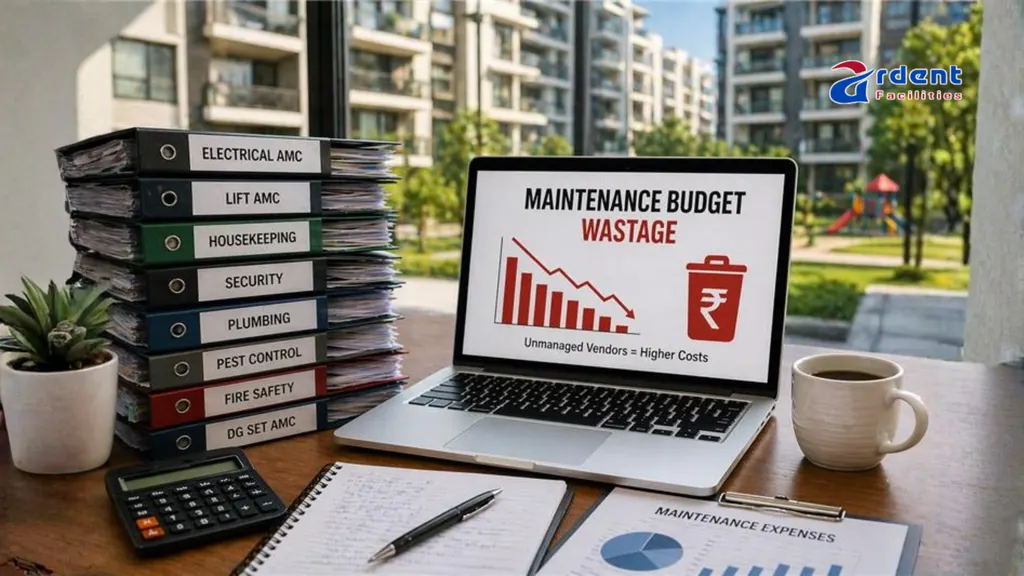
Across hundreds of apartment societies and commercial complexes, the single biggest reason for silent maintenance budget leakage is this: multiple unmanaged vendors operating without coordination, accountability, or audit.
This is where structured Property Management becomes critical — not as an expense, but as a cost-control system.
The Typical Vendor Structure in Most Apartment Societies
In most societies, vendors are appointed gradually over time:
- One contractor for housekeeping
- One agency for security
- Different AMC vendors for lift, fire, STP, DG, pumps
- Local electrician and plumber on call
- Pest control from another vendor
- A billing person or accountant part-time
Each of them works independently. Each reports to a different committee member. No one person owns the complete operational picture.
There is no integrated supervision, no unified SOP, and no cross-verification of tasks.
This is exactly the environment where maintenance budgets start leaking — not in lakhs visibly, but in small, repeated, unnoticed wastage every single month.
Where Exactly the Maintenance Budget Gets Wasted
This wastage is rarely visible in one bill. It is scattered across vendors and months.
Duplicate manpower and overlapping duties
Security guards clean lobbies at night. Housekeeping staff help in garbage movement. Electrician attends plumbing complaints. Everyone does a bit of everyone’s work, yet the society pays full manpower cost to each vendor.
Overbilling and unverified consumption
Housekeeping bills for 8 staff, but attendance fluctuates. Security charges include relievers who rarely appear. Consumables like phenyl, garbage bags, and cleaning agents are billed without usage tracking.
Emergency repairs due to zero preventive maintenance
Motors burn because no one checks vibration. Drain lines choke because no one schedules desilting. Lift faults increase because housekeeping water enters shafts during mopping.
AMC mismanagement
AMCs exist on paper. Vendors attend only after complaints. No one tracks whether monthly, quarterly, and annual checks are actually performed.
No rate negotiation and market benchmarking
Vendors appointed years ago continue at revised rates without comparison. RWAs rarely know the current market rate for security, housekeeping, or technical services.
Individually, these look like small inefficiencies. Together, they easily consume 15–30% of the annual maintenance budget.
Why RWAs and Society Committees Cannot Track This Wastage
RWA members are volunteers. They are businessmen, professionals, doctors, retired officers. They do not have time to audit vendor coordination daily.
More importantly, they lack operational visibility:
- No consolidated reporting from all vendors
- No attendance audit system
- No preventive maintenance calendar
- No single point of accountability
- No technical knowledge to question AMC reports
So they end up reacting to complaints instead of managing systems.
This is not mismanagement. It is structural limitation.
What a Professional Property Management Company Does Differently
A professional Property Management company does not simply “supervise vendors.” It restructures the entire maintenance ecosystem.
Through formal Property Management Services, the society moves from vendor-driven operations to system-driven operations.
Key changes happen immediately:
- Centralized control under one facility manager
- Standard operating procedures for every task
- Attendance, duty, and performance tracking
- Preventive maintenance calendar across all equipment
- Vendor performance audits and rate rationalization
Instead of ten vendors answering ten committee members, all vendors report to one accountable management system.
This is the foundation of professional Property Management.
Vendor Consolidation vs Vendor Chaos
| Factor | Multiple Unmanaged Vendors | Professional Property Management Services |
|---|---|---|
| Accountability | Split across vendors | Single point responsibility |
| Manpower usage | Overlapping duties | Optimized deployment |
| Billing transparency | Based on vendor claims | Verified with audits & logs |
| Preventive maintenance | Rarely followed | Calendar-based execution |
| AMC tracking | Only during breakdowns | Routine verification |
| Rate control | No benchmarking | Periodic market comparison |
| Complaint handling | Reactive | Systematic and preventive |
| Budget control | Unpredictable | Planned and optimized |
This difference is not theoretical. It is visible within 3–6 months of structured implementation.
How Property Management Services Reduce 15–30% Maintenance Costs Logically
Cost reduction does not come from cutting services. It comes from removing waste.
A professional team restructures:
- Manpower deployment between Housekeeping Services and Security Guard Services
- Technical inspection schedules to avoid emergency repairs
- Consumable control and stock registers
- AMC validation and performance review
- Vendor renegotiation based on current market rates
When societies adopt integrated Property Management Services, they discover that they were never short of budget — they were short of structure.
Relevant services that get integrated under one system include:
Why This Problem Is More Serious in Rental Property Management and Commercial Property Management
In owner-occupied apartments, residents raise complaints. In rental and commercial properties, inefficiencies go unnoticed longer.
In Rental Property Management, tenants do not question how maintenance money is spent. Owners live elsewhere. Vendors take advantage of this gap.
In Commercial Property Management, equipment load is higher — lifts, HVAC, DG, fire systems, plumbing usage. Poor coordination leads to frequent breakdowns, tenant dissatisfaction, and higher operational cost.
This is why structured Rental Property Management and Commercial Property Management require even tighter vendor control and preventive systems.
How Ardent Facilities Delivers Integrated Property Management Across Gujarat
Ardent Facilities Pvt. Ltd. approaches societies differently. Instead of asking, “Which vendors do you have?”, the first question is, “How are these vendors being managed?”
Their Property Management model includes:
- Detailed vendor and manpower audit
- Preventive maintenance planning for all equipment
- Duty restructuring across housekeeping, security, and technical staff
- Attendance and billing verification
- Monthly reporting to RWA with actionable insights
This integrated approach has helped apartments and commercial complexes across Ahmedabad, Vadodara, Surat, and Gandhidham regain control over maintenance budgets without reducing service quality.
Explore: Property Management
The Hidden Operational Conflicts Between Vendors That RWAs Never Notice
One of the most underestimated causes of maintenance budget wastage is not overbilling. It is vendor conflict.
In many societies, housekeeping blames security for lobby dirt. Security blames housekeeping for water near lift doors. The lift vendor blames housekeeping for water seepage. The plumber blames civil work. The electrician blames the pump operator.
Every vendor protects their scope. No one owns the outcome.
This is where unmanaged vendor structure silently increases expenses. Because when responsibility is unclear, the society pays for the same problem multiple times through different vendors.
A common example seen repeatedly in Gujarat apartments:
Housekeeping staff wash basements daily with excess water. Water enters lift pits and electrical ducts. After a few months, lift sensors start failing. The lift AMC attends multiple breakdown calls. Eventually, parts are replaced outside AMC coverage. The society pays.
But the root cause was never the lift.
It was lack of coordinated SOP between housekeeping and technical maintenance.
Only structured Property Management identifies and stops these cross-vendor operational mistakes.
The Myth of “Old Trusted Vendors” in Apartment Societies
RWAs often hesitate to question vendors who have worked for years. There is comfort in familiarity.
However, long-term vendors without performance audits become one of the biggest sources of inefficiency:
- Manpower strength increases over time without justification
- Rates get revised annually without market comparison
- Scope of work remains outdated
- No productivity measurement exists
A professional Property Management company does not remove old vendors blindly. Instead, it introduces measurable KPIs, attendance systems, duty charts, and performance reviews.
The same vendor, when placed under structured monitoring, often delivers better service at lower effective cost.
How Preventive Maintenance Planning Changes the Entire Budget Pattern
Most societies operate on a breakdown maintenance model.
Motor burns → repair.
Pipe leaks → repair.
STP smells → call vendor.
Fire panel error → call technician.
This reactive pattern is expensive because emergency repairs cost more than planned servicing.
Under professional Property Management Services, every asset is listed and scheduled:
- Pump vibration and ampere checks
- STP bacterial dosing schedule
- Terrace tank cleaning calendar
- Drain line jetting schedule
- Electrical panel thermal scanning
- Lift shaft dry cleaning protocol
When preventive systems run properly, emergency expenses drop drastically within a year.
This is how logical cost reduction happens without visible “cost cutting”.
The Role of Data and Reporting in Controlling Vendor Costs
Another major difference professional Property Management brings is documentation.
Most RWAs operate verbally. Complaints are on WhatsApp. Vendor instructions are verbal. Bills are approved based on trust.
A structured system introduces:
- Daily logbooks
- Attendance registers verified by supervisors
- Consumable stock records
- Preventive maintenance reports
- Incident reports with root-cause analysis
- Monthly management reports to RWA
When data exists, unnecessary billing automatically reduces because vendors know their work is being recorded and reviewed.
Why Societies Feel “Operations Are Fine” Even When Budgets Are Leaking
This is a psychological trap.
If lifts are running, security guards are at the gate, and cleaning is happening, committees assume operations are fine.
But operational presence is not operational efficiency.
You can have all services running and still waste lakhs annually due to poor coordination.
Professional Rental Property Management and Commercial Property Management particularly suffer from this illusion because there is less daily scrutiny from owners.
Early Warning Signs That Your Society Has Vendor Chaos
RWAs can identify this problem if they notice patterns like:
- Frequent small repair bills every month
- High manpower cost but constant complaints
- AMCs that never submit service reports
- Different committee members handling different vendors
- No single person able to explain the full maintenance structure
These are not minor signs. These are indicators that maintenance cost is running without control.
The Financial Impact Over 5 Years That Most RWAs Never Calculate
If a society with 120 flats wastes even ₹60,000 per month through inefficiencies, that is ₹7.2 lakhs per year.
Over 5 years, that becomes ₹36 lakhs.
This amount could have funded major repainting, CCTV upgrades, solar panels, or lift modernization.
Instead, it disappears into unstructured vendor operations.
This long-term impact is why professional Property Management Services are not an expense but a financial safeguard.
Why Builders and Developers Should Implement Property Management From Day One
Many builders hand over societies with multiple vendor contracts already in place but without a management structure.
This creates chaos from the first year of society formation.
When builders appoint a professional Property Management company during the handover phase, the society starts with:
- Defined SOPs
- Vendor alignment
- Asset registers
- Preventive calendars
- Budget control systems
This prevents years of financial leakage from the beginning.
Conclusion: Audit Your Vendor Structure Before Increasing Maintenance Charges
Most societies increase maintenance charges every year assuming expenses have genuinely risen.
In reality, a significant portion of that increase comes from unnoticed vendor inefficiencies.
Before raising maintenance fees on residents, RWAs and builders should ask a more important question:
“Are we managing vendors, or are vendors managing our budget?”
A professional Property Management company brings structure, audit, and accountability — turning maintenance from an expense into a controlled system.
FAQs - Property Management
1. What is the biggest reason apartment societies waste maintenance budgets?
The biggest reason is multiple vendors working independently without coordination, audits, or accountability. This leads to duplicate manpower, overbilling, missed preventive maintenance, and repeated repair expenses that RWAs cannot easily track.
2. How do property management services reduce maintenance costs in apartments?
Property management services reduce costs by consolidating vendor control, verifying manpower and billing, implementing preventive maintenance schedules, and introducing reporting systems that eliminate operational inefficiencies.
3. Why can’t RWAs detect vendor-related budget leakage?
RWAs are volunteer bodies without daily operational supervision, technical expertise, or consolidated reporting from vendors. This structural limitation makes it difficult to identify where small but continuous wastage occurs.
4. Is professional property management useful for small and mid-size societies?
Yes. Mid-size societies benefit the most because they usually lack full-time supervision and structured systems, making them more vulnerable to vendor inefficiencies and unnecessary expenses.
5. Why is vendor consolidation important in rental and commercial property management?
In rental and commercial properties, owners are not present to monitor operations daily. Vendor consolidation ensures accountability, preventive maintenance, and cost control even in the absence of direct owner supervision.