
Production managers in Gujarat’s manufacturing belt do not make vendor changes without reason. When a Vatva GIDC auto-component unit switches from a traditional labour contractor to a structured labour supplier, or when a Savli petrochemical plant quietly stops renewing its contractor licence arrangement and moves to a workforce outsourcing model — it is not a trend driven by preference. It is driven by compliance pressure, operational failure, and the very real cost of getting labour arrangements wrong.
This shift is accelerating across Ahmedabad, Vadodara, Surat, and Gandhidham. Understanding why — and what it means for your production unit’s vendor strategy — is more relevant in 2026 than it has ever been.
What Has Actually Changed?
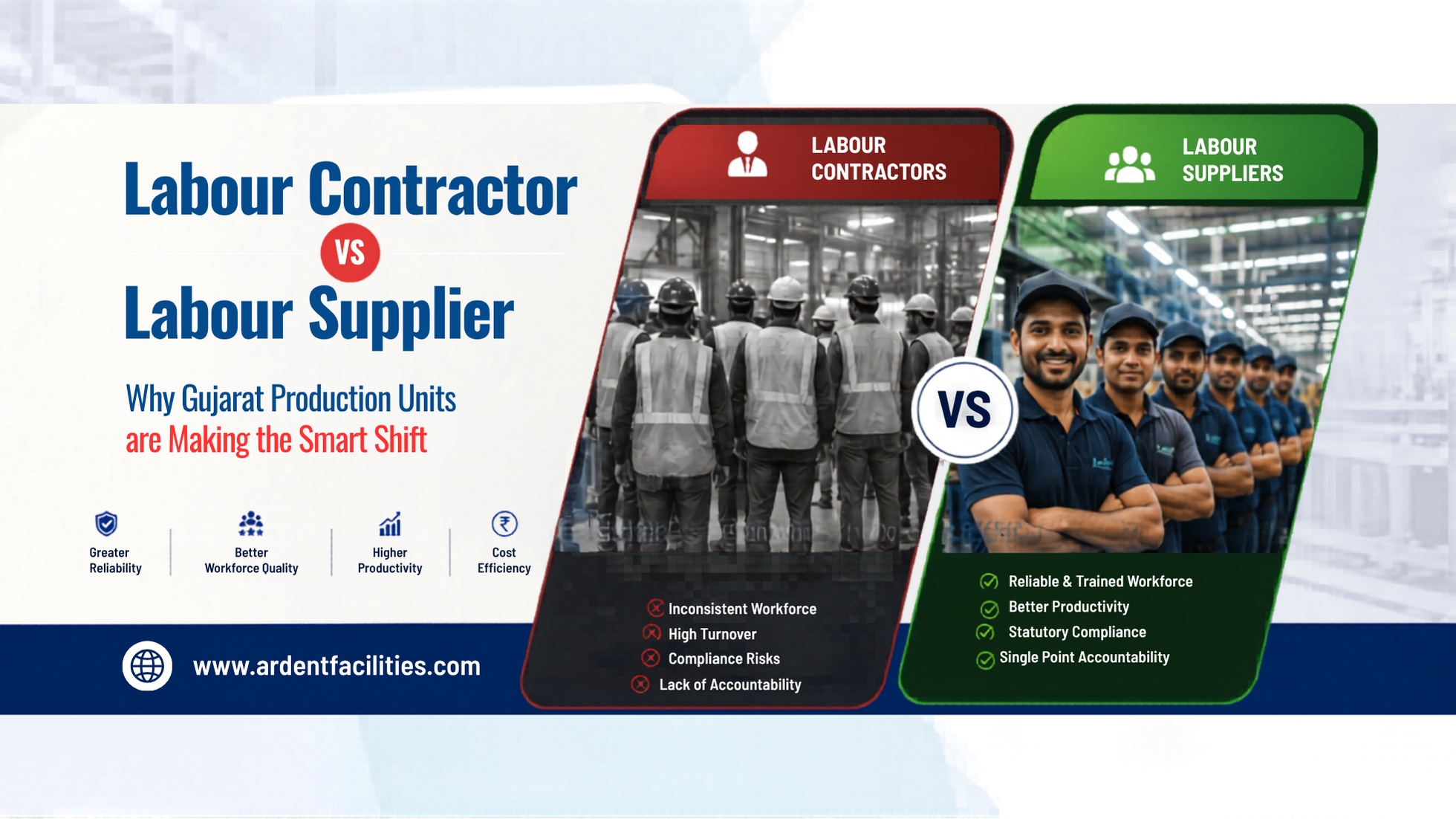
Traditional labour contractors mainly supply workers, while structured labour suppliers manage PF, ESI, payroll, digital attendance, and workforce compliance for production units.
Labour suppliers operate as structured workforce outsourcing partners — with documented employment relationships, full statutory compliance, digital attendance systems, and monthly compliance reports that eliminate the principal employer’s liability exposure.
The shift is not semantic. It reflects a fundamental change in how Gujarat’s production sector views workforce risk — and what factory management teams now demand from their workforce vendors.
What Is Breaking Down in the Traditional Labour Contractor Model
The traditional contractor model worked for decades when labour department enforcement was periodic and documentation requirements were manageable. Both conditions have changed significantly since 2023.
Enforcement frequency has increased sharply. Gujarat’s Labour Department intensified inspection drives across GIDC units in Vatva, Naroda, Odhav, Savli, and Waghodia through 2024–2025. Factories that previously managed with informal contractor arrangements or partially maintained registers now face show-cause notices, penalties, and in repeat cases, prosecution under the Contract Labour Act.
Documentation requirements have multiplied. The convergence of New Labour Codes, expanded EPFO enforcement, and ESIC audit drives means a production unit working with contract labour must now maintain:
- Principal employer registration certificate
- Contractor licence — verified as current
- Muster Roll — Form XVI — updated daily
- Wage Register — Form XVII — signed monthly
- PF challan proof — deposited by the 15th of every month
- ESI contribution proof — deposited by the 21st
- Attendance records compatible with EPFO’s digital verification requirements
A traditional labour contractor managing 40–50 workers across 2–3 production sites rarely maintains all of this documentation consistently. When an inspector arrives, the gap becomes the principal employer’s legal problem — not the contractor’s.
Worker stability has deteriorated under contractor models. When workers are employed by a small contractor who pays irregularly, delays PF deposits, or disappears between contract renewals — workers leave. Production units in Surat’s textile manufacturing zone and Ahmedabad’s pharmaceutical corridor report that contractor-supplied workers have significantly higher absenteeism and attrition than those supplied through structured labour suppliers with documented employment terms.
The Operational Reality in Gujarat’s Industrial Zones — 2025–2026
Here is what is actually happening on the ground across Gujarat’s four major manufacturing corridors:
Ahmedabad (Vatva, Naroda, Odhav GIDC): Auto-component manufacturers, pharmaceutical packaging units, and FMCG production facilities are the most active in transitioning vendor models. The catalyst in most cases is a PF audit or ESIC inspection that revealed contractor non-compliance — and the subsequent realisation that the factory bore the liability. The shift to structured labour supplier in Ahmedabad arrangements provides these facilities with monthly PF and ESI deposit proofs, pre-verified worker documentation, and a contractual compliance guarantee.
Vadodara (Savli, Waghodia, Gorwa): Petrochemical and engineering companies near Savli GIDC are driving some of the most structured transitions. These facilities operate under multiple compliance frameworks simultaneously — factory licences, environmental clearances, PESO approvals, and labour law requirements. A contractor who cannot maintain basic muster rolls is incompatible with a facility that files quarterly compliance reports to multiple government departments. Labour supplier in Vadodara engagements that include digital attendance integration and monthly compliance dashboards are now a vendor requirement — not a premium option.
Surat (Hazira, Sachin GIDC, Kim): Surat’s industrial landscape spans heavy engineering at Hazira, chemicals at Sachin GIDC, and textile manufacturing spread across the city. The common workforce challenge across all three is seasonal demand volatility — production units scaling from 80 workers in slow months to 200+ during peak export periods. Traditional contractors cannot scale this quickly without compliance shortcuts. Structured labour supplier in Surat arrangements include pre-registered worker pools, enabling rapid deployment without the PF registration backlogs that accompany sudden contractor headcount increases.
Gandhidham (Kandla, Adipur, Mundra corridor): Port-adjacent logistics and trading companies in Gandhidham face a unique compliance challenge — workers who move between multiple employer sites depending on vessel arrival schedules and cargo volumes. The traditional contractor model in this market was always informal. The formalisation pressure from EPFO’s port zone enforcement drives in 2024 changed that quickly. Structured Labour Supplier in Gandhidham services that handle multi-site worker deployment with centralised payroll and statutory compliance are now preferred by Kandla port contractors and Mundra logistics firms.
The Specific Operational Shifts Driving This Transition
Beyond enforcement pressure, five specific operational changes are making structured labour suppliers the preferred model for production units:
- Digital Attendance Systems Are Now a Compliance Requirement
EPFO’s UAN-linked attendance verification and the expanded use of digital wage payment traceability mean that paper-based muster rolls maintained by traditional contractors are increasingly insufficient. Production facilities working with structured labour suppliers receive biometric or app-based attendance data that integrates directly with PF portal requirements. A traditional labour contractor managing attendance on paper registers cannot meet this requirement without significant process changes that most small contractors lack the systems to implement.
- Worker Documentation Pre-Verification
Before a single worker enters a production facility, a structured labour supplier verifies:
- Aadhaar-linked UAN (Universal Account Number) — confirmed active
- Previous employment PF balance — to avoid exit disputes
- ESI IP number — to confirm existing registration
- Background verification — criminal record check, address verification
- Skill certification where applicable — ITI, NSDC, sector council
A traditional contractor rarely performs any of this systematically. When an unverified worker causes a production incident, theft, or safety violation — the principal employer’s liability is both legal and operational.
- Faster Replacement Guarantees
Production units cannot absorb 3–4 day gaps when a contractor worker does not show up. Structured labour suppliers maintain bench strength — pre-verified workers available for deployment within 24–48 hours. This replacement guarantee is contractually documented, unlike informal contractor arrangements where absenteeism management falls back to the production supervisor.
- Compliance Reporting as a Vendor Deliverable
Every month, a structured labour supplier delivers:
- PF challan deposit proof — challan number and date
- ESI contribution confirmation — with IP numbers
- PT payment receipt — Gujarat slab-specific
- Attendance summary — worker-wise, shift-wise
- Wage payment confirmation — bank transfer records
This documentation package is what a production unit needs when an EPFO officer, ESIC auditor, or labour inspector requests proof of statutory compliance for contract workers. A traditional contractor who provides a verbal assurance that “PF is deposited” is not a defensible compliance position in 2026.
- Single-Point Accountability
When a worker raises a wage dispute, an ESIC claim is rejected due to contribution gaps, or a PF withdrawal is delayed because of incorrect UAN seeding — the production unit needs one point of contact to resolve it. Structured labour suppliers assign dedicated compliance managers to each client account. Traditional contractors typically have no back-office capable of handling these escalations.
Labour Contractor vs Labour Supplier for Production Units in Gujarat
| Factor | Traditional Labour Contractor | Structured Labour Supplier |
|---|---|---|
| Compliance Management | Limited documentation support | Full PF, ESI, PT & labour compliance |
| Attendance System | Manual registers | Digital attendance & reporting |
| Worker Verification | Mostly informal | Aadhaar, UAN & ESI verified workers |
| Replacement Support | Delayed worker replacement | Fast replacement within 24–48 hours |
| Payroll Process | Cash/manual handling | Bank transfer & salary records |
| Inspection Readiness | High compliance risk | Audit-ready documentation |
| Worker Stability | Higher absenteeism | Better workforce retention |
| Monthly Reports | Rarely provided | Monthly compliance dashboard |
| Legal Risk for Factory | Higher liability exposure | Reduced compliance risk |
| Best Suitable For | Small temporary setups | Manufacturing & production units |
The New Labour Codes Factor — Why 2026 Is a Critical Year
India’s four New Labour Codes — when fully implemented — change the statutory compliance landscape for everyone using contract labour:
- Code on Wages expands the definition of wages to include allowances previously excluded from PF and ESI calculation — increasing contribution bases
- Social Security Code extends PF and ESI coverage to gig workers and platform workers — expanding who counts as a covered worker
- Industrial Relations Code changes threshold requirements for standing orders and retrenchment procedures — affecting how long-term contract arrangements are structured
- Occupational Safety Codeincreases documentation requirements for contractors at factories and hazardous process facilities
For production units still using traditional labour contractors, the New Labour Codes represent a compliance cliff. Most small contractors do not have the payroll systems, legal knowledge, or administrative capacity to recalculate contributions under the new wages definition, register new categories of workers under expanded ESI coverage, or update standing orders under the Industrial Relations Code.
Structured Manpower Services in Surat and across Gujarat are already updated for Labour Code compliance — because their business model depends on being ahead of statutory changes, not catching up after an inspection.
What a Structured Labour Supplier Engagement Looks Like — Practically
For a production unit considering the transition, here is what a structured labour supplier engagement delivers from day one:
- Onboarding:Worker Aadhaar verification, UAN activation, ESI IP registration, skill mapping, induction documentation — completed before deployment
- Monthly operations:Attendance captured digitally, wages paid by bank transfer, PF and ESI deposited on time with proof shared by the 20th of each month
- Compliance calendar:PT filing Gujarat-specific, TDS deduction where applicable, Form 16A issued annually
- Exit management:Full and final settlement calculated correctly, UAN transfer initiated, relieving documentation provided — eliminating gratuity liability ambiguity
- Inspection readiness:All statutory registers maintained at worksite, principal employer registration verified, contractor licence current — available for production on day of inspection
This is not a premium service. It is the baseline standard that compliance-conscious production units in Gujarat now require from any workforce vendor.
Ardent Facilities — Labour Supplier and Manpower Services Across Gujarat
Ardent Facilities Private Limited is an ISO 9001:2015 certified workforce services company providing structured labour supply and manpower outsourcing across Ahmedabad, Surat, Vadodara, and Gandhidham.
Their workforce services are built for production environments — manufacturing units, warehouses, GIDC facilities, port-adjacent operations, and logistics parks — where compliance documentation, worker stability, and rapid deployment capability are non-negotiable requirements.
Services include:
- Labour supplier in Ahmedabad— covering Vatva, Naroda, Odhav, Chandkheda, and SG Highway industrial corridors
- Labour supplier in Vadodara— serving Savli GIDC, Waghodia, Gorwa, and Vadodara’s engineering manufacturing belt
- Labour Supplier in Surat— scalable workforce for Hazira heavy industry, Sachin GIDC, and Surat’s textile manufacturing zone
- Labour Supplier in Gandhidham— structured workforce supply for Kandla port contractors, Mundra logistics firms, and Kutch industrial operations
- Manpower Services in Surat— role-based manpower outsourcing for production, warehousing, and operations teams in Surat
Every engagement includes monthly compliance reporting, digital attendance options, PF and ESI deposit confirmation, and a dedicated compliance contact for your facility.
Pricing is customised based on workforce size, deployment location, and scope of compliance services. To discuss your production unit’s specific workforce requirement — call +91 98254 00349
The Transition Is Not a Choice — It Is a Timeline
Production units that are still managing contract labour through traditional, informally-operated contractors are not in a stable compliance position — they are in a deferred liability position. The enforcement machinery across Gujarat’s industrial zones has become too consistent, the documentation requirements too specific, and the principal employer’s statutory exposure too clearly defined for informal arrangements to remain viable.
The question for most production managers is not whether to transition to a structured labour supplier model — it is how quickly to do it and which partner to trust with the transition.
A registered, ISO-certified, Gujarat-based labour supplier who understands your industry, your GIDC zone’s inspection patterns, and your workforce deployment cycles is not a vendor upgrade. It is a compliance infrastructure decision that protects your facility, your management team, and your production continuity.
To discuss your workforce vendor transition — visit ardentfacilities.com
Ardent Facilities Private Limited | ISO 9001:2015 Certified | Labour Supplier and Manpower Services — Ahmedabad, Vadodara, Surat, Gandhidham | +91 98254 00349 | info@ardentfacilities.com
FAQs
Q1: What is the difference between a labour contractor and a labour supplier for production units in India?
A labour contractor mainly deploys workers, while a labour supplier manages workers with proper PF, ESI, attendance, payroll, and compliance documentation for production units.
Q2: Why are Gujarat factories switching from labour contractors to labour suppliers in 2025–2026?
Factories are shifting due to stricter labour inspections, PF/ESI audits, digital compliance requirements, and the need for stable, legally compliant workforce management.
Q3: Is a labour supplier required to maintain PF and ESI for contract workers in Gujarat?
Yes. Labour suppliers must maintain PF and ESI compliance, deposit contributions on time, and provide proof records to the principal employer monthly.
Q4: How do digital attendance systems improve compliance for production units using labour suppliers?
Digital attendance systems improve payroll accuracy, support PF calculations, reduce disputes, and provide real-time records required during labour and EPFO inspections.
Q5: What should a production unit check before engaging a new labour supplier in Gujarat?
Check contractor licence validity, PF and ESI registrations, compliance records, local operational support, digital attendance capability, and previous client documentation history.