
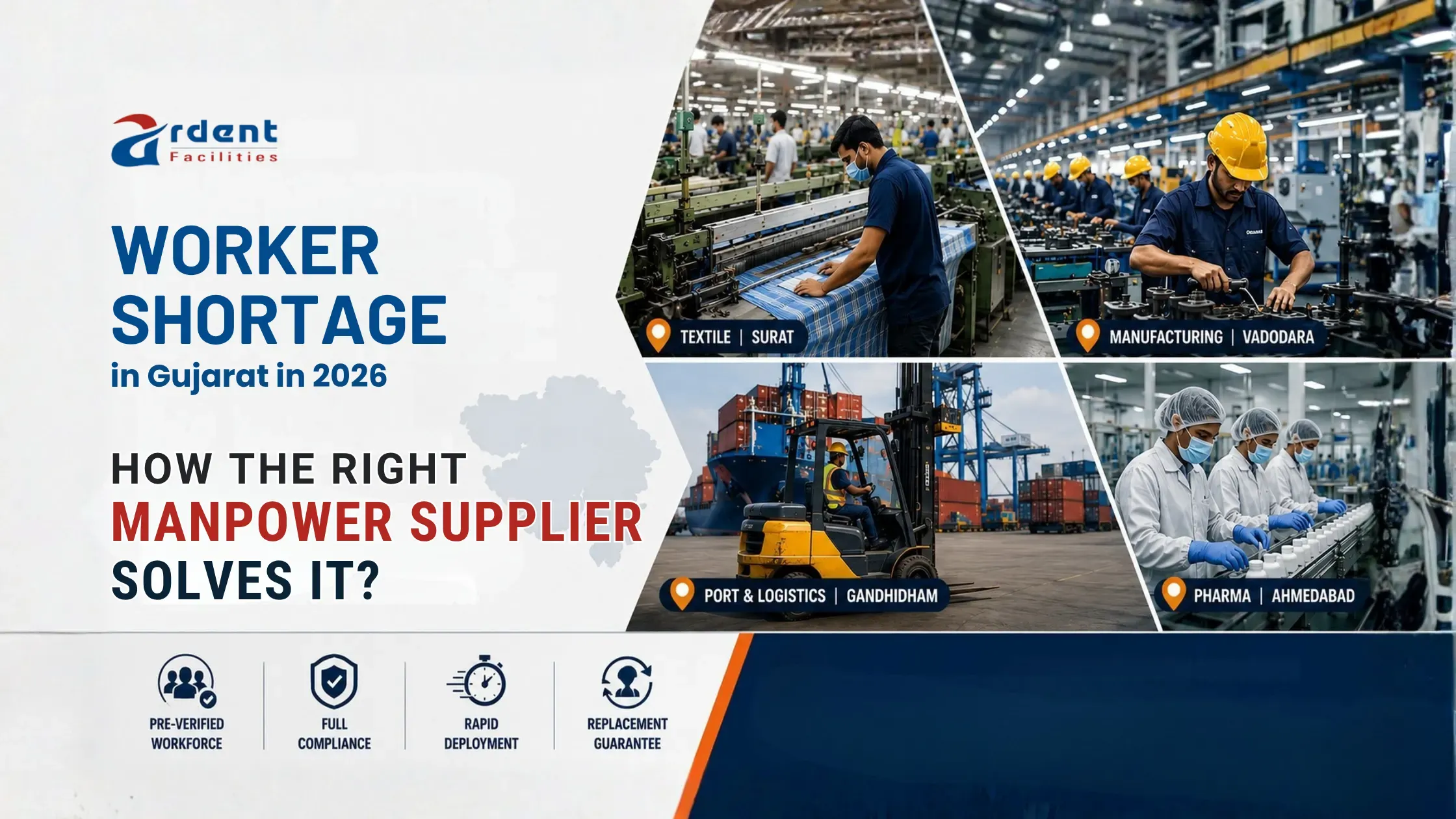
Gujarat’s 2026 worker shortage is being driven by simultaneous demand across manufacturing, textiles, logistics, pharma, and electronics — while the supply of deployable blue-collar workers is not recovering at the same pace. New industrial investments under the China+1 shift, PM MITRA textile expansion, and semiconductor manufacturing are competing for the same labour pool in Ahmedabad, Surat, Vadodara, and Gandhidham. At the same time, gig work is pulling workers away from factory shifts, and compliant hiring has become harder for businesses that still depend on informal channels. For plant managers and HR heads, the issue is no longer just vacancy filling; it is workforce continuity.
Why Gujarat Is Facing a Worker Shortage in 2026 — The Real Causes
Gujarat is facing a worker shortage in 2026 because industrial demand is rising faster than the blue-collar supply base can expand. The pressure is coming from fresh factory investments, shifting worker preferences, and stricter compliance rules that are shrinking the informal labour market.
China+1 manufacturing shift is creating demand before training pipelines exist
Global manufacturers are moving production out of China and into India, and Gujarat is one of the biggest beneficiaries. Electronics, pharma, chemicals, and engineering units are expanding quickly, but these projects need operators, helpers, fitters, and packers before local training pipelines can prepare them. That gap creates immediate hiring pressure in GIDC zones across the state.
PM MITRA textile parks are intensifying labour competition
Surat and Ahmedabad are seeing stronger textile worker demand because PM MITRA-linked activity is pulling fresh investment into the sector. That creates a sudden need for weaving, dyeing, finishing, and packing labour in locations that already depend on the same worker pool. When multiple mills expand at the same time, labour movement becomes faster than recruitment.
Gig economy work is changing worker behaviour
Delivery apps, logistics platforms, and on-demand service jobs are offering blue-collar workers more flexibility than fixed factory shifts. Many younger workers now prefer daily earnings, flexible timing, and less supervision over structured production work. That shift is especially visible in industrial belts where attendance discipline and overtime intensity are high.
Reverse migration has stabilised, but not fully reversed
The post-COVID movement of workers back to Uttar Pradesh, Bihar, and Rajasthan has stabilised, but not all those workers returned to Gujarat. Many GIDC-linked units still operate below their earlier workforce comfort level because a large share of migrant labour rebuilt its life in home states. The supply gap is now structural, not temporary.
New Labour Code compliance is shrinking informal supply
The 2026 compliance environment is pushing unregistered labour contractors out of the market. Businesses that once depended on informal hiring now face tighter documentation, wage, and statutory expectations, and many small suppliers cannot keep up. That reduces the available pool of deployable workers at short notice and makes a registered manpower supplier more valuable than ever.
Which Gujarat Industries Are Hit Hardest
Textile, petrochemical, logistics, and pharma businesses are feeling the shortage most sharply. These sectors depend on immediate deployment, shift continuity, and skill-fit workers — all of which are harder to secure in 2026.
Textile units in Surat and Ahmedabad
Surat and Ahmedabad textile clusters need semi-skilled operators, power loom technicians, dyeing helpers, and finishing workers, but those roles now face stronger churn. Migration during festival periods and competition from newly set-up units make retention harder. A manpower supplier with a textile-ready database can reduce disruption by matching workers to specific production lines instead of sending generic labour.
Petrochemical and engineering units in Vadodara
Savli GIDC and Waghodia need ITI-trained fitters, welders, chemical plant operators, and maintenance helpers. The situation is tightening because skilled workers are being pulled toward semiconductor and defence-related projects that promise newer technology exposure and stronger career visibility. In this segment, manpower quality matters as much as speed.
Port and logistics operations in Gandhidham
Kandla Port and Mundra-linked operations face the most unpredictable labour swings in Gujarat. Export cycles, vessel schedules, and cargo surges can change quickly, and loading demand often spikes with very short notice. Experienced logistics managers in Gandhidham know that peak export demand for skilled loaders can arrive in less than two weeks; any manpower supplier without a pre-vetted Kutch-region database will struggle to respond on time.
Pharma and FMCG units in Ahmedabad
SG Highway, Naroda, and Vatva continue to need workers who understand basic GMP discipline, hygiene, and process consistency. Pharma and FMCG plants cannot absorb untrained labour the way low-spec assembly operations sometimes can. They need production helpers and packaging staff who can follow instructions, maintain cleanliness, and protect batch quality.
Why Standard Hiring Channels Are Failing Gujarat Businesses in 2026
Standard hiring channels are failing because they were not built for fast, compliant blue-collar deployment at industrial scale. Businesses now need verified workers, shift readiness, and document control, while common hiring routes still produce uneven quality.
| Hiring Channel | Speed | Compliance | Quality | Scalability |
|---|---|---|---|---|
| Job portals | Slow | None | Inconsistent | Low |
| Local informal contractors | Fast | High risk | Unverified | Limited |
| In-house HR bulk hiring | Very slow | Manual | Variable | Very low |
| Registered manpower supplier | Fast | Full | Pre-vetted | High |
Job portals work better for white-collar hiring than for blue-collar industrial roles. Verification is limited, worker intent is mixed, and many applicants do not match shift-based factory conditions.
Informal local contractors may appear fast, but they create compliance exposure and often lack proper documentation. Once inspections begin or attrition rises, businesses discover that speed without verification becomes an operational risk.
In-house HR teams also struggle with bulk blue-collar recruitment because their systems are built for interviews, not mass deployment. Walk-in hiring can fill a few seats quickly, but it often leads to poor screening and early exits within 30–60 days.
What the Right Manpower Supplier Actually Does — Beyond Just Sending Workers
A capable manpower supplier does far more than forward resumes or line up workers at the gate. In 2026, the real value lies in compliance, continuity, and workforce readiness.
Pre-vetted worker database
A strong supplier maintains a ready pool of workers whose identity documents, past experience, and basic skill levels have already been verified. That reduces onboarding friction and improves placement quality. It also prevents the common problem of deploying fresh, untested labour during urgent production gaps.
Statutory compliance coverage
The right supplier handles PF, ESI, professional tax, wage documentation, and New Labour Code alignment within its operating model. That keeps the compliance burden from shifting onto the client in a way that creates hidden risk. For plant managers, this means fewer surprises during audits and labour inspections.
Rapid deployment capability
Industrial requirements do not always arrive with long notice. A mature manpower supplier can deploy 20–200 workers within 5–7 working days when the requirement is urgent and the role profile is clear. That speed matters when a production line has already absorbed absenteeism, resignations, or seasonal demand spikes.
Replacement guarantee
No-shows and early exits are part of blue-collar workforce reality. The right supplier responds with immediate replacement so the line does not stop for want of a single worker. This becomes especially important in shift-based operations where one vacancy can affect output across an entire team.
Inspection readiness
Good suppliers keep statutory registers, attendance records, and PF challans in order at the worksite, not just in the back office. That reduces principal employer liability and makes inspections easier to handle. A business should never discover missing records only after a compliance notice arrives.
New Labour Code alignment
The 2026 labour environment demands updated contracts, wage structures, and benefit calculations. A serious manpower supplier keeps those elements current instead of treating them as a back-office afterthought. That protects both the supplier and the client from avoidable compliance problems.
Gujarat City-by-City — Manpower Shortage Solutions in 2026
Ahmedabad
Textile mills, pharma units, and logistics hubs across SG Highway, Naroda GIDC, and Vatva are operating with heavy workforce pressure in 2026. Gig economy attrition and new factory openings are competing for the same labour pool, which leaves HR teams chasing the same worker profiles across multiple sectors. For industrial buyers, Manpower Supplier in Ahmedabad and Manpower Supplier Ahmedabad become practical search terms because a local deployment team can respond faster than a city-neutral hiring process.
Surat
Surat’s diamond polishing and synthetic textile units face layered shortage pressure because seasonal migration patterns already affect attendance during festival periods. PM MITRA-linked investment has intensified the competition for workers, especially in finishing, packing, and production support roles. Businesses needing Manpower Services in Surat need a supplier that understands both textile cycles and worker retention realities.
Vadodara / Baroda
Savli GIDC and Waghodia continue to pull ITI-trained technicians, welders, and plant helpers into engineering and petrochemical operations, but semiconductor-linked opportunities are changing worker expectations. New projects and defence manufacturing units are also creating a stronger pull on the same skilled base. Companies looking for Manpower Services in Vadodara and Manpower Services in Baroda need a manpower partner that understands technical workforce placement, not just headcount filling.
Gandhidham
Kandla and Mundra port operations face the most unpredictable workforce demand of any Gujarat city because cargo volumes shift with trade cycles and export schedules. That creates short windows where worker demand doubles and then normalises quickly, making labour planning difficult. Industrial buyers searching for Manpower Services in Gandhidham should prioritise suppliers with a pre-vetted Kutch-region worker database and logistics experience.
How to Evaluate a Manpower Supplier in Gujarat — 5 Non-Negotiables for 2026
A good manpower supplier should reduce risk, not create it. These five checks separate operational partners from short-term labour brokers.
- New Labour Code compliance — Ask whether contracts, wage structures, and benefit handling already align with the 2026 labour framework. A supplier who hesitates on this point will create downstream compliance issues.
- Pre-vetted worker database — Confirm whether they maintain an active Gujarat labour pool or recruit from zero for every requirement. Fresh recruitment slows deployment and weakens consistency.
- Statutory register maintenance at worksite — Ask who keeps PF challans, ESI records, and attendance registers at the facility. If those records stay only at the supplier office, inspection readiness weakens.
- Replacement SLA — A reliable supplier should state how fast a no-show or early-exit worker gets replaced. Without that commitment, production continuity depends on luck.
- Local Gujarat presence — Confirm whether they can respond to an emergency, inspection, or workforce gap in Vadodara or Gandhidham within hours. Local reach matters when operations cannot wait.
Ardent Facilities — Manpower Supplier Across Gujarat (ISO 9001:2015)
Ardent Facilities Private Limited provides ISO 9001:2015-certified manpower services across Ahmedabad, Surat, Vadodara, and Gandhidham. The team supports pre-vetted workforce deployment, PF and ESI compliance, New Labour Code-aligned contracts, statutory register maintenance, rapid deployment, and replacement support for industrial clients that need dependable workforce continuity.
Engagement is customised based on your workforce requirement, city, industry type, and deployment timeline. Ardent also offers a free workforce gap assessment, where the operations team reviews your current headcount situation, identifies the fastest compliant deployment path, and creates a practical workforce plan for your business. No obligation is required for the assessment.
To discuss your 2026 workforce requirement in Gujarat — call +91 98254 00349, email info@ardentfacilities.com, or visit ardentfacilities.com
Conclusion
Gujarat’s worker shortage in 2026 is not a temporary disruption; it is a structural shift driven by industrial expansion, gig economy competition, and stricter compliance requirements. Businesses that continue relying on informal, unregistered labour sources will face growing operational and legal pressure as enforcement tightens. The right manpower supplier does not just fill vacancies — they protect compliance, preserve production continuity, and strengthen workforce resilience in a market that no longer rewards weak labour planning.
Facing worker shortage at your Gujarat plant in 2026?
Get a free workforce gap assessment from Ardent’s operations team and receive a compliant, rapid deployment plan tailored to your industry and city.
📞 Call +91 98254 00349
📧 Email info@ardentfacilities.com
🌐 Visit ardentfacilities.com
FAQs
Q1: Why is there a worker shortage in Gujarat in 2026?
Gujarat’s worker shortage in 2026 comes from multiple pressures at once. China+1 manufacturing investment, PM MITRA textile expansion, gig economy pull, and incomplete reverse migration recovery are all tightening the blue-collar supply pool. Industrial demand is rising faster than deployable labour can be replaced.
Q2: What does a manpower supplier do for industrial businesses in Gujarat?
A manpower supplier provides pre-vetted workers, manages statutory compliance, supports replacement for no-shows, and aligns contracts with New Labour Code requirements. For industrial businesses in Gujarat, that means faster deployment, better workforce control, and less inspection risk at the plant level.
Q3: How quickly can a manpower supplier deploy workers in Gujarat?
A registered manpower supplier with a local worker database can usually deploy workers within 5–7 working days when the role profile and headcount are clear. For urgent Gujarat requirements, call +91 98254 00349 and ask for Ardent’s free workforce gap assessment.
Q4:What is the risk of using an unregistered manpower supplier in 2026?
An unregistered manpower supplier can create subsidiary PF and ESI liability, poor wage documentation, and inspection risk at GIDC facilities. In 2026, those gaps become more serious because labour compliance expectations are tighter and less forgiving for informal arrangements.
Q5:Which industries in Gujarat face the worst worker shortage in 2026?
Textile units in Surat and Ahmedabad, petrochemical and engineering plants in Vadodara, port logistics operations in Gandhidham, and pharma facilities in Ahmedabad face the sharpest shortage pressure. These sectors need workers with speed, discipline, and basic operational readiness.