
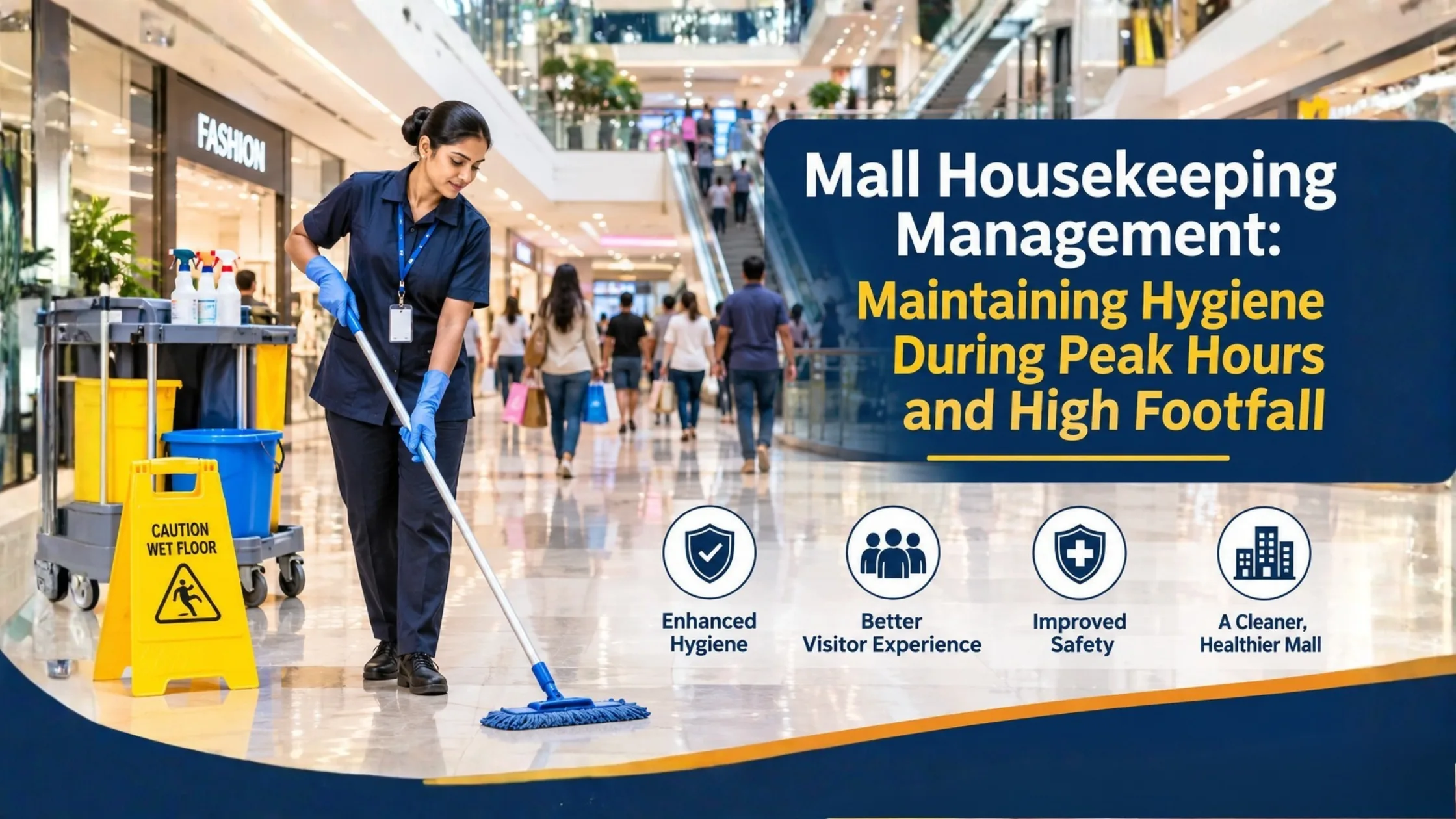
A shopper forgives a lot in a mall. A crowded escalator, a long billing queue, a parking squeeze. A dirty washroom or a sticky food-court table is rarely forgiven. People remember it, and they tell others.
That is why corporate housekeeping services for malls need a different mindset from office cleaning. An office has predictable occupancy. A mall has surges: weekend afternoons, festival weeks, sale days, school holidays, and the 7 PM rush after work. The cleaning team has to work while thousands of people are walking, eating, shopping and spilling.
This guide explains how experienced facility teams plan housekeeping services for high-footfall malls: where hygiene fails first, how to structure peak-hour coverage, what to ask a vendor, and how to measure results. It is written for mall administrators, facility managers, operations heads and procurement teams who want a practical standard to work to, not a generic checklist.
Mall housekeeping management means running cleaning as a live, zone-based operation, not a closing-time chore. Strong corporate housekeeping services combine peak-hour deployment, restroom and food-court rotations, trained supervisors, checklists and audits so malls stay clean, safe and welcoming even when thousands of visitors walk through every hour.
Why Malls Are the Toughest Test for Housekeeping Services
A mall combines the cleaning challenges of six different buildings under one roof:
- A restaurant: food courts generate spills, grease, waste and pest risk.
- A public toilet complex: washrooms see heavy and continuous use.
- A transit hub: entrances carry dust, rainwater and mud all day.
- A retail floor: tenants expect clean frontage and clear walkways.
- An entertainment venue: cinemas and play zones add popcorn, drinks and children.
- A glass showroom: visitors judge the mall by how its glass, lifts and railings look.
Standard weekday cleaning does not hold up here. The mall needs commercial housekeeping services built around continuous presence, quick response and clear accountability.
There is also a business reason to take this seriously. Cleanliness shapes how long people stay and whether they return. Tenants also notice. A mall with poor common-area hygiene finds it harder to retain good brands and defend its rentals.
The Hygiene Hotspots in a Mall
Not every square foot needs the same attention. In our experience on large commercial sites, a handful of zones cause most complaints.
Washrooms
Washrooms are the single biggest driver of visitor perception. Common failures are wet floors, empty soap dispensers, missing tissue, blocked drains and odour. These happen because cleaning was periodic, not continuous.
Food Courts and Seating Areas
Tables must be cleared and sanitised between customers, not once an hour. Floors around counters need constant mopping. Bins overflow quickly, and uncollected waste attracts flies and pests.
Entrances, Atriums and Escalators
Mats get saturated in monsoon, and grit scratches flooring. Escalator handrails and lift buttons are high-touch surfaces that need regular sanitising.
Parking and Service Areas
These are often ignored. Yet oil spills, dust and garbage near basements and loading docks can affect safety and pest control for the whole building.
Kids’ Zones and Cinemas
Soft play areas, seating and arcade machines need scheduled disinfection with child-safe products.
Back-of-House Waste Handling
Wet and dry waste segregation, compactor rooms and garbage chutes decide whether odour reaches the shopping floor.
Building a Peak-Hour Housekeeping Plan
The most common mistake is scheduling the largest team at night. Night cleaning matters, but your reputation is built at 6 PM on a Saturday. A sound plan has four layers.
1. Map Footfall Before You Map Staff
Study at least four weeks of footfall data by hour and by day. Note festival dates, sale events and cinema release days. Deploy staff against the curve, not against the clock.
2. Split the Day into Three Phases
| Phase | Typical Window | Primary Focus |
|---|---|---|
| Pre-opening | 2–3 hours before opening | Deep cleaning of floors, glass, washrooms, restocking consumables |
| Peak-hour operations | Opening to closing, with surge cover | Rotational patrol, spill response, washroom and food-court cycles |
| Post-closing | After last shop shuts | Machine scrubbing, waste removal, restocking, next-day preparation |
3. Zone the Floor and Assign Owners
Divide the mall into zones, each with a named housekeeper and a supervisor. When a zone has an owner, problems have an owner too. Shared responsibility tends to mean no responsibility.
4. Use Rotational Cycles for High-Use Areas
For washrooms and food courts, set a cycle (for example, a check every 20 to 30 minutes at peak) and log each visit. Increase frequency on festival days instead of waiting for complaints. Treat these figures as starting points and adjust them using your own footfall and complaint data.
Quick-Response Teams
Keep a small “floating” team that does nothing except respond to spills, vomit, broken glass and overflowing bins. Staff radios or a simple call-based system so tenants and security can reach them within a minute.
Staffing a Mall: Roles, Shifts and Ratios
A mall housekeeping team is more than cleaners. A well-run deployment typically includes:
- Housekeeping Manager or Site Head: owns the SLA and client reporting.
- Shift Supervisors: inspect zones, brief staff and handle escalations.
- Zone Housekeepers: routine cleaning and restocking.
- Washroom Attendants: dedicated, continuous washroom care.
- Machine Operators: scrubber-dryers and floor polishing.
- Waste and Pest Control Coordinators: segregation, disposal and vendor coordination.
Staffing numbers depend on built-up area, number of floors, washroom count and footfall. Instead of copying a “cleaners per square foot” figure from a blog, ask vendors to show the workload calculation behind their proposal: tasks, frequency, minutes per task and productivity assumptions. A vendor who cannot explain their manpower number is guessing.
Three practical points about people:
- Training matters more than headcount. Ten trained staff outperform fifteen untrained ones. Training should cover chemical dilution, colour-coded cloths, safe handling of wet floors and polite interaction with visitors.
- Attendance drives hygiene. Peak days are exactly when absenteeism hurts. Good providers maintain a trained reserve pool, much like a replacement plan in industrial manpower supply.
- Grooming and conduct reflect your brand. Uniforms, ID cards and courteous behaviour are part of the service, not an extra.
Equipment, Chemicals and Technology That Actually Help
Good tools raise productivity and consistency. The ones that make a measurable difference in malls:
- Ride-on and walk-behind scrubber-dryers for large floor areas, which clean and dry in one pass and reduce slip risk.
- Microfibre systems with colour coding (for example, separate colours for washrooms, food zones and glass) to prevent cross-contamination.
- Wet-and-dry vacuums for lobby and escalator areas.
- Auto-dispensing soap, sanitiser and tissue units with level sensors, where the budget allows.
- Digital checklists with QR codes on washroom doors, so a housekeeper scans on every visit and managers see the log live.
- Visitor feedback buttons or QR feedback at washroom exits, which turn complaints into real-time alerts.
Chemicals should be matched to surface and risk: neutral cleaners for marble and vitrified tiles, food-safe sanitisers in food courts, and hospital-grade disinfectants only where needed. Using strong acids on the wrong floor is a quick way to damage an expensive finish.
In-House vs Outsourced Mall Housekeeping: A Comparison
Many mall owners and facility heads weigh whether to hire their own team or appoint a specialist. The right answer depends on scale and management capacity.
| Factor | In-House Team | Outsourced Housekeeping Partner |
|---|---|---|
| Management effort | High: hiring, training, attendance, discipline | Lower: vendor manages workforce and supervision |
| Manpower flexibility | Limited; hard to scale for festivals | Easier surge deployment and replacements |
| Compliance (PF, ESI, minimum wages, labour codes) | Your responsibility | Vendor handles statutory compliance, with documentation |
| Equipment and chemicals | Capital purchase and upkeep | Often included or provided under the contract |
| Training and standards | Depends on internal capability | Structured training, SOPs and audits |
| Cost predictability | Variable (attrition, overtime, absenteeism) | Fixed monthly structure against defined scope |
| Accountability | Internal escalation | Contract, SLA and penalty clauses |
| Best suited for | Small properties with stable needs | Medium and large malls, multi-site operations |
For most malls above a modest size, outsourced commercial housekeeping services give better control of cost and quality, provided the contract is written around outcomes and not just headcount. In multi-tenant properties, it also helps to understand how facility management and property management work together in commercial buildings, because cleaning, maintenance and tenant coordination affect one another.
Quality Control: How to Measure Hygiene
“The mall looks clean” is not a standard. Measure these:
- Zone inspection scores: supervisors rate each zone against a checklist, several times a day.
- Washroom log compliance: percentage of scheduled cleaning cycles completed on time.
- Complaint response time: minutes from complaint to resolution.
- Visitor and tenant feedback: a short monthly survey of store managers is very revealing.
- Consumable availability: instances of empty soap or tissue per week.
- Pest and odour incidents: tracked and reviewed with the pest control team.
- Surprise audits: done by the client or an independent reviewer.
Share these in a short monthly review. A reliable provider welcomes this scrutiny. If a vendor resists measurement, treat that as information. And if service has already slipped at your property, this practical recovery plan for housekeeping service failures shows how to reset standards without disrupting daily operations.
Safety, Compliance and Sustainability
Slip and fall prevention. Place wet-floor signage immediately, and clean during low-traffic moments where possible. Use anti-skid practices around entrances and food courts.
Worker safety. Provide gloves, masks, non-slip footwear and training for chemical handling. Maintain material safety data sheets for the products you use.
Statutory compliance. Your housekeeping partner should be able to show registration, PF and ESI coverage, minimum wage payments and valid contractor licences. As a principal employer, you share exposure if the contractor defaults, so ask for compliance proof every month.
Quality management. Look for process discipline such as ISO 9001:2015 certification, which signals documented procedures and corrective action, though it should be a starting point and not the only test.
Waste and sustainability. Segregate wet, dry and sanitary waste at source, use concentrated chemicals to reduce plastic, and consider water-saving mopping systems and low-VOC products.
Choosing a Mall Housekeeping Services Partner
When you shortlist vendors, go beyond price. Ask:
- Can you show a site with similar footfall? Visit it unannounced.
- How will you staff peak hours? Look for a specific, data-based answer.
- What is your replacement plan for absent staff? Same-day cover is the benchmark.
- Who supervises, and what is the supervisor-to-staff ratio?
- How do you train and re-train? Ask to see a training calendar.
- What reports will I receive, and how often?
- Which SLAs and penalties will be in the contract?
- How do you handle statutory compliance, and can I audit it?
- Do you also provide related services such as security, manpower supply and payroll outsourcing, so you can consolidate vendors?
The last point matters more than it seems. When housekeeping, security and facility support come from one accountable partner, facility management becomes easier to coordinate and finger-pointing reduces.
Housekeeping Services Across Gujarat
Climate, footfall patterns and building types differ by city, and a good provider plans for those differences.
- Housekeeping Services in Ahmedabad: large mixed-use malls and high weekend footfall call for strong supervision and surge staffing, especially around festivals.
- Housekeeping Services in Vadodara: a mix of mall, corporate and institutional sites benefits from well-trained, stable teams and routine audits.
- Housekeeping Services in Surat: textile-market and retail-heavy areas generate dust and heavy visitor movement, so entrance and floor care need extra attention in monsoon.
- Housekeeping Services in Gandhidham: with industrial and port-linked activity nearby, dust control and quick manpower replacement are practical priorities.
Ardent Facilities has served clients across Ahmedabad, Vadodara, Surat and Gandhidham since 2000, which means supervisors and reserve staff are available locally and not flown in at short notice.
Conclusion
A clean mall is not an accident. It results from planning around footfall, assigning clear zone ownership, training people properly and measuring outcomes every week. The strongest corporate housekeeping services treat peak hours as the main event, not an exception, and they back that approach with supervision, equipment, compliance and honest reporting.
If your current housekeeping services leave you handling complaints, chasing attendance or guessing about quality, it may be time to reset the model. Start with a footfall study, define measurable standards, and choose a partner willing to be held to them.
Want a mall or commercial property that stays spotless even on your busiest days?
Talk to Ardent Facilities, a Gujarat-based facility management company (est. 2000, ISO 9001:2015 certified), for a site assessment and a tailored housekeeping plan.
📞 Request a free site visit and quotation today.
🌐 www.ardentfacilities.com
FAQs
What are corporate housekeeping services for malls?
Corporate housekeeping services for malls are structured, contract-based cleaning and hygiene operations managed by a professional provider. They cover common areas, washrooms, food courts, parking, waste handling and restocking, delivered with trained staff, supervisors, equipment and reporting against agreed service levels.
How often should mall washrooms be cleaned during peak hours?
Most malls schedule washroom checks every 20 to 30 minutes at peak and log each visit. On festival days or during sales, shorten the interval. Use your complaint data and footfall to refine the frequency over time.
How many housekeeping staff does a mall need?
It depends on built-up area, floors, washroom count, food-court size and footfall. Ask your provider for a workload-based calculation covering tasks, frequency and productivity, rather than relying on a fixed per-square-foot rule.
Is it better to hire in-house housekeeping staff or outsource?
Small properties with stable needs may manage in-house. Medium and large malls usually gain from outsourcing because of easier surge staffing, statutory compliance support, trained supervision and contract-based accountability.
What should a mall housekeeping contract include?
Scope of work, zone-wise frequencies, manpower deployment, supervisor ratio, equipment and consumables responsibility, SLAs, reporting format, statutory compliance proof, replacement terms, penalty and review clauses, and a notice period.
How do you keep a mall clean without disturbing shoppers?
Use quiet equipment, place clear signage, assign dedicated response teams for spills, and schedule heavy cleaning before opening and after closing. Staff should be trained to work unobtrusively and politely.
Do you provide housekeeping services in Ahmedabad, Vadodara, Surat and Gandhidham?
Yes. Ardent Facilities provides housekeeping services in Ahmedabad, Vadodara, Surat and Gandhidham for malls, offices, factories and other commercial properties.
How do I check if my housekeeping vendor is performing well?
Track inspection scores, washroom log completion, complaint response time, consumable availability and tenant feedback. Combine these with monthly review meetings and occasional surprise audits.