
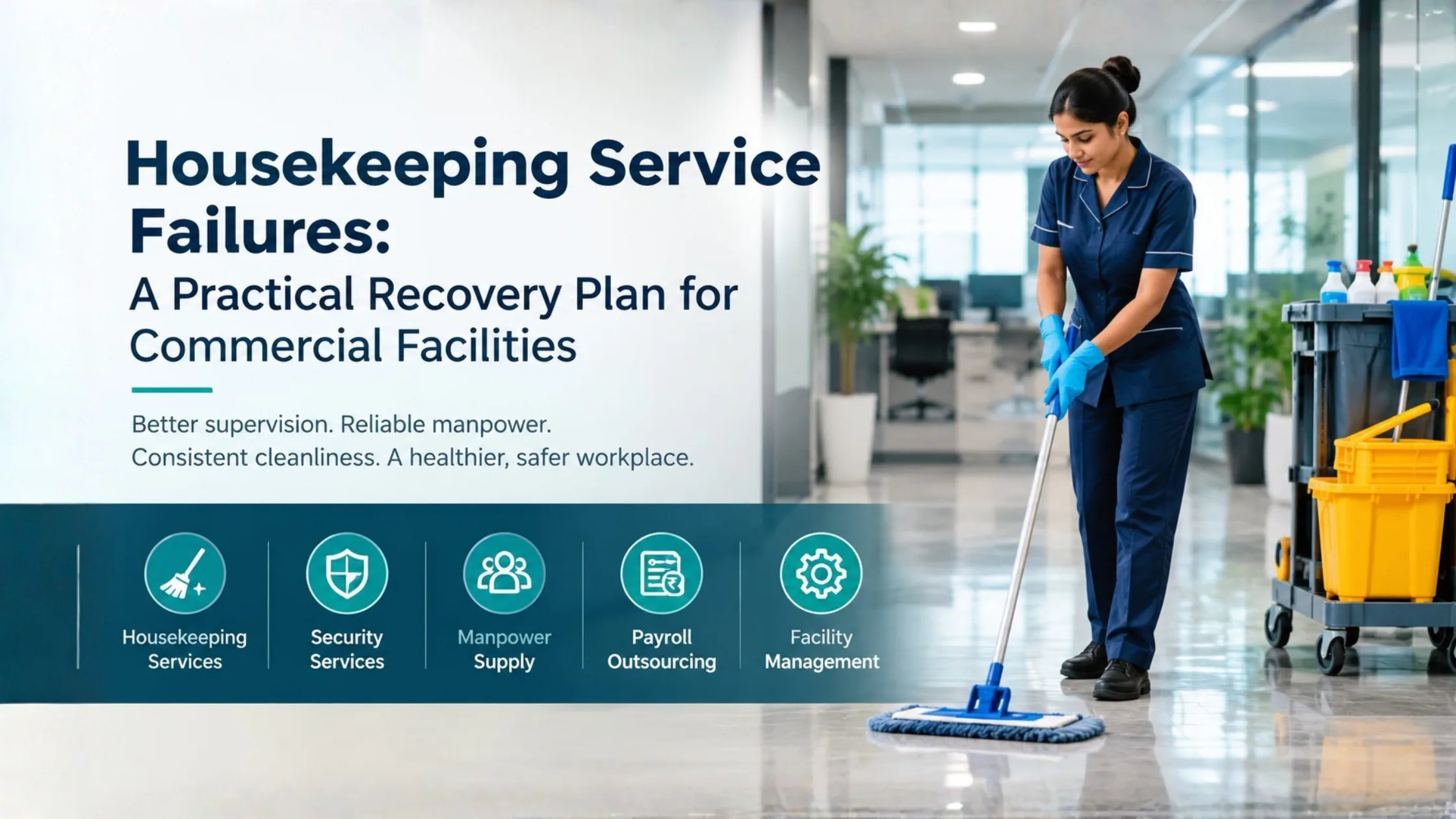
A housekeeping failure rarely arrives as a single bad day. It builds quietly. A washroom is missed on Tuesday. Dustbins overflow by Thursday. By the following Monday, a director has noticed the reception, a plant manager is fielding complaints, and your inbox is full of messages beginning with “Again?”
If that sounds familiar, you are not alone, and you are not stuck. Housekeeping services in a commercial facility are a system of people, supplies, supervision, and checks. When one part breaks, the whole thing wobbles. The good news is that most failures can be traced to a handful of fixable causes.
This guide is written for HR, admin, facility, procurement, and plant managers who need results, not theory. It covers how to diagnose what went wrong, stabilise the site in three days, rebuild standards over a month, and decide whether to retain or replace your vendor. The advice draws on how facility teams work on the ground across industrial and corporate sites in Gujarat.
- Most housekeeping failures come from five causes: unstable staffing, a vague scope of work, weak supervision, missing supplies or equipment, and no measurable standards.
- Stabilise the site in the first 72 hours, then rebuild in 30 days with a clear scope, checklists, audits, and a supervisor you can reach.
- Decide early whether to fix the current vendor or replace them. The comparison table below helps.
- Strong corporate housekeeping services are measured through inspection scores, attendance, response time, and complaint closure, not just “the floor looks clean.”
- Conditions differ across Ahmedabad, Vadodara, Surat, and Gandhidham. Your recovery plan should reflect local dust, humidity, and footfall.
Why Housekeeping Services Fail in Commercial Facilities
Before fixing anything, find out why it broke. Treating symptoms, such as shouting at the housekeeper on duty, rarely helps. In most cases the cause is structural.
Unstable staffing
High attrition and frequent replacements mean every new person starts from zero. Without a proper induction, they learn by guessing. Attendance gaps are filled by whoever is available, not whoever is trained.
A vague scope of work
“Daily cleaning of premises” is not a scope. If the contract does not say which areas, how often, with what method, and to what standard, both sides will interpret it differently. The vendor will say the work was done. You will say it wasn’t. Both may be right.
Weak or absent supervision
Housekeeping staff without a trained supervisor drift. Supervisors do more than count heads. They assign zones, check quality, handle shortages, and escalate problems before you hear about them.
Missing supplies and equipment
Cleaning chemicals diluted to stretch stock, worn mops, a single scrubbing machine shared between two floors: these quietly lower the result no matter how hard the team works.
No measurement
If nobody audits the work, quality depends on mood. Sites without inspection scores or complaint logs can’t tell the difference between a bad week and a bad contract.
Warning Signs You Should Not Ignore
Catch these early and recovery is easy. Ignore them and it gets expensive.
- Repeated complaints about the same washroom, pantry, or corridor
- Different housekeeping staff appearing every week
- Supervisor unreachable or only visible during your complaints
- Consumables (hand wash, tissue, liquid soap) running out mid-week
- Shift start times slipping, with the first hour of the day uncleaned
- Machines or tools missing, broken, or “under repair” for weeks
- Invoices arriving on time while service reports do not
- Statutory documents (attendance, wage proof, PF/ESI records for deployed staff) delayed or incomplete
Three or more of these together usually point to a systemic problem, not an individual one.
The First 72 Hours: Stabilise Before You Fix
In the first three days, your goal is control, not perfection.
Day 1: Walk the site and document. Visit every zone with your admin or facility lead. Photograph problem areas with time stamps. Note headcount on duty against the contracted number. Check stock of consumables and the condition of equipment.
Day 2: Hold a candid review with the vendor. Share your findings, with photos. Ask for a written explanation and a corrective plan within 24 hours. Pay attention to the quality of their response. A vendor who takes ownership is salvageable. One who deflects probably isn’t.
Day 3: Apply a short-term patch. Ask for a temporary supervisor or additional staff on priority zones such as washrooms, reception, cafeterias, and production-floor entry points. Place a basic sign-off sheet in each critical area so every clean is recorded with a time and initials.
This puts a floor under the problem while you plan the real fix.
The 30-Day Recovery Plan
| Week | Focus | Key Actions | Outcome |
|---|---|---|---|
| Week 1 | Reset the scope | Rewrite the zone-wise scope of work. Define frequency per area (hourly, twice daily, daily, weekly). List the equipment and consumables required. | Both parties agree on what “done” means |
| Week 2 | Fix the team | Confirm headcount against the contract. Verify staff documents. Run a short induction on methods, safety, and site rules. Assign a dedicated supervisor. | Stable, trained, accountable crew |
| Week 3 | Install controls | Introduce daily checklists, a weekly joint inspection, and a complaint log with response-time targets. | Quality is visible and measurable |
| Week 4 | Review and decide | Compare inspection scores and complaint trends against Week 1. Decide whether to continue, escalate, or replace. | An evidence-based decision |
Don’t skip Week 4. Too many managers keep a struggling arrangement running out of inertia. A formal review gives you a clear basis to continue, renegotiate, or change.
Fix the Vendor or Replace Them? A Comparison
Not every failure justifies a change. Switching providers carries its own disruption, so weigh both options honestly.
| Factor | Fix the Current Vendor | Replace the Vendor |
|---|---|---|
| Best when | Problems are recent and mostly about supervision or scope | Failures are repeated, and corrective plans have not worked |
| Speed of improvement | Faster, as the team already knows the site | Slower at first (mobilisation, induction), then more stable |
| Management effort | Moderate: audits and review meetings | High initially: tendering, onboarding, handover |
| Risk | Problems return if root causes remain | Transition gaps if handover is poor |
| Cost impact | Usually unchanged, perhaps with penalties or credits | May change; compare on value, not only price |
| Warning sign to replace | Vendor misses corrective deadlines, or statutory documents stay incomplete | n/a |
A useful rule: give a vendor one structured 30-day chance with clear metrics. If scores don’t improve, move on. If you do replace them, schedule a handover overlap of a few days so the site is never uncovered.
Building Standards That Hold: Checklists, Audits, and KPIs
Recovery only lasts if the new standards survive past the first month.
Zone-wise checklists
Each area gets its own checklist, with tasks, frequency, and a sign-off column. Washrooms need the strictest frequency. Reception and meeting rooms need presentation-focused checks. Production floors need dust and spill control.
Joint weekly inspections
A short walk-through by your admin lead and the vendor’s supervisor, scored against the same sheet each time, removes arguments. Scores come from observation, not opinion.
KPIs worth tracking
- Inspection score per zone (out of a fixed total)
- Attendance against contracted headcount
- Complaint response and closure time
- Consumable availability (no stock-outs)
- Staff retention on the site
- Statutory compliance document submission on time
Keep it to five or six measures. Anything more and nobody reads the report.
Training and refreshers
Good corporate housekeeping services invest in short, regular training on chemical handling, machine use, and hygiene practice. A trained housekeeper protects your facility as much as your floors. Ask vendors to show their training records, not just describe them.
How Recovery Differs for Offices, Factories, and Mixed Sites
Corporate offices: Presentation and hygiene drive perception. Focus on reception, washrooms, pantries, and meeting rooms, with a visible supervisor during working hours.
Factories and industrial units: The stakes include safety. Oil spills, dust accumulation, and blocked walkways cause incidents. Housekeeping here should align with your safety team, and staff need site-specific induction before entering production areas.
Mixed campuses (offices plus plant): These need two standards under one contract. Define them separately in the scope so quality in one area isn’t traded off against the other.
Residential or institutional complexes: Frequency and sensitivity matter more. Staff conduct and discretion become part of the standard.
City Notes: Ahmedabad, Vadodara, Surat, and Gandhidham
Conditions shape what “good” looks like. Your plan should reflect them.
Housekeeping services in Ahmedabad: Heavy commercial and industrial activity, plus summer dust, means entry areas and glass surfaces need extra frequency. Large corporate parks and manufacturing belts also demand reliable shift cover.
Housekeeping services in Vadodara: With a strong mix of industrial estates, offices, and institutions, Vadodara sites often need combined housekeeping and compliance support. Check that staffing documentation is complete.
Housekeeping services in Surat: Monsoon humidity and a dense industrial and textile presence make moisture control, anti-slip practice, and drainage cleanliness important.
Housekeeping services in Gandhidham: Proximity to port and logistics operations brings dust and coastal air. Equipment maintenance and floor-care schedules need to be tighter, and vendors need a dependable local workforce.
Providers with real presence across these cities can maintain consistent standards across multiple sites, which helps if your company operates in more than one location.
What to Ask Before You Appoint a New Provider
Use these questions in your tender or vendor meeting:
- How do you recruit, verify, and train housekeeping staff?
- Who supervises our site, and how quickly can we reach them?
- What is your replacement process when someone is absent?
- What equipment and consumables are included in the quote?
- How do you document statutory compliance for deployed staff?
- What quality certifications and audit systems do you follow?
- Can you share references from similar facilities?
- What does your first 30 days at a new site look like?
Vague answers to the first three questions are your signal to look elsewhere.
How Ardent Facilities Approaches Recovery
Ardent Facilities has been serving businesses in Gujarat since 2000 and is ISO 9001:2015 certified. We provide housekeeping, security, manpower supply, payroll outsourcing, and property management across Ahmedabad, Vadodara, Surat, and Gandhidham. When we take over a struggling site, we begin with a documented walk-through, agree a zone-wise scope with you, assign a trained supervisor, and report against clear inspection scores. Because one partner can also handle manpower and payroll compliance, there are fewer handoffs and fewer places for things to slip.
Conclusion
Housekeeping failures feel urgent and personal, but they are usually systemic. Find the root cause, stabilise in 72 hours, rebuild over 30 days, and measure results with simple, visible metrics. Then make an honest call: retain the vendor if scores improve, replace them if they don’t.
Reliable housekeeping services come from clear scope, trained people, accountable supervision, and regular audits. Get those four right and the cleanliness of your facility stops being a daily worry.
Struggling with inconsistent housekeeping at your facility? Talk to Ardent Facilities for a free site walk-through and a practical recovery plan. Call us or visit ardentfacilities.com to request a consultation for your site in Ahmedabad, Vadodara, Surat, or Gandhidham.
FAQs
What is the first step when housekeeping services fail?
Document the problem with dated photos and a headcount check, then meet the vendor to agree a written corrective plan within 24 hours. Add temporary supervision and sign-off sheets to stabilise the site.
How long does it take to recover from poor housekeeping service?
Visible improvement usually starts within the first week. A stable, measurable standard typically takes about 30 days of structured scope, training, and audits.
How do I know if I should replace my housekeeping vendor?
Replace the vendor if failures repeat after a structured 30-day improvement period, corrective deadlines are missed, or statutory documents for deployed staff remain incomplete.
What should a housekeeping scope of work include?
It should list areas, task frequency, methods, headcount per shift, equipment, consumables, supervision, reporting, inspection criteria, and penalties or credits for missed standards.
Which KPIs measure housekeeping performance?
Useful KPIs include zone inspection scores, attendance against contracted headcount, complaint closure time, consumable availability, staff retention, and timely compliance documentation.
Do corporate housekeeping services differ from factory housekeeping?
Yes. Corporate sites prioritise presentation and hygiene, while factories also require dust, spill, and safety control aligned with the plant’s safety procedures.
Are housekeeping services available across Gujarat?
Yes. Ardent Facilities provides housekeeping services in Ahmedabad, Vadodara, Surat, and Gandhidham, along with manpower, security, and payroll outsourcing.