
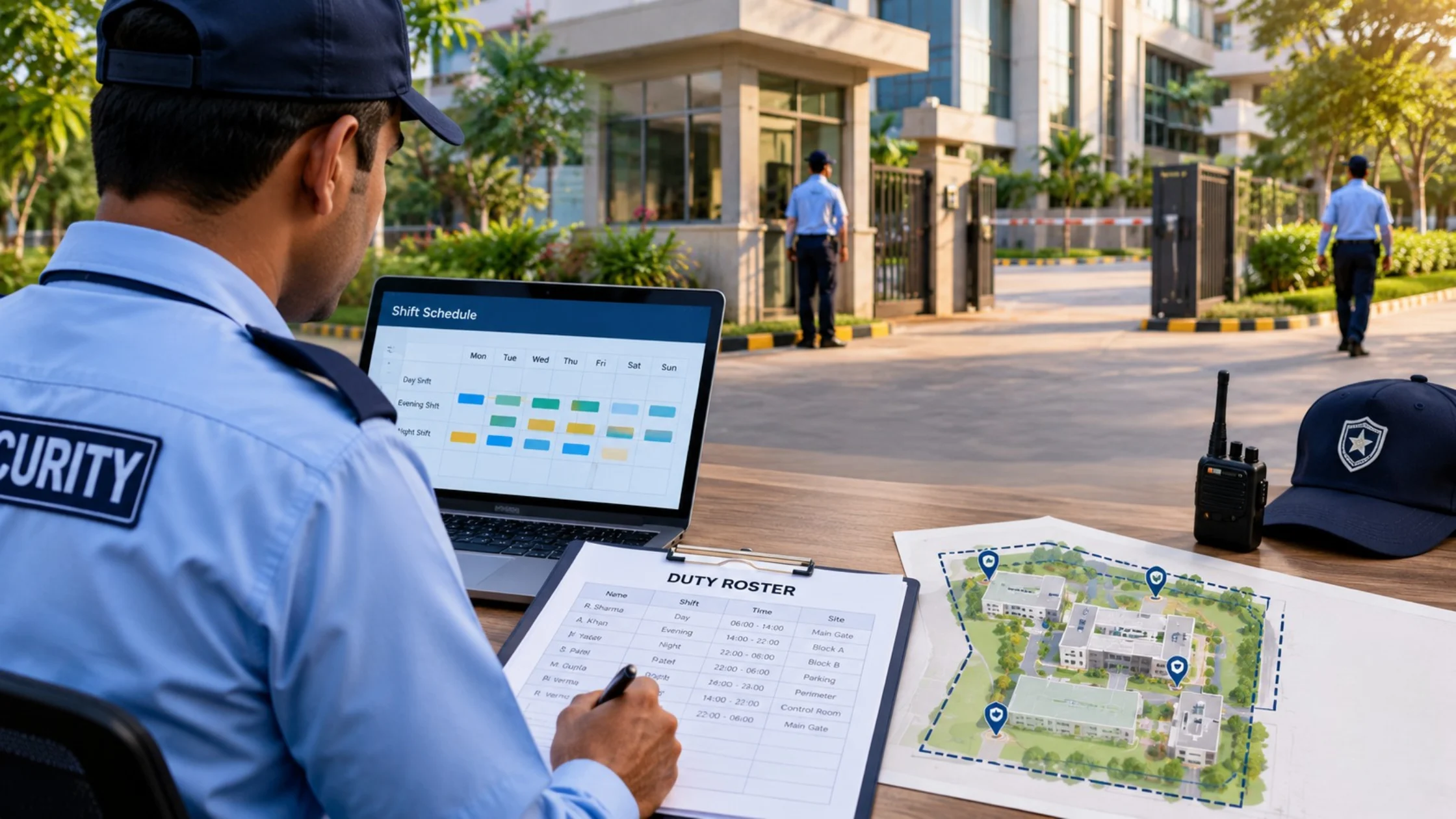
Ask any plant manager what keeps them awake, and security gaps will rank high. Most of those gaps do not come from a lack of guards. They come from a poorly planned roster: a post uncovered at shift change, a guard on his fourth straight night, or a relief who never arrived.
A duty roster looks like a simple table of names and timings. In practice it is the backbone of your site’s security. This is why experienced security guard agencies treat rostering as a core discipline, not an admin chore.
At Ardent Facilities, we have managed security manpower for industrial, commercial and residential sites across Gujarat since 2000. This guide shares what we have learned about shift planning and site coverage, so HR, admin and facility teams can judge any roster, whether it comes from an in-house team or a security guard agency you are evaluating.
QUICK ANSWER
A security guard duty roster is the schedule that decides who guards which post, during which shift, and who replaces them when someone is absent. A weak roster causes gaps, fatigue, overtime disputes and security failures. A strong one is built on post-wise risk, legal working-hour limits and a relief reserve.
- A 24×7 post needs roughly 4.5 to 5 guards on the payroll, not 3.
- Eight-hour shifts are safer and easier to defend legally than 12-hour shifts.
- Reliable security guard agencies keep a trained relief pool so no post is ever left empty.
- Good rosters are published in advance, logged daily and reviewed monthly.
What Is a Security Guard Duty Roster?
A duty roster is a written schedule that assigns guards to posts and shifts over a set period, usually a week or a month. A usable roster shows:
- The post (main gate, loading bay, control room, perimeter patrol)
- The guard assigned and the supervisor in charge
- Shift timings and weekly offs
- The designated relief for each guard
- Special duties, such as visitor management, vehicle checks or fire watch
The roster is also a record. After an incident, a theft or an audit, it shows who was on duty and where.
Why Roster Planning Decides Your Site Security
Three outcomes depend directly on the roster.
Continuity. Security fails most often at transitions. If the outgoing guard leaves at 6:00 and the incoming guard arrives at 6:20, your gate was open for 20 minutes. Good rosters build in a handover overlap.
Alertness. A guard working 12 hours after a restless day will miss things. Fatigue is a security risk, and it is also a compliance risk.
Accountability. When posts and names are fixed in advance, nobody can claim ignorance. Supervisors can check attendance against the roster each shift.
How to Build a Duty Roster, Step by Step
Step 1: Map every post and its risk level.
Walk the site with your agency’s supervisor. List each post and note what it protects, who passes through and what time of day carries the highest risk. A factory’s finished-goods gate at 2 a.m. carries more risk than the front desk at noon.
Step 2: Decide which posts need 24×7 cover.
Main gates, control rooms and material stores usually do. An administrative block may need guards only during working hours plus a night watchman.
Step 3: Choose the shift pattern.
Match the pattern to the site’s operations (see the comparison below).
Step 4: Calculate total manpower, including relief.
This is where most budgets go wrong. See the next section.
Step 5: Allocate guards by skill and experience.
Put your most alert and experienced guard on the main gate. Place a guard comfortable with registers and visitor systems at reception. Keep a trained fire-safety guard on rotation at high-risk areas.
Step 6: Rotate fairly.
Rotate night duty so no guard is stuck on it permanently. Announce the roster at least a week before the period starts.
Step 7: Assign a supervisor to every shift.
Someone must own the roster on the ground, check attendance at shift start and arrange a replacement immediately if a guard is absent.
Step 8: Review monthly.
Check absenteeism, overtime hours, incident logs and complaints. Adjust the roster where the data points.
The 24×7 Manpower Calculation Most Sites Get Wrong
Many clients assume one 24×7 post needs three guards: one per 8-hour shift. It does not.
A post that runs all day and night is open for 168 hours a week. Under the Factories Act, 1948, an adult worker’s weekly hours are generally capped at 48, with a weekly rest day. Dividing 168 by 48 gives 3.5 guards just to cover the hours, before anyone takes a day off.
Then add leave, sick days, festivals and training time. In our experience, a 24×7 post realistically needs about 4.5 to 5 guards on the agency’s payroll. If a quotation shows three guards for a round-the-clock post, ask how the agency will cover weekly offs. Either the guards are working illegal or exhausting hours, or the post will sit empty on some days.
Note: working-hour and overtime rules depend on your establishment type and the labour code provisions currently in force. Confirm applicability with your compliance team or labour consultant.
Choosing a Shift Pattern: 8-Hour vs 12-Hour
| Factor | Three 8-Hour Shifts | Two 12-Hour Shifts | Rotating 8-Hour with Relief Pool |
|---|---|---|---|
| Guards needed per 24×7 post | About 4.5–5 | About 3.5–4 | About 4.5–5 |
| Guard alertness | High | Drops in later hours | High |
| Overtime exposure | Low | High, as 12 hours exceeds daily limits | Low |
| Legal comfort | Strong | Needs careful compliance handling | Strong |
| Handover points per day | 3 | 2 | 3 |
| Best suited for | Factories, warehouses, large campuses | Small sites with tight budgets | Multi-post sites with variable demand |
| Typical risk | Higher manpower cost | Fatigue, missed rounds, overtime disputes | Needs good supervision |
Twelve-hour shifts look cheaper on paper because fewer guards are needed. The savings often vanish through overtime, absenteeism and the cost of an incident. For most industrial and corporate sites, we recommend three 8-hour shifts with a trained relief pool.
Roster Planning by Site Type
Factories and industrial units. Shift changes in the plant create traffic surges at the gate. Stagger guard handovers a few minutes before the plant’s own shift change so the gate is fully staffed when the rush begins. Add a dedicated guard for truck entry and exit checks, and a patrol guard at night for the perimeter.
Warehouses and logistics hubs. Peak risk usually coincides with loading and dispatch. Roster extra guards at those windows instead of spreading the same number evenly across the day.
Corporate offices and IT parks. Access control and visitor management dominate. Rosters should favour well-presented, communication-trained guards at reception, with a smaller night team.
Residential societies and townships. Gate and patrol duties run all day, with visitor and delivery traffic peaking in mornings and evenings. Women guards are often needed for resident comfort and for searches.
Educational and healthcare campuses. Rosters need clearly defined zones, an emergency response plan and guards trained to handle crowds and distressed visitors calmly.
Common Roster Mistakes (and Fixes)
- Mistake: No relief reserve. One absence leaves a post empty.
Fix: Keep a pool of pre-verified, site-briefed relief guards. - Mistake: Same guard on night duty for months.
Fix: Rotate nights on a fixed cycle. - Mistake: Last-minute roster changes by phone.
Fix: Publish the roster in writing and record every change with the reason. - Mistake: Overtime used to fill structural gaps.
Fix: Fix the manpower count instead of relying on overtime. - Mistake: Roster exists, but nobody checks attendance against it.
Fix: Supervisors verify each shift start and log it. - Mistake: Ignoring peak-risk windows.
Fix: Review incident logs and shift extra strength to the hours where problems cluster.
In-House vs Outsourced Rostering
| Aspect | In-House Security Team | Security Guard Agency |
|---|---|---|
| Relief during absence | Depends on your own spare staff | Agency maintains a relief pool |
| Roster management | HR or admin handles it | Agency supervisor handles it |
| Statutory compliance (PF, ESI, wages) | Your responsibility | Agency’s responsibility, with your oversight |
| Training and refreshers | You arrange it | Agency arranges it |
| Replacement of unsuitable guards | Slow, often HR-heavy | Faster, since the agency controls the pool |
| Cost predictability | Varies with attrition | Fixed monthly contract rate |
| Management time required | High | Lower, with periodic review |
For most mid-sized and large sites, outsourcing the guard force to a licensed security guard agency reduces management load and improves coverage reliability. The key word is licensed. Under the Private Security Agencies (Regulation) Act, 2005 (PSARA), agencies must hold a valid licence, and guards must meet verification and training requirements. Always ask to see the licence before signing.
What to Ask a Security Guard Agency About Rostering
Use these questions during vendor evaluation. A confident agency will answer them without hesitation.
- How many guards will you deploy against each 24×7 post, and how do you cover weekly offs?
- Do you keep a relief pool, and how fast can a replacement reach my site?
- Who is the on-site supervisor, and how often does the area manager visit?
- How are guards verified and trained before deployment?
- How will you share and record the roster, and how are changes documented?
- How do you handle PF, ESI and wage payment, and can I see proof each month?
- What is your escalation process if a guard does not report?
Rostering Across Ahmedabad, Baroda, Surat and Gandhidham
Each Gujarat city has its own site profile, and the roster should reflect it.
- Security guards in Ahmedabad: Strong mix of industrial belts like Naroda, Odhav, Vatva and Sanand, plus corporate offices, malls and residential societies. Industrial sites need heavy gate management and night patrols. Corporate sites lean towards front-desk professionalism.
- Security guards in Baroda: Chemical, engineering and pharma units around Makarpura, Waghodia and Savli need guards trained in hazardous-area discipline and strict material control.
- Security guard in Surat: Textile, diamond and trading clusters involve high-value goods and heavy movement, so access control, vehicle checks and tight shift handovers matter most.
- Security guard in Gandhidham: Port, logistics and warehousing activity near Kandla runs around the clock. Rosters should account for truck movement peaks and container yard patrols.
A local agency that already staffs these areas can bring a ready relief pool near your site. That cuts replacement time sharply compared with sending someone from another city.
Conclusion
A duty roster is the plan behind every gate, patrol and handover on your site. It works when it starts with risk, respects legal working hours, includes a real relief reserve and is checked every day. It fails when it is built only to hit a low monthly price.
When you evaluate security guard agencies, look past the rate card. Ask how they calculate manpower, how they cover absences and who supervises the shifts. The answers show whether you are buying real coverage or paper coverage. The right security guard agency will treat your roster as seriously as you treat your site.
Need a roster that actually covers your site?
Ardent Facilities has provided security, manpower, housekeeping, payroll outsourcing and property management services since 2000. We are ISO 9001:2015 certified and serve clients across Ahmedabad, Vadodara/Baroda, Surat and Gandhidham.
Request a free site assessment and a post-wise manpower plan.
Call or WhatsApp us, or fill in the enquiry form at ardentfacilities.com.
FAQs
1. What is a security guard duty roster?
A duty roster is a schedule that assigns security guards to specific posts and shifts for a week or month. It lists names, timings, weekly offs, supervisors and relief arrangements so every post stays covered.
2. How many security guards are needed for one 24x7 post?
A 24×7 post is open 168 hours a week. With a 48-hour weekly working cap per guard plus leave and rest days, it typically needs about 4.5 to 5 guards on the agency’s payroll, not just 3.
3. Is a 12-hour or 8-hour guard shift better?
Eight-hour shifts are generally safer and easier to manage legally. Twelve-hour shifts reduce headcount but raise fatigue, overtime and compliance risks.
4. Who prepares the duty roster, the client or the agency?
Usually the agency’s supervisor prepares it after a site risk assessment, and the client approves it. The client should still review it for gaps, especially at shift changes.
5. How often should a security guard roster be reviewed?
Review it monthly using attendance, overtime and incident data. Also review it after any security incident, change in plant shifts or expansion of the site.
6. What happens if a guard does not report for duty?
A good security guard agency sends a pre-briefed relief guard from its pool and informs the client immediately. Without a relief arrangement, the post stays empty until someone is found.
7. How do I choose between security guard agencies?
Check the PSARA licence, statutory compliance record, guard training process, supervision structure, relief capability and client references in your region. Compare their manpower calculation for each post, not only the monthly rate.
8. Can one agency supply security guards in Ahmedabad, Baroda, Surat and Gandhidham?
Yes, if it has operations and a local relief pool in each city. A multi-city agency like Ardent Facilities can manage guards across these locations under one point of contact.