
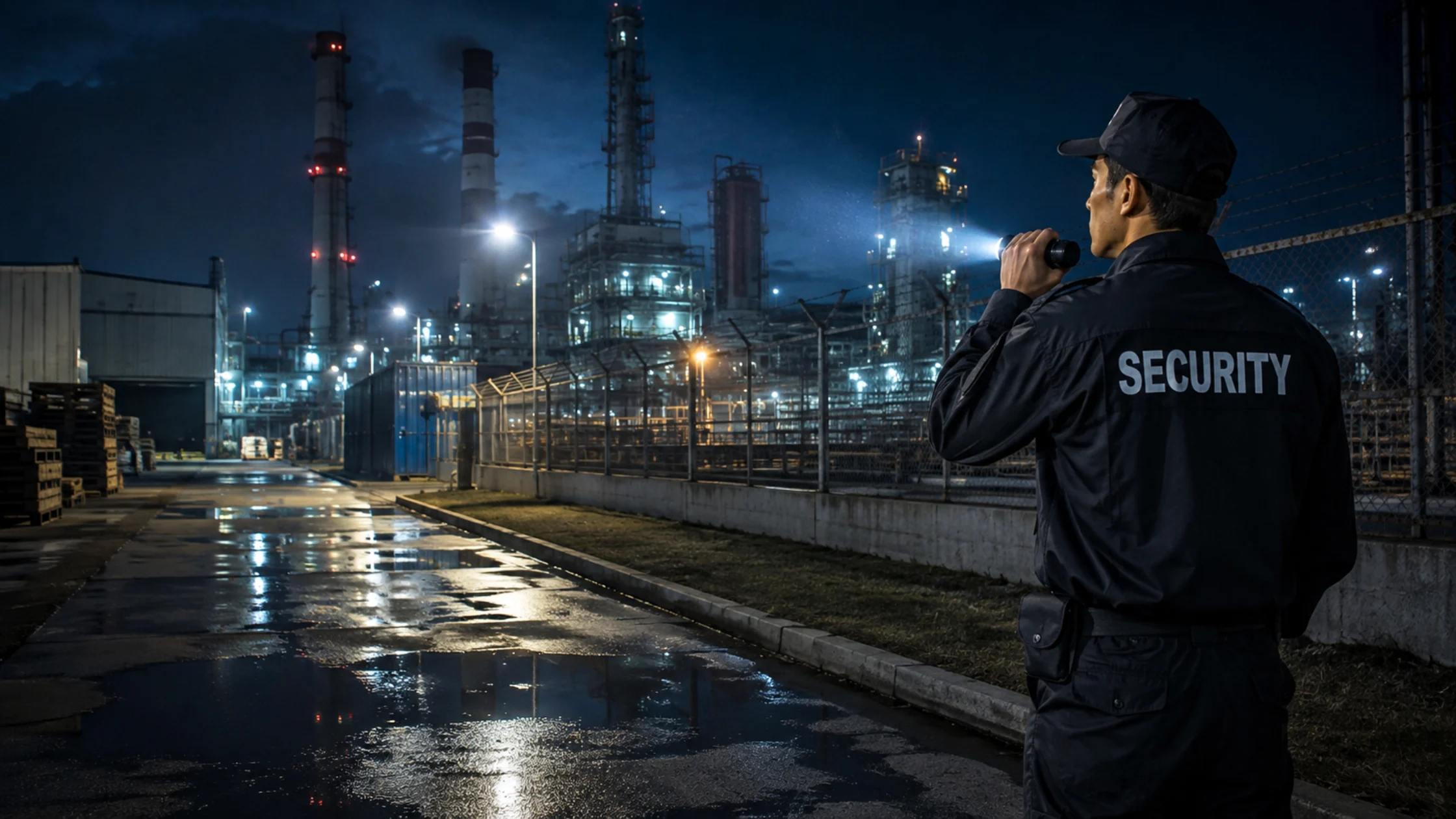
Ask any plant manager when they worry most about their facility, and the honest answer is rarely during working hours. It’s the stretch between 10 PM and 5 AM, when the last shift has left, the gates are locked, and the only people on site are a handful of guards, if the site is staffed at all properly.
Industrial areas in Gujarat, whether it’s a GIDC estate in Ahmedabad, a chemical belt unit near Vadodara, a textile unit in Surat, or a warehousing cluster in Gandhidham, share a common vulnerability profile after dark. Poor street lighting on approach roads, isolated boundary walls, unmonitored loading bays, and reduced police patrol frequency all combine to make the night shift the riskiest window in a 24-hour industrial operation.
This is precisely where a competent security guard agency earns its fee. Not by simply placing a body at the gate, but by designing a night-specific protection system: trained guards who know what to watch for, patrol patterns that don’t become predictable, communication protocols that get help moving in minutes rather than hours, and documentation that holds up when insurance claims or police reports are needed.
This blog walks through the real risks factories and industrial units face after sunset, what a professional security guard agency does differently to prevent them, and how to evaluate whether your current night security setup is actually doing its job.
Industrial facilities face higher security risks after dark, particularly between 9 PM and 6 AM, when supervision is reduced and response times can increase. This guide explains the key night-shift risks affecting factories, warehouses, and industrial estates, and how a professional security guard agency can build an effective protection system using trained security personnel, disciplined patrols, technology integration, and rapid escalation procedures. It also covers how to evaluate a security guard agency, compares in-house and outsourced night security, and provides a practical checklist for HR managers, plant heads, and operations leaders across Ahmedabad, Vadodara (Baroda), Surat, and Gandhidham.
Why Night Shifts Are the Weakest Link in Industrial Security
Three structural factors make night hours riskier than day hours in an industrial setting.
Reduced human presence. A factory that runs three shifts might still have hundreds of workers on the floor at 2 AM, but administrative staff, supervisors, and management are almost always absent. Fewer eyes on the premises means incidents go unnoticed longer.
Lower visibility and slower response. Perimeter lighting is often the first budget item to get neglected, and even well-lit compounds have blind spots near stores, scrap yards, and loading docks. If something goes wrong, the nearest police response in an industrial estate can take considerably longer at night than during the day.
Predictability of routine. Repeat offenders, whether petty thieves or organized scrap theft rings, study a facility’s patterns before acting. A gate that’s unlocked at a fixed time, a guard who does the same patrol route every two hours, or a shift change that leaves a five-minute gap in coverage; these are the details opportunists exploit.
A security guard agency that understands industrial operations builds its night protocols specifically around breaking this predictability.
Top Night Shift Security Risks in Industrial Areas
1. Theft of raw material, finished goods, and scrap This is the most common incident type reported by manufacturing units. Copper wiring, machine parts, packaged finished goods, and scrap metal are high-value, easy-to-move targets, and night shifts offer the widest window for someone to load a vehicle undetected.
2. Unauthorized entry and trespassing Boundary walls, especially along the rear or side of a plot bordering open land, are common entry points. Outsiders looking for shelter, or individuals casing the property for a future theft, often test access at night first.
3. Fire and electrical hazards going unnoticed A short circuit, an overheating machine left running, or a discarded cigarette near flammable storage can escalate quickly when there’s no one nearby to catch it in the first ten minutes. Night guards trained in basic fire response are often the actual first line of defense, not the fire brigade.
4. Vehicle and material movement without authorization Unrecorded entry or exit of trucks, especially during shift changes, is a common way inventory discrepancies happen. Without a disciplined gate register and verification process, it’s difficult to trace what left the premises and when.
5. Guard negligence, sleeping on duty, or collusion This is uncomfortable to discuss but common. Poorly supervised, underpaid, or undertrained guards are more likely to doze off during low-activity hours, or in worse cases, be complicit in theft. This is a direct outcome of weak hiring and supervision by the security provider, not something facility management can fully solve on its own.
6. Delayed emergency response If a guard spots something suspicious but has no clear escalation protocol, no direct line to a control room, or no backup guard to verify before acting, the incident often plays out before anyone intervenes.
7. Labour and contractor-related incidents Facilities running night shifts with contract labour face additional exposure: unauthorized visitors on the floor, disputes escalating without management present, or safety violations that go unchecked without a supervisor on-site.
What Happens When Night Security Fails
The cost of a night security lapse rarely stays contained to the value of what’s stolen. A single incident can trigger insurance premium increases, strained relationships with clients who audit your facility’s security posture, production downtime if machinery or material is damaged, and in fire-related cases, potential regulatory scrutiny. For export-oriented units, a security lapse during a client audit cycle can also affect vendor certification status. The real cost of weak night security shows up in these downstream effects, which is why treating it as a checkbox expense is a mistake many factory owners only recognize after an incident.
How a Professional Security Guard Agency Prevents Night Shift Risks
A capable security guard agency doesn’t approach night security as “the same guards, fewer people.” It builds a distinct protocol for the night window.
Trained, vetted, and background-verified guards Every guard deployed for night duty should be verified through police clearance and background checks, and specifically briefed on the facility’s layout, high-risk zones, and emergency contacts before their first shift.
Structured, randomized patrol schedules Fixed-time patrols are easy to predict and exploit. A professional agency builds randomized patrol intervals so guards cover the perimeter, loading areas, and stores at unpredictable times, closing the gap that repeat offenders rely on.
Two-guard or supervisor check-in systems For larger industrial sites, a lone guard is a liability. Agencies with strong night protocols pair guards or run periodic supervisor check-ins via call or app-based reporting, so there’s always verification and backup.
Technology-backed monitoring CCTV integration, guard tour management systems (where a guard scans checkpoints using a mobile app or RFID tag), and centralized control room monitoring add a layer of accountability that a guard’s word alone can’t provide.
Clear escalation protocols Guards need to know exactly who to call, in what order, and within what time frame, whether it’s a facility manager, the police control room, or a fire response team. Ambiguity here is where response time is lost.
Documented gate and material movement registers Every vehicle, visitor, and material movement should be logged with time, purpose, and authorization signature. This single practice resolves most disputes around missing inventory.
Regular audits and unannounced spot checks A reliable agency doesn’t wait for a client complaint to check guard performance. Supervisors conducting unannounced night visits keep guards alert and surface gaps before they become incidents.
In-House Night Security vs. Outsourced Security Guard Agency
| Factor | In-House Security Team | Outsourced Security Guard Agency |
|---|---|---|
| Recruitment & Background Verification | Managed internally, often inconsistent | Standardized police verification and vetting process |
| Guard Training | Limited, ad hoc | Structured training on patrol, fire response, and escalation |
| Backup for Absenteeism | Difficult to arrange replacement quickly | Agency provides substitute guards without coverage gaps |
| Supervision & Audits | Depends on internal bandwidth | Dedicated supervisors conduct scheduled and surprise checks |
| Technology Integration (patrol apps, CCTV monitoring) | Rarely implemented independently | Often bundled as part of the service |
| Cost Predictability | Variable (PF, ESIC, uniforms, training borne separately) | Fixed monthly cost with compliance included |
| Statutory Compliance (PF, ESIC, labour law) | Facility bears full liability | Agency handles compliance and documentation |
| Scalability for Multiple Shifts/Sites | Requires internal HR effort to scale | Agency scales guard deployment across shifts and locations |
For most mid-sized and large industrial units, the outsourced model wins on accountability and cost predictability, provided the security guard agency is chosen carefully. In-house teams can work for very small, single-shift operations where the owner or a trusted supervisor is directly involved in oversight.
What to Check Before Hiring a Security Guard Agency for Night Shifts
- Licensing under the Private Security Agencies (Regulation) Act (PSARA) — Confirm the agency holds a valid PSARA license for the state of operation.
- Guard verification process — Ask specifically how police verification and background checks are conducted, not just whether they happen.
- Night-specific training — Does the agency train guards separately for night duty, including fire response and emergency escalation, or is it the same generic training for all shifts?
- Supervision structure — Who checks on night guards, how often, and how is it documented?
- Technology capability — Does the agency offer patrol tracking, a control room, or reporting dashboards, or is it purely manual?
- Replacement guarantee — What happens if a guard doesn’t show up at 11 PM? Ask for their actual backup process, not just a policy statement.
- Client references in similar industries — A security guard agency serving retail showrooms operates very differently from one experienced with industrial estates. Ask for references from factories or warehouses specifically.
- Compliance documentation — PF, ESIC, minimum wage adherence, and labour law compliance should be transparent and available on request.
City-Specific Night Security Considerations
Security Guards in Ahmedabad GIDC estates like Vatva, Naroda, and Odhav have dense industrial clustering, which means shared boundary walls and higher foot traffic even at night. Agencies operating security guards in Ahmedabad need strong coordination with local police chowkis and familiarity with estate-specific access norms.
Security Guards in Baroda Vadodara’s industrial belt, particularly around Gorwa, Makarpura, and the Vadodara-Halol corridor, includes several chemical and process industries where night security must also account for hazardous material protocols, not just theft prevention.
Security Guard in Surat Surat’s textile and diamond processing units often run round-the-clock operations. Security guard in Surat deployments need to handle high shift-change volumes and, in many cases, tighter material movement documentation given the value density of goods in transit.
Security Guard in Gandhidham As a port-linked logistics and warehousing hub, Gandhidham’s facilities deal with high-value cargo movement at night. Guards here need experience coordinating with transport documentation and container yard protocols in addition to standard patrol duties.
A security guard agency with actual operating experience across all four cities, rather than a head-office presence with subcontracted local guards, understands these regional differences and builds them into deployment plans.
A Practical Night Security Checklist for Plant and Facility Managers
- Perimeter lighting is functional and covers blind spots, not just the main gate
- Guards are briefed on facility-specific risk zones, not generic instructions
- Patrol timings are randomized and logged
- A working communication line exists between guards, supervisors, and management
- Gate registers capture every vehicle and material movement with signatures
- CCTV coverage overlaps with guard patrol routes rather than replacing them
- Guards have received basic fire and first-response training
- There’s a documented escalation chain for emergencies
- Guard attendance and replacement process is reliable and verifiable
- Periodic, unannounced audits are conducted by the agency’s supervisors
If more than two or three of these are missing at your facility, it’s worth a direct conversation with your current security guard agency, or a review of alternatives.
Conclusion
Night shift risk isn’t a theoretical concern for industrial units in Gujarat; it’s a documented pattern that shows up in theft reports, insurance claims, and the occasional fire incident that could have been caught in its first few minutes. The gap between a facility that stays protected after dark and one that doesn’t usually comes down to whether the security guard agency running the show treats night duty as a distinct discipline or as an afterthought.
Trained guards, randomized patrols, technology-backed monitoring, and clear escalation protocols aren’t extras, they’re the baseline for any factory, warehouse, or industrial estate that operates around the clock. If your current setup is missing more than one or two of these, it’s worth a closer look before an incident forces the conversation.
Ardent Facilities has been providing trained, PSARA-verified security guards to factories, warehouses, and industrial estates across Ahmedabad, Baroda, Surat, and Gandhidham since 2000. Get in touch for a night security audit of your facility, and a deployment plan built around your site’s actual risk profile, not a generic guard placement. Contact Ardent Facilities today.
FAQs
Q1. What is the biggest night shift security risk for factories in Gujarat?
Theft of raw material, finished goods, or scrap is the most frequently reported incident, largely because reduced supervision and low visibility make it easier for material to leave the premises unnoticed.
Q2. How many guards are needed for night shift security at an industrial unit?
It depends on plot size, number of entry points, and risk profile, but most mid-sized industrial units need a minimum of two guards per shift so there’s backup coverage and no single point of failure.
Q3. Does a security guard agency provide guards trained specifically for night duty?
A professional security guard agency should, since night duty requires different skills, alertness management, patrol discipline, and emergency response, compared to day shift guarding.
Q4. Is CCTV enough, or do factories still need physical security guards at night?
CCTV is a monitoring tool, not a deterrent or a responder. Cameras record what happened; guards can prevent it from happening or intervene while it’s in progress. The two work best together, not as substitutes for each other.
Q5. How do I verify if a security guard agency is PSARA licensed?
Ask the agency directly for their PSARA license number and state of registration, and cross-check it with the relevant state’s Controlling Authority for Private Security Agencies, which maintains licensed agency records.
Q6. What should be included in a night security service agreement?
It should clearly specify guard count per shift, patrol frequency, escalation protocol, replacement guarantee for absenteeism, reporting format, and compliance responsibilities (PF, ESIC, minimum wages).