
A production line doesn’t care why a worker didn’t show up. It only cares that the line is short-staffed, and every idle minute has a cost attached to it. Sudden manpower exits — whether from a mass resignation after a wage dispute, a contractor abruptly shutting operations, or a group of workers leaving for a festival and never returning — are one of the most disruptive events a factory can face. Yet most facilities still treat manpower continuity as an afterthought, something to fix only after the shift has already gone understaffed.
This is where a dependable manpower supplier changes the outcome entirely. Factories in Gujarat’s industrial belts — from GIDC estates in Ahmedabad to the chemical and engineering clusters in Vadodara, textile units in Surat, and the port-linked industries in Gandhidham — cannot afford a week-long hiring cycle when a shift is short by fifteen or fifty people. They need a structured, time-bound recovery plan.
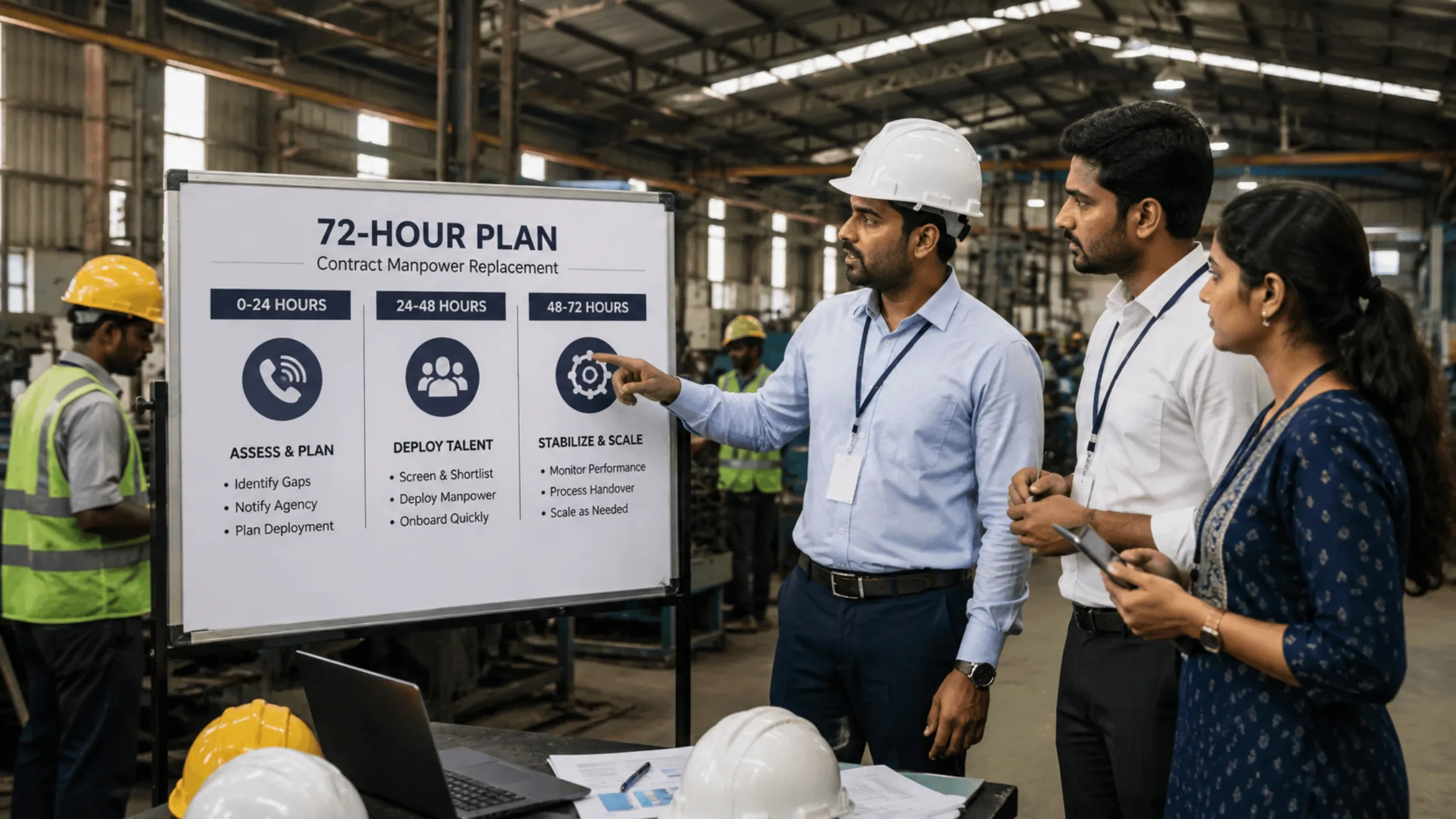
This article lays out exactly that: a 72-hour framework that HR managers, plant heads, and procurement teams can follow the moment a manpower crisis hits, along with the preventive systems that stop the next one from becoming a full-blown emergency.
When contract workers leave a production floor without notice, operations can be disrupted within hours. This guide provides a practical 72-hour manpower replacement framework for factory owners, plant managers, and HR teams, covering workforce stabilization, rapid sourcing, candidate verification, deployment, and long-term prevention strategies. It also explains why partnering with an experienced manpower supplier across Ahmedabad, Vadodara, Surat, and Gandhidham helps businesses maintain production continuity and reduce the impact of unexpected workforce shortages.
Why Sudden Worker Exits Are More Common Than Factories Admit
Ask any plant manager in an industrial cluster and they’ll admit it happens more often than official numbers suggest. Common triggers include:
- Contractor-level disputes where a labour contractor fails to pay wages on time, prompting the entire crew to walk out together.
- Seasonal migration, particularly around harvest seasons and major festivals, when a large share of the migrant workforce returns home with little notice.
- Wage or working-condition disagreements that escalate faster than HR can mediate.
- Poaching by competing units, especially during peak production seasons when demand for skilled contract labour spikes across a cluster.
- Sudden contractor exit, where the manpower vendor itself shuts operations or loses its licence, leaving the client factory with no legal workforce overnight.
None of these are rare, isolated events. They are structural risks built into any operation that depends on contract labour without a backup mechanism. The factories that recover quickly are not the ones that avoid these situations — they’re the ones that have a plan ready before the situation happens.
The Real Cost of an Unfilled Shift
Every hour a production line runs short-staffed carries a cost that goes well beyond the missing wages. Factories typically underestimate three categories of loss:
- Direct production loss — missed output targets, delayed dispatches, and penalty clauses in B2B contracts for late delivery.
- Compliance exposure — running with a workforce below sanctioned strength can violate factory licensing norms and client audit requirements, especially for export-oriented units.
- Overtime and burnout costs — the remaining workers are pushed into extended shifts, which increases accident risk and accelerates further attrition.
A single day of being short by even 10% of your contract workforce can cost more than a month of retainer fees paid to a reliable manpower supplier. That comparison alone should reframe how factories budget for workforce continuity.
The 72-Hour Manpower Replacement Framework
This is the core operational plan. It assumes a factory has just discovered a sudden shortfall — whether five workers or fifty — and needs to restore full strength within three days without compromising verification or compliance.
Hour 0–4: Triage and Damage Control
The first four hours are about containment, not replacement.
- Quantify the exact gap. Identify which departments, shifts, and skill categories are affected. A shortfall in unskilled housekeeping staff is a very different problem from a gap in trained machine operators.
- Redeploy internally first. Temporarily shift available staff from lower-priority areas to critical production lines.
- Notify your manpower supplier immediately, even before the full picture is clear. Suppliers with a standing relationship can start sourcing while you’re still assessing scope.
- Document the gap for compliance records. Under contract labour regulations, factories are expected to maintain workforce strength records; documenting the shortfall protects you during any later audit.
Hour 4–24: Activating Your Manpower Supplier Network
This is where an established manpower supplier proves its value over ad hoc hiring.
- A supplier with an active labour pool in Ahmedabad, Vadodara, Surat, or Gandhidham can pull from a pre-verified bench of workers rather than starting recruitment from scratch.
- Skill-matching happens against your original job requisition — machine operators, loaders, packers, housekeeping staff, or security personnel — rather than generic labour.
- Suppliers with multi-location presence can also transfer workers between nearby industrial clusters if local supply is temporarily tight, something an in-house HR team rarely has the network to do.
Hour 24–48: Screening, Verification, and Onboarding
Speed cannot come at the cost of skipping due diligence — this is where many factories make costly mistakes under pressure.
- Identity and background verification should never be skipped, even under time pressure. A reputable manpower supplier maintains this as a standard, not an optional add-on.
- Statutory paperwork — PF, ESIC, and labour licence compliance — must be completed before deployment, not after.
- Basic safety induction is non-negotiable for factory floor roles, regardless of how urgent the staffing gap is.
Hour 48–72: Deployment and Floor Integration
- New workers are deployed in phased batches rather than all at once, so supervisors can properly integrate them into existing teams.
- Pairing new workers with experienced staff for the first shift reduces errors and safety incidents.
- A follow-up check at the 72-hour mark confirms attendance stability and flags any early signs of a second wave of attrition.
In-House Hiring vs. Manpower Supplier: Which Recovers Faster?
| Factor | In-House Emergency Hiring | Established Manpower Supplier |
|---|---|---|
| Typical time to fill gap | 7–14 days | 24–72 hours |
| Access to pre-verified workers | Limited, starts from scratch | Existing screened labour pool |
| Compliance documentation | Managed internally, often delayed | Handled as part of standard onboarding |
| Multi-city backup capacity | Rarely available | Available across linked locations |
| Cost during crisis | High (overtime, agency finder fees, rushed hiring) | Predictable, contract-based |
| Skill-matching accuracy | Inconsistent under time pressure | Matched against pre-defined job roles |
| Risk of repeat attrition | Higher, due to rushed vetting | Lower, due to structured screening |
The gap isn’t about capability — in-house HR teams are perfectly capable of hiring well. The gap is about speed under pressure, and that’s precisely the problem a manpower supplier is built to solve.
Building a Standing Replacement Reserve
The factories that never panic during sudden attrition are the ones that treat manpower continuity as infrastructure, not an emergency response. Three practices make the biggest difference:
- Maintain a standing agreement with a manpower supplier that includes an agreed replacement SLA (48 hours, 72 hours, etc.), not just a general hiring arrangement.
- Pre-clear a buffer headcount of 5–8% above sanctioned strength with your supplier, so replacements can be pulled from an already-vetted bench.
- Run quarterly workforce risk reviews to identify which departments are most exposed to sudden exits — usually the ones with the lowest wage bands or highest physical strain.
Common Mistakes Factories Make During a Manpower Crisis
- Hiring the first available workers without verification, which creates compliance risk and often results in repeat attrition within weeks.
- Overloading remaining staff instead of activating external replacement channels early, which triggers a second wave of resignations.
- Treating the manpower supplier as a last resort instead of a first call, losing valuable hours in the critical 0–24 window.
- Failing to document the shortfall, which weakens the factory’s position during statutory compliance audits.
- Ignoring the root cause — if the same department keeps losing workers suddenly, the fix isn’t faster replacement, it’s addressing wage or working-condition issues at the source.
City-Specific Manpower Realities: Ahmedabad, Vadodara, Surat, Gandhidham
Manpower availability and worker behaviour differ meaningfully across Gujarat’s industrial hubs, and a one-size-fits-all replacement plan rarely works well.
Ahmedabad and its GIDC belt carry the state’s largest concentration of manufacturing and manpower supply activity, which means a manpower supplier in Ahmedabad typically has the deepest labour bench and fastest replacement turnaround for general manufacturing, housekeeping, and security roles.
Vadodara‘s industrial base leans heavily toward chemical, engineering, and process manufacturing, so manpower services in Baroda need to prioritise workers with relevant safety training and handling experience, not just headcount.
Surat, dominated by textile and diamond processing units, sees some of the sharpest seasonal swings in contract labour availability, particularly around festival migration — making a standing manpower supplier relationship more critical here than almost anywhere else in the state.
Gandhidham, driven by port and logistics-linked industries, often needs faster cross-shift deployment due to the round-the-clock nature of cargo and warehousing operations, so manpower services in Gandhidham are frequently structured around tighter shift-rotation SLAs.
How to Choose a Manpower Supplier Before You Need One
Waiting until a crisis hits to start vendor discovery is the single biggest planning failure factories make. When evaluating a manpower supplier, look for:
- A documented replacement SLA in the service agreement, not a verbal promise.
- Proof of statutory compliance handling — PF, ESIC, labour licence renewals.
- Multi-city or multi-cluster presence, so they can pull backup workers if local supply tightens.
- References from existing factory clients in your specific industry vertical.
- A track record that predates the current hiring cycle — longevity signals stability under pressure.
FAQs
Q1. How quickly can a manpower supplier realistically replace a large group of contract workers?
For most manufacturing and facility roles, an established supplier with a pre-verified labour bench can deploy replacements within 24 to 72 hours, depending on the skill level required and the size of the shortfall.
Q2. What happens to statutory compliance if workers are replaced in a hurry?
A reliable manpower supplier completes PF, ESIC, and labour licence documentation as a standard part of onboarding, so speed doesn’t come at the cost of compliance, provided the supplier is properly licensed.
Q3. Should factories maintain a backup manpower supplier even if their current vendor performs well?
Yes. Having a secondary supplier relationship, even a dormant one, significantly shortens response time if the primary vendor is unable to fill a sudden gap.
Q4. Is it cheaper to hire directly during a crisis instead of using a manpower supplier?
Direct emergency hiring usually costs more once overtime, rushed recruitment fees, and compliance risk are factored in, and it typically takes longer to reach full workforce strength.
Q5. How can factories reduce the frequency of sudden worker exits?
Regular wage audits, timely payment cycles, and periodic workforce satisfaction reviews address most root causes before they escalate into mass walkouts.