
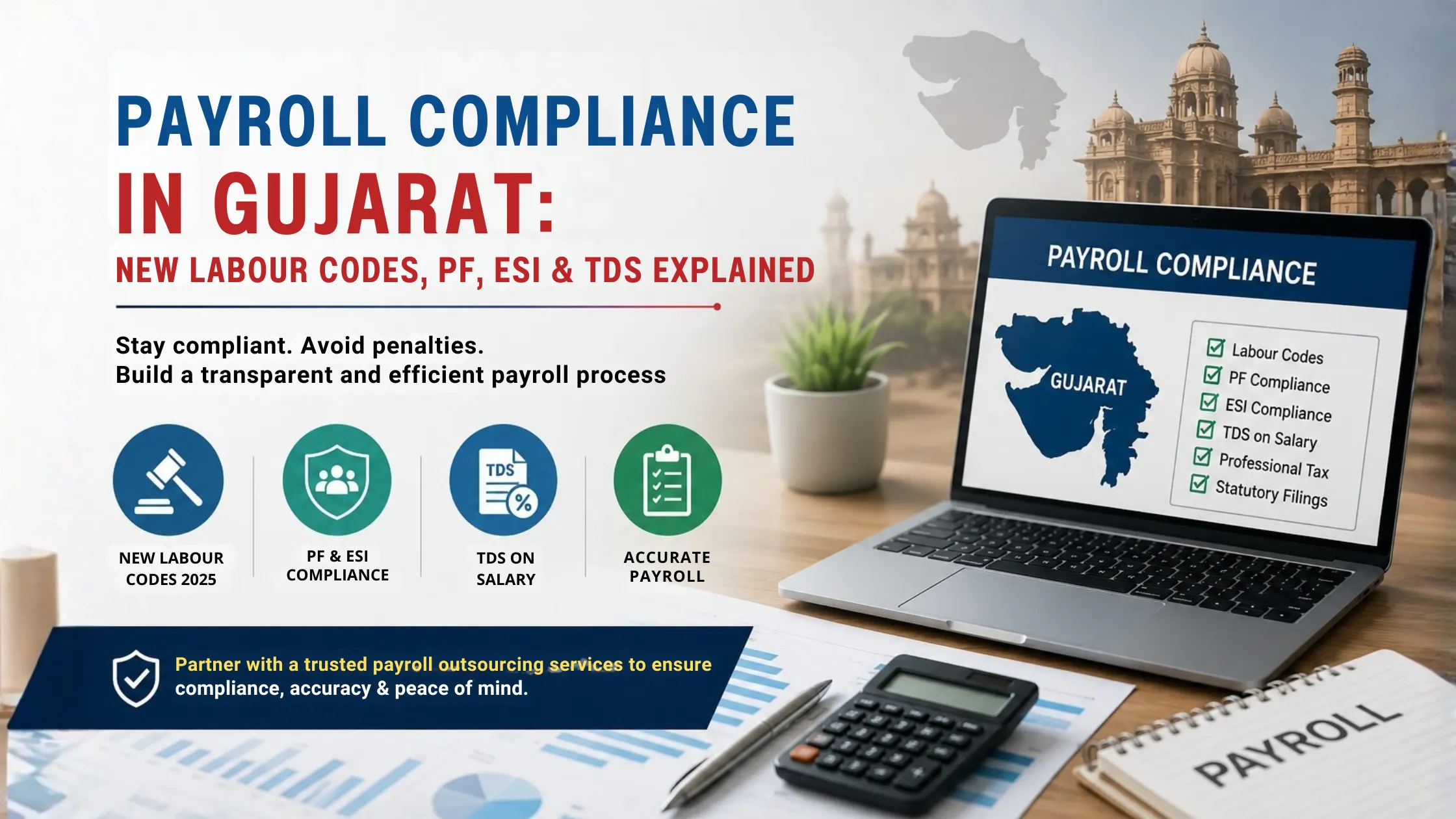
If you run HR, finance, or operations for a manufacturing unit, a plant, or a corporate office in Gujarat, you’ve probably felt it this year — payroll compliance stopped being routine. The four new Labour Codes, which consolidate 29 separate central labour laws, came into force on 21 November 2025, and the Central Government notified the final Central Rules in May 2026. Gujarat moved faster than most states, notifying its own rules across all four codes early in the transition. That means Gujarat employers aren’t waiting for a “future date” to comply — the compliance clock is already running.
For HR managers, factory owners, and procurement teams, this raises a practical question: how do you keep PF, ESI, gratuity, and TDS calculations accurate when the underlying wage definitions, thresholds, and contribution rules have all shifted at once? This is exactly where reliable payroll outsourcing services earn their keep — turning a moving regulatory target into a predictable, audit-ready monthly process.
This guide walks through what’s changed under the new Labour Codes, how PF, ESI, and TDS are affected, where Gujarat-specific rules add extra complexity, and why so many businesses across Ahmedabad, Vadodara, Surat, and Gandhidham are now outsourcing payroll rather than managing it in-house.
Gujarat’s implementation of India’s four new Labour Codes is changing how businesses approach payroll compliance, from the definition of “wages” to requirements involving PF, ESI, gratuity, and TDS. This guide explains the key changes, ongoing transition areas, and what HR and finance teams need to review. It also explores why businesses across Ahmedabad, Vadodara, Surat, and Gandhidham are increasingly considering professional payroll outsourcing services to manage statutory compliance accurately without expanding their in-house payroll teams.
Why Payroll Compliance in Gujarat Just Got More Complicated
For decades, Indian payroll ran on a patchwork of separate laws — the Payment of Wages Act, the Minimum Wages Act, the EPF & Miscellaneous Provisions Act, the ESI Act, the Payment of Bonus Act, and dozens of others, each with its own definitions and thresholds. The four new Labour Codes were meant to simplify this by folding those 29 laws into a single framework: the Code on Wages, the Industrial Relations Code, the Code on Social Security, and the Occupational Safety, Health and Working Conditions (OSH) Code.
In practice, “simplification” has meant a transition period where employers must run two mental models at once — the old compliance logic they’re used to, and the new one that’s now legally in force. Gujarat has been one of the more proactive states in notifying its rules, which is good news for legal clarity but means Gujarat employers can’t afford to lag on implementation the way businesses in slower-moving states might.
For a facility management and manpower company like ours, working across security staffing, housekeeping teams, and payroll outsourcing, this shift touches almost every client conversation right now — because payroll errors under the new codes don’t just mean a wrong number on a payslip. They mean PF shortfalls, ESI non-compliance, and gratuity miscalculations that surface months later as penalties.
The New Labour Codes: What Actually Changed
Here’s the practical summary HR teams need, without the legal jargon:
- Code on Wages, 2019 — Standardises how “wages” is defined across PF, gratuity, and bonus calculations. This is the single biggest driver of payroll changes.
- Industrial Relations Code, 2020 — Raises the threshold for standing orders and prior government permission for retrenchment/closure from 100 to 300 workers in many cases, and formally recognises fixed-term employment.
- Code on Social Security, 2020 — Overhauls PF, ESI, gratuity, and maternity benefit administration, and extends social security cover to gig and platform workers.
- OSH Code, 2020 — Consolidates safety, health, and working-conditions rules, including provisions that permit longer daily working hours in exchange for a shorter working week, subject to state notification.
Gujarat has notified state-specific rules under the Code on Social Security, including the Code on Social Security (Gujarat) (Amendment) Rules, 2026, which reduced the continuous-service requirement for gratuity eligibility for certain fixed-term categories and introduced faster compensation timelines for workplace injury cases. If your payroll or HR policies haven’t been updated to reflect these Gujarat-specific amendments, you’re likely non-compliant without realising it.
The New Wage Definition — And Why It Breaks Old CTC Structures
This is the change that quietly affects every other calculation. Under the Code on Wages, “wages” now means all remuneration paid to an employee, except a defined list of exclusions — HRA, overtime, conveyance, commission, bonus, gratuity, and a few others. Critically, those exclusions together cannot exceed 50% of an employee’s total remuneration.
In plain terms: if your company has historically structured CTC with a low basic pay and large allowances to keep PF and gratuity contributions down, that structure no longer holds up. The “wages” figure used for PF and gratuity calculations must now be at least 50% of total CTC — and for many companies, that pushes statutory contributions up by 3–4% of gross payroll cost.
This single change is why so many Gujarat employers are re-running their CTC structures this year. Get it wrong, and you’re either under-contributing to PF (a compliance risk) or overpaying without adjusting your budgeting (a cost-control problem).
PF (Provident Fund) Under the New Regime
Provident Fund remains mandatory for establishments with 20 or more employees, administered through EPFO, but three things have changed the way it’s calculated and reported:
- Wage base recalculation. Because “wages” now must equal at least 50% of CTC, PF contributions (12% from employer, 12% from employee on wages up to the statutory ceiling) are often calculated on a higher base than before.
- Gratuity eligibility for fixed-term employees. Under Gujarat’s amended Social Security Code rules, the continuous-service threshold for gratuity has been reduced for certain fixed-term workers — meaning payroll systems need to track service periods differently than under the older five-year rule.
- Digital compliance and reconciliation. EPFO’s return filing and UAN-linked tracking is increasingly matched against GST and Income Tax filings, so mismatches between declared wages across filings now surface faster than they used to.
For plant managers and factory owners running contract labour alongside permanent staff, this is where errors compound quickest — because contract workers’ PF often gets tracked by a third-party contractor whose records don’t match your own.
ESI Compliance: What Employers in Gujarat Must Track
ESI (Employees’ State Insurance) applies to establishments with 10 or more employees (in most states, including factories and many commercial establishments in Gujarat) where covered employees earn up to the notified wage ceiling. Under the Code on Social Security, ESI’s coverage logic has been extended in two directions relevant to Gujarat employers:
- Broader establishment coverage, including hazardous industry categories and, in a phased manner, gig and platform workers through a new Social Security Fund.
- Contribution rates remain at the familiar structure (employer and employee shares on gross wages up to the ESI ceiling), but because the underlying wage definition has changed, the wages used to calculate ESI contributions may now differ from what many payroll teams have been using.
For factories and plants running multiple shifts with contract housekeeping or security staff, ESI compliance is frequently where audits find gaps — not because employers are avoiding it, but because contract manpower records and in-house payroll records aren’t reconciled monthly.
TDS on Salaries: Where Payroll Teams Still Get It Wrong
TDS under Section 192 of the Income Tax Act hasn’t been restructured by the Labour Codes — but it’s directly affected by the wage and CTC changes described above, in three common ways:
- Reclassified components. When allowances are restructured to meet the 50% wages rule, some previously tax-exempt components may shift into taxable salary, changing monthly TDS.
- New/old tax regime declarations. Employees must declare their regime choice, and payroll must apply the correct slab and exemption rules — a step that’s easy to get wrong at scale when CTC structures are also changing mid-year.
- Form 16 and quarterly TDS return accuracy. Any restructuring mid-financial-year needs careful handling to avoid mismatches between Form 24Q filings and actual salary paid, which is a common trigger for income tax notices to the employer.
Getting TDS wrong isn’t just an employee-relations problem (unhappy staff over incorrect deductions) — it’s a compliance exposure for the company when quarterly returns don’t reconcile with actual disbursements.
Gujarat-Specific Compliance Points Employers Miss
Beyond the four Labour Codes, Gujarat employers still need to track state-specific obligations that often get overlooked:
- Gujarat Shops and Establishments Act amendments (2026) — updated working hour, overtime, and night-shift conditions, including safeguards for women working night shifts, which HR policies must reflect.
- Gujarat minimum wage and Variable Dearness Allowance (VDA) revisions — updated periodically (typically April–June and October–December cycles), and payroll must apply the correct zone-wise and skill-category rate.
- Professional Tax — a Gujarat-specific deduction that’s separate from central payroll obligations but must still be processed correctly every month.
- Labour Welfare Fund contributions and statutory register maintenance, increasingly checked through digitised labour inspections.
Because labour is a concurrent subject, Gujarat’s own notifications can move ahead of or differ from central guidance — which is exactly why a payroll process built only around central rules eventually falls out of step with state requirements.
In-House Payroll vs. Outsourced Payroll: A Practical Comparison
| Factor | In-House Payroll Team | Outsourced Payroll Services |
|---|---|---|
| Tracking Labour Code & Gujarat rule changes | Falls on internal HR/finance, often reactive | Dedicated compliance team tracks central and Gujarat-specific updates |
| PF, ESI, TDS accuracy under new wage rules | Higher risk of miscalculation during CTC restructuring | Wage base, PF, ESI, and TDS recalculated systematically |
| Cost predictability | Fixed salary + software + training costs, regardless of volume | Scales with headcount; lower fixed overhead |
| Handling contract & multi-site staff | Difficult to reconcile across locations manually | Centralised processing across Ahmedabad, Baroda, Surat, Gandhidham sites |
| Audit and inspection readiness | Documentation often scattered across departments | Statutory registers and filings maintained audit-ready |
| Response to sudden regulatory change | Slower — requires internal upskilling or legal consultation | Faster — compliance updates built into existing processes |
Neither approach is “wrong” in principle — but for growing or multi-location businesses, the compliance burden of the new Labour Codes tips the balance meaningfully toward outsourcing, at least for the next few years while state rules continue to evolve.
Why Businesses in Ahmedabad, Baroda, Surat & Gandhidham Are Outsourcing Payroll
Gujarat’s industrial geography means compliance isn’t uniform — a factory in Gandhidham dealing with port-linked logistics labour has different staffing patterns than a corporate office in Ahmedabad or a manufacturing unit in Surat’s textile belt. That’s part of why demand for payroll services in Ahmedabad, payroll services in Baroda, payroll services in Surat, and payroll outsourcing in Gandhidham has grown steadily since the Labour Codes came into force — businesses want one accountable partner who understands both the central framework and Gujarat’s own notifications, rather than trying to interpret both internally.
A good payroll outsourcing company doesn’t just process salaries — it should also handle statutory registrations, PF/ESI filings, TDS deductions and returns, minimum wage and VDA updates, and full documentation for labour inspections. For plant managers and factory owners already stretched across production, safety, and staffing, that’s a meaningful reduction in operational risk.
How Ardent Facilities Manages Payroll Compliance for You
Ardent Facilities has supported payroll compliance for manufacturing, corporate, and institutional clients across Gujarat for several years, alongside our security, housekeeping, and manpower supply services. Our payroll outsourcing approach is built specifically around the realities of the new Labour Codes:
- CTC structures reviewed and realigned to the 50% wage-definition rule
- PF and ESI contributions recalculated on the correct wage base, with monthly reconciliation
- TDS deductions applied accurately against updated salary structures and employee regime declarations
- Gujarat-specific obligations — minimum wage/VDA updates, Professional Tax, Labour Welfare Fund, Shops and Establishments compliance — tracked and applied without manual follow-up
- Statutory registers and filings maintained in an audit-ready format at all times
- Coordination with our manpower and contract labour teams so contract staff payroll reconciles with your in-house records
Whether you need full payroll outsourcing or support restructuring your compliance process around the new codes, our team works directly with your HR and finance departments to remove the guesswork.
Conclusion
The new Labour Codes haven’t just added paperwork — they’ve changed the underlying math behind PF, ESI, gratuity, and TDS calculations, and Gujarat’s early adoption of state rules means local employers are already living with these changes. Getting payroll wrong in this environment isn’t a minor administrative slip; it’s a direct compliance and financial risk. For HR managers, factory owners, and operations leaders across Ahmedabad, Baroda, Surat, and Gandhidham, professional payroll outsourcing services offer a practical way to stay compliant without pulling internal teams away from their core responsibilities.
Not sure if your current payroll structure holds up under the new Labour Codes? Talk to Ardent Facilities’ payroll compliance team for a free review of your PF, ESI, and TDS setup — and see how our payroll outsourcing services can take the compliance burden off your HR and finance teams. Contact us today to get started.
FAQs
Q1. Are the new Labour Codes fully applicable in Gujarat right now?
Yes, largely. The four Labour Codes came into force nationally on 21 November 2025, and Gujarat was among the earlier states to notify its own rules across all four codes. Employers in Gujarat should treat the codes as active compliance obligations, not future changes.
Q2. Does the new wage definition affect every employee's salary structure?
It affects any structure where allowances (HRA, overtime, conveyance, bonus, etc.) exceed 50% of total CTC. If your current structure relies heavily on such allowances, PF and gratuity contributions will likely need to be recalculated on a higher wage base.
Q3. Has the PF contribution rate changed under the new codes?
The statutory contribution rate itself (broadly 12% employer and 12% employee, subject to the wage ceiling) hasn’t changed — what’s changed is the wage base it’s calculated on, due to the new “wages” definition.
Q4. Do fixed-term employees now qualify for gratuity sooner in Gujarat?
Yes. Under Gujarat’s amended Social Security Code rules, the continuous-service requirement for gratuity has been reduced for certain fixed-term employment categories, moving away from the older five-year threshold.
Q5. Is ESI coverage changing for factories and plants in Gujarat?
ESI’s core eligibility thresholds remain broadly similar, but coverage has been extended to additional worker categories, and the wage base used for contributions is affected by the same wage-definition changes that affect PF.
Q6. Why should we consider payroll outsourcing instead of managing this in-house?
Because the compliance landscape is genuinely moving — central rules, Gujarat state rules, minimum wage revisions, and TDS implications are all shifting together. A specialised payroll outsourcing company tracks these changes as its core function, reducing the risk of penalties, incorrect filings, or employee disputes over salary errors.