
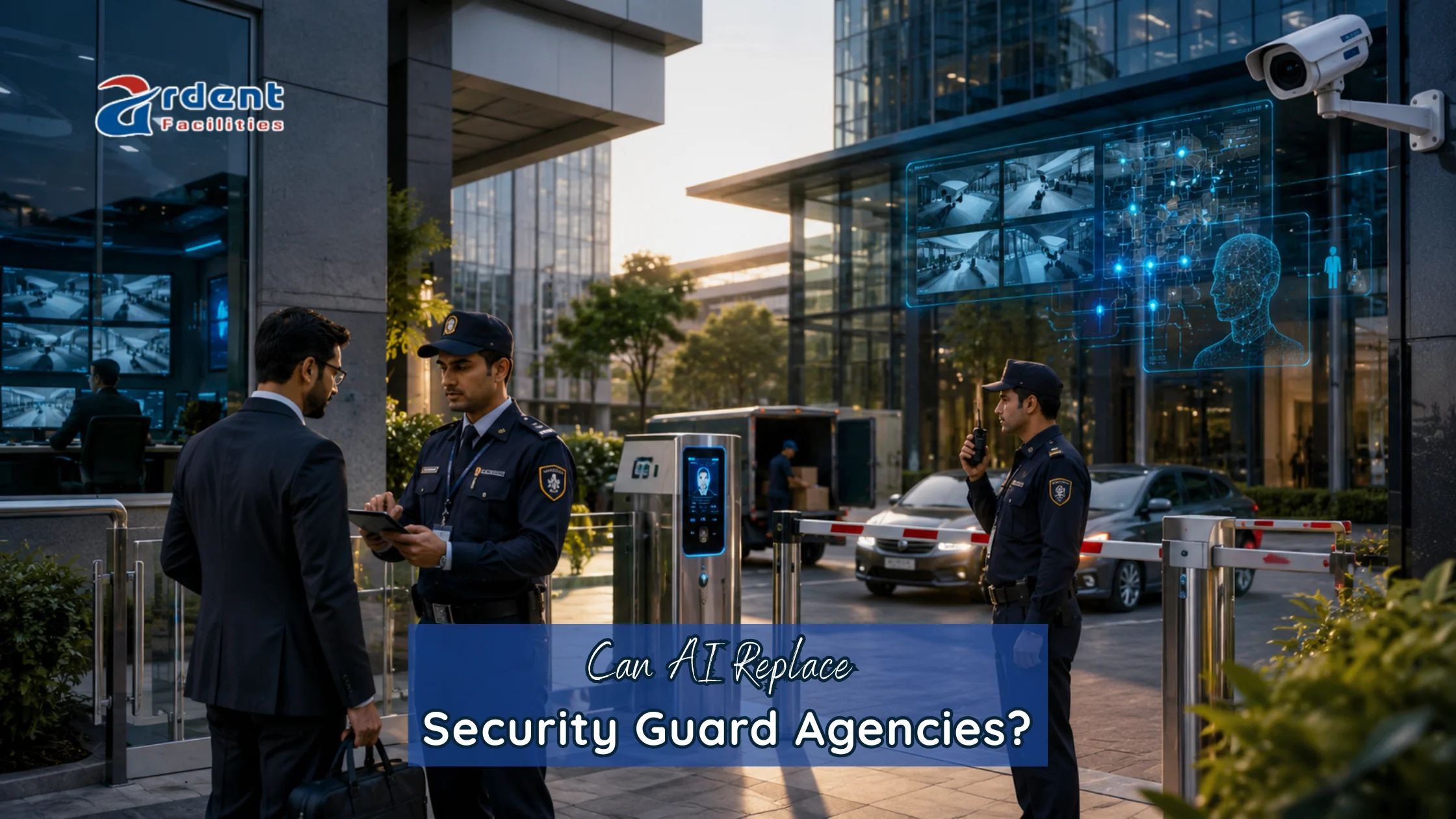
Every few months, a new headline claims that artificial intelligence is about to make human security guards obsolete. Smart cameras can now detect a person loitering near a gate. Facial recognition can flag an unauthorised visitor. Sensors can alert a control room the moment a fence line is breached. For a facility manager evaluating budgets, the pitch is tempting: fewer people, lower payroll, round-the-clock digital vigilance.
But ask any HR manager, plant owner, or admin head who has actually run a factory floor, a warehouse, or a corporate campus, and you’ll hear a different story. Cameras don’t stop a forklift from being driven out the back gate at 2 a.m. Sensors don’t de-escalate an argument between a contractor and a visitor at the reception desk. Software doesn’t physically verify a delivery driver’s ID against a gate pass, and it certainly doesn’t take responsibility when something goes wrong.
This is the real question facing procurement and operations teams in 2026: not “AI or guards,” but where each one belongs, and why a professional security guard agency remains the backbone of a serious risk management plan. This article breaks down what AI genuinely improves, where it consistently fails, and why businesses across Gujarat continue to rely on trained, verified, and supervised security personnel — even as they adopt smarter technology.
QUICK SUMMARY
Artificial intelligence is transforming modern security through smart surveillance, facial recognition, video analytics, and automated monitoring. However, AI cannot replace the human judgment, rapid decision-making, accountability, and on-ground response provided by a professional security guard agency. This guide compares AI and human security across real business scenarios, highlights their strengths and limitations, explains key compliance considerations, and helps organizations in Ahmedabad, Vadodara (Baroda), Surat, and Gandhidham determine the right security strategy for their facilities in 2026.
What “AI Security” Actually Means in 2026
Before comparing AI to human guards, it helps to be precise about what “AI security” covers today. It is not a single product — it’s a set of tools layered onto existing infrastructure:
- Video analytics that flag motion, loitering, or object detection (a bag left unattended, a vehicle parked too long)
- Facial recognition and access control integrated with entry gates and biometric systems
- Sensor-based intrusion detection — thermal cameras, fence vibration sensors, glass-break detectors
- Predictive analytics that use historical incident data to flag “higher-risk” time windows or zones
- Chatbots and AI-based visitor management for logging entries at reception
These tools are genuinely useful. They are not, on their own, a replacement for the function a security guard agency performs, which is fundamentally about presence, judgment, verification, and response — not just detection.
What AI Does Genuinely Well
It’s worth being fair to the technology, because pretending AI adds no value would be dishonest, and it would also miss an opportunity. In our experience deploying hybrid security setups for manufacturing units and corporate offices, AI tools consistently deliver value in a few specific areas:
Continuous, fatigue-free monitoring. A camera doesn’t get tired at 3 a.m. or lose focus during a slow shift. For large perimeters or low-footfall zones, this is a genuine advantage over relying on a single guard to stay alert for eight hours straight.
Faster anomaly flagging. Video analytics can flag an unusual pattern — a vehicle circling a facility multiple times, a person near a restricted zone after hours — far faster than a guard reviewing hours of footage manually.
Data trails for audits and insurance. Timestamped, searchable footage and access logs make it easier to reconstruct an incident, support an insurance claim, or demonstrate compliance during an audit.
Reducing guard workload on repetitive checks. Automated visitor logging and biometric access frees up guards to focus on judgment-heavy tasks instead of manually writing entries in a register.
None of this replaces the guard. It changes what the guard should be doing.
Where AI Falls Short: The Cases That Matter Most
This is the part that gets glossed over in vendor pitches. Here’s where AI systems reliably fail — and where the failures actually cost businesses money, safety, and reputation.
AI cannot physically intervene. A camera can record a theft in progress. It cannot stop it. By the time a control room operator reviews an alert, dispatches someone, and that person arrives, the incident is often over.
AI cannot exercise contextual judgment. A trained guard can tell the difference between a nervous new employee who forgot their ID and someone deliberately avoiding the camera. Facial recognition and rule-based systems struggle with exactly this kind of nuance — and false positives (or false negatives) carry real consequences, from wrongly detaining an employee to missing an actual threat.
AI cannot de-escalate. Altercations between contractors, aggressive visitors, or disputes at a loading dock require a calm, trained human presence. This is a skill set built through training and experience, not something a sensor array offers.
AI cannot verify identity documents, gate passes, or delivery manifests with legal accountability. Someone has to physically check that the person walking in matches the ID they’re presenting, that a delivery truck’s paperwork matches the material being unloaded, and that a departing vehicle isn’t carrying unauthorised goods. This is routine, unglamorous work — and it’s precisely the kind of work that prevents pilferage and unauthorised removal of stock, which remains one of the most common loss categories in Gujarat’s manufacturing and warehousing sector.
AI has no legal or contractual accountability. If a security breach occurs, a camera vendor doesn’t answer to your insurer, your board, or a labour inspector. A licensed security guard agency, operating under a service contract with defined SLAs, does.
AI systems fail without maintenance and connectivity. Power cuts, network downtime, and camera blind spots are routine realities at industrial sites — especially during Gujarat’s monsoon season when connectivity and power reliability both take a hit. A guard on the ground doesn’t stop working because the Wi-Fi went down.
AI vs. Human Security Guards: A Side-by-Side Comparison
| Capability | AI-Based Systems | Trained Security Guards |
|---|---|---|
| Continuous monitoring | Excellent — no fatigue, 24/7 coverage | Good, but requires shift rotation and supervision |
| Physical intervention | None | Immediate, on-site response |
| Contextual judgment | Limited, rule-based | Strong, built on training and experience |
| De-escalation of conflict | Not possible | Core skill of trained personnel |
| Identity/document verification | Partial (biometric only) | Full manual + biometric verification |
| Legal and contractual accountability | None | Backed by agency contract, insurance, SLAs |
| Performance during power/network failure | Fails or degrades | Unaffected |
| Cost structure | High upfront capex, lower marginal cost | Ongoing operational cost, scalable per shift |
| Compliance with labour and statutory norms | Not applicable | Managed by agency (PF, ESI, licensing) |
| Deterrence value | Moderate (visible cameras) | High (visible, uniformed human presence) |
| Adaptability to new situations | Requires reprogramming/retraining models | Adapts in real time |
The pattern is clear: AI strengthens detection and documentation. Guards deliver response, judgment, and accountability. A facility that only has one half of this equation is carrying risk it probably hasn’t priced in.
Why Trained Security Professionals Remain Non-Negotiable
For HR managers and admin heads, the case for trained guards isn’t nostalgia for the old way of doing things — it’s about specific, recurring operational needs that technology hasn’t solved:
Deterrence through visible human presence. Studies on situational crime prevention consistently show that visible, uniformed guards are a stronger deterrent than cameras alone, because a camera only records — a guard can act.
Emergency response. Fire evacuations, medical emergencies, and workplace accidents all require immediate human coordination — directing people to exits, administering first aid, coordinating with emergency services. No AI system does this.
Vendor, contractor, and visitor management. Facilities with high daily footfall — factories, warehouses, corporate parks — need someone physically verifying and logging every non-employee who enters. This is a compliance requirement as much as a safety one.
Night shift and low-footfall coverage. This is where incidents are statistically more likely, and precisely where human presence matters most, because response time is critical and AI-only setups have no one to dispatch.
Building relationships with local law enforcement and quick-response teams. An experienced security guard agency typically has established coordination protocols with local police stations — something no software vendor offers.
The Real Cost of Under-Securing a Facility
Businesses that cut guard strength in favour of an AI-only setup often underestimate the downstream cost of a single serious incident: stock loss, equipment theft, safety violations leading to regulatory penalties, insurance claim disputes (insurers frequently ask whether a licensed security provider was contracted), and reputational damage with clients who audit vendor facilities before placing orders. For manufacturing units supplying to larger corporates, having a professional, verifiable security guards service in place is increasingly a vendor qualification requirement, not just an internal preference.
The Compliance Angle: Why a Licensed Security Guard Agency Matters
Security staffing in Gujarat isn’t just an operational decision — it’s a regulatory one. A registered security guard agency operating under the Private Security Agencies (Regulation) Act (PSARA) ensures:
- Guards are police-verified and background-checked before deployment
- Statutory compliance on PF, ESI, minimum wages, and labour welfare for deployed personnel
- Proper documentation for contract labour under the Contract Labour (Regulation & Abolition) Act
- Trained personnel in fire safety, first aid, and emergency protocols
- Clear contractual accountability if an incident occurs on your premises
Businesses that deploy unverified guards through informal channels — or attempt to substitute trained staff entirely with technology — expose themselves to compliance risk that has nothing to do with security itself and everything to do with labour law liability.
What the Best Security Guard Agencies Do in 2026 (Hybrid Model)
The agencies delivering real value today aren’t choosing between AI and human guards — they’re integrating both. A modern security guards service typically combines:
- Trained, verified guards stationed at entry points, sensitive zones, and patrol routes
- CCTV and video analytics feeding a central control room for faster incident detection
- Biometric access control paired with manual verification for high-security areas
- Digital shift logs, incident reporting, and patrol tracking (via QR-code checkpoints or apps) for accountability
- Regular training refreshers covering fire safety, conflict de-escalation, and evolving threat scenarios
This hybrid model gives businesses the best of both: the coverage and data AI provides, and the judgment, response, and accountability that only trained people deliver.
How to Evaluate a Security Guard Agency Before You Sign
For procurement and admin teams comparing vendors, a few questions separate a serious agency from a low-cost placement service:
- Is the agency PSARA-licensed for the state you’re operating in?
- Are guards police-verified with documented background checks?
- Does the agency handle statutory compliance (PF, ESI, minimum wages) directly, or does that liability fall back on you?
- What training do guards receive — fire safety, first aid, conflict management?
- Does the agency offer supervisory visits and audits, or just deploy and disappear?
- Can they scale guard strength for your site across shifts, including night and weekend coverage?
- Do they integrate with your existing CCTV/access control systems, or work in isolation?
A security guard agency that can’t answer these clearly is a staffing risk, not a security solution.
Security Guards in Ahmedabad, Baroda, Surat, and Gandhidham: Regional Considerations
Security needs vary meaningfully across Gujarat’s industrial hubs, and a facility management partner with local depth matters more than a national brand name with no regional presence.
Security Guards in Ahmedabad — With its mix of manufacturing units, corporate parks, and warehousing zones (GIDC areas, Odhav, Naroda, Vatva), Ahmedabad facilities typically need a combination of perimeter security, material gate checks, and reception-level access control, especially for units supplying to larger OEMs with vendor audit requirements.
Security Guards in Baroda — Vadodara’s concentration of chemical, engineering, and process industries means guard deployments often need to account for hazardous material zones, restricted access areas, and coordination with plant safety protocols — not just general perimeter duty.
Security Guard in Surat — With its dense textile and diamond processing industry, high-value inventory and cash-handling zones in Surat demand guards trained specifically in material verification and high-footfall access control, particularly around shift changes.
Security Guard in Gandhidham — As a port-adjacent logistics and warehousing hub, Gandhidham facilities typically prioritise cargo verification, gate audit trails, and coordination with transport documentation — areas where a guard’s manual verification skill is irreplaceable.
A regionally established security guard agency understands these differences and staffs accordingly, rather than applying a one-size-fits-all deployment plan.
Conclusion
AI has genuinely improved how facilities detect risk and document incidents — and any business ignoring that is leaving value on the table. But detection is not the same as response, and data is not the same as judgment. The businesses making the smartest security decisions in 2026 aren’t asking whether to choose AI or a security guard agency — they’re combining both, using technology to extend visibility while relying on trained, verified professionals for the presence, verification, and accountability that no algorithm can provide. For facilities across Ahmedabad, Baroda, Surat, and Gandhidham, that hybrid approach isn’t just safer — it’s what compliance, insurers, and increasingly, your own clients now expect.
Call to Action
Looking for a licensed, PSARA-compliant security guard agency that pairs trained personnel with smart monitoring? Ardent Facilities has been deploying verified security professionals across Ahmedabad, Baroda, Surat, and Gandhidham since 2000. Contact us today for a facility risk assessment and a customised security deployment plan.
FAQs
Q1. What is included in payroll outsourcing services for contract staff?
Payroll outsourcing services typically include salary processing, statutory deductions (PF, ESI, PT), challan filing, wage register maintenance, bonus and gratuity computation, and compliance documentation — all managed on behalf of the principal employer or contractor.
Q2. Is the principal employer liable if a contractor fails to deposit PF for contract staff?
Yes. Under the Contract Labour (Regulation and Abolition) Act, the principal employer carries a fallback obligation to ensure wages and, in practice, statutory dues are paid, and can be held jointly accountable if the contractor defaults.
Q3. Are contract workers entitled to bonus and gratuity?
If contract workers meet the eligibility conditions under the respective Acts — such as minimum working days for bonus, or continuous service for gratuity — their contractual status alone does not exclude them from these entitlements.
Q4. How often do PF and ESI contribution rates change?
ESI rates and PF wage ceilings are revised periodically by the respective statutory bodies. A payroll outsourcing partner tracks these revisions so contributions are always calculated at the current applicable rate.
Q5. Why do companies in Gujarat prefer outsourcing payroll for contract staff instead of managing it in-house?
Because contract staff payroll compliance spans multiple central and state laws with overlapping deadlines and region-specific variations (Ahmedabad, Vadodara, Surat, Gandhidham), outsourcing to a specialized payroll outsourcing company reduces both the administrative burden and the statutory risk exposure for the principal employer.
Q6. What documents should we ask our payroll or manpower vendor for every month?
At minimum: PF ECR and payment challan, ESI contribution challan, Professional Tax deposit proof, and an updated wage/attendance register for contract staff deployed at your site.