
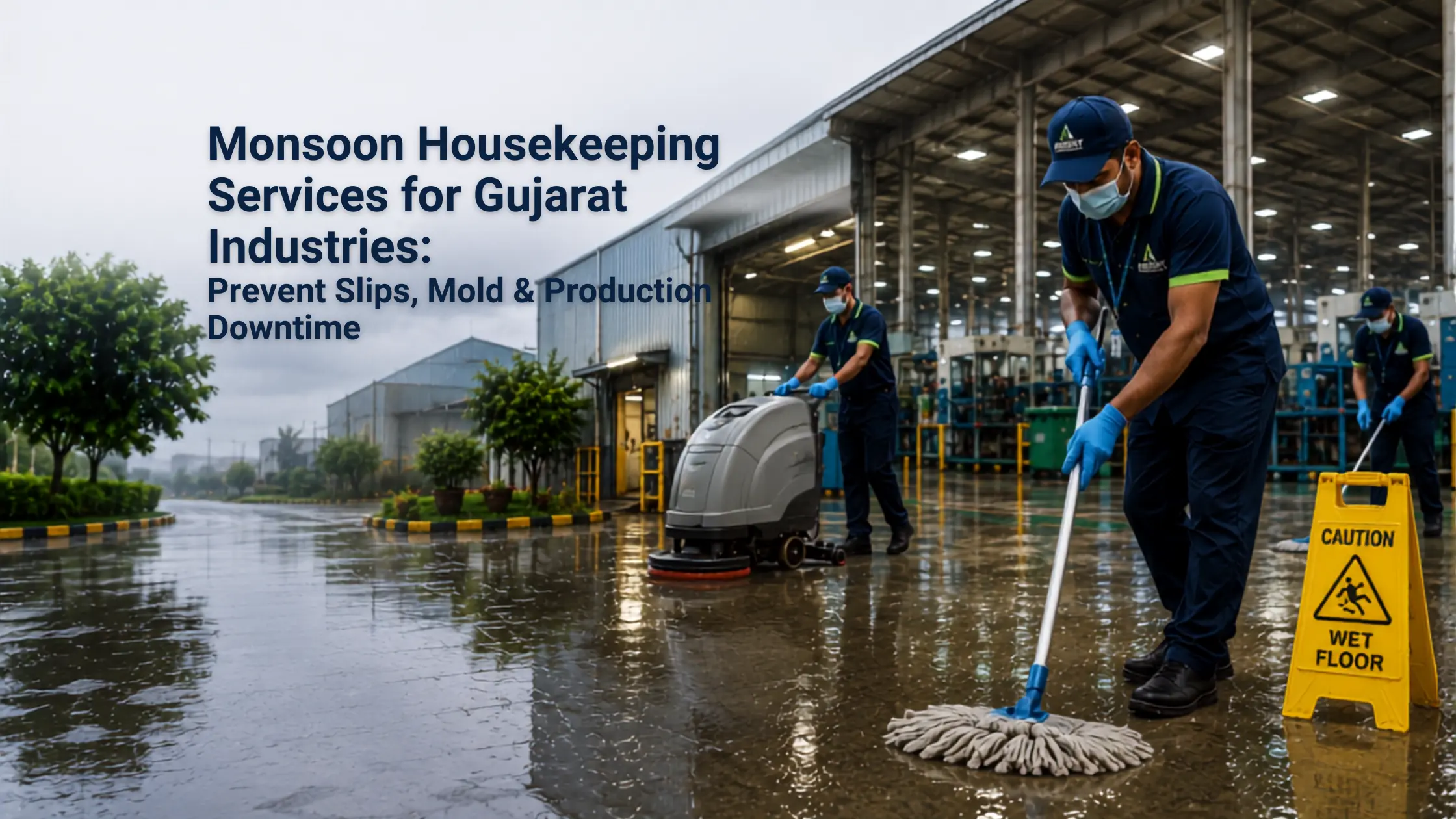
Every facility manager in Gujarat knows the feeling. The first heavy rain of the season hits, and within a day, the entry lobby has a puddle near the door, the warehouse floor near the loading dock turns slick, and by the second week, someone notices a musty smell near the stored raw material or archived files. None of this is bad luck. It’s what happens when a facility’s housekeeping plan hasn’t been rebuilt for the season.
Housekeeping Services that work well in the dry months — daily sweeping, occasional mopping, weekly deep cleaning — simply aren’t built for June through September in Gujarat. Humidity levels in Surat and Vadodara routinely cross 80%, Ahmedabad sees sudden waterlogging near industrial zones, and Gandhidham’s coastal air adds salt-driven corrosion and moisture into the mix. A housekeeping team that isn’t specifically briefed and equipped for this shift will always be one step behind — reacting to slip incidents, mold complaints, and machine downtime instead of preventing them.
This guide is written for the people who actually carry that risk on their shoulders: HR managers signing off on safety audits, plant heads answering to corporate on downtime, and procurement teams deciding whether to renew a housekeeping vendor for another year. We’ll walk through what monsoon-specific housekeeping actually requires, what happens when it’s skipped, and how to evaluate whether your current setup — in-house or outsourced — is actually ready for the next three months of rain.
QUICK SUMMARY
The monsoon season in Gujarat creates significant challenges for factories, warehouses, commercial buildings, and corporate offices, including slippery floors, excess moisture, mold growth, clogged drainage systems, and higher workplace safety risks. Standard cleaning routines are often inadequate during this period. This guide explains how professional Housekeeping Services help businesses strengthen monsoon cleaning protocols, prevent accidents, protect inventory and production areas, and maintain workplace compliance. Designed for HR managers, plant heads, facility managers, and procurement teams across Ahmedabad, Vadodara, Surat, and Gandhidham, it outlines practical strategies for keeping facilities safe, hygienic, and operational throughout the 2026 monsoon season.
Why Monsoon Changes Everything for Facility Housekeeping
Monsoon isn’t just “more cleaning.” It changes the type of risk a facility faces.
In dry months, the primary housekeeping concerns are dust accumulation, general hygiene, and appearance. In monsoon, the concerns shift to moisture control, slip prevention, material protection, and pest management — each of which, if mishandled, has a direct line to either a safety incident or a production loss.
A few specific shifts worth understanding:
Floors stay wet far longer than staff expect. Standard mopping routines assume floors dry within 20–30 minutes. During monsoon, with humidity above 75%, the same floor can stay damp for over an hour, especially in poorly ventilated warehouse corners. That extended wet window is exactly when most slip-and-fall incidents happen — not during the mopping itself, but 40 minutes after, when the “wet floor” sign has been removed but the surface hasn’t actually dried.
Mold doesn’t wait for visible dampness. Mold spores begin colonizing surfaces once relative humidity crosses roughly 70% for 48 hours, well before any visible water damage appears. By the time staff notice a musty smell or discoloration on a wall or stored carton, the mold has usually been growing for one to two weeks. This matters enormously for facilities storing raw material, finished goods, paper records, or textiles — all common in Gujarat’s manufacturing and export sector.
Drainage failures compound quickly. A blocked stormwater drain or roof gutter that would be a minor issue in December becomes a flooding risk in July. Housekeeping teams that only clean inside the building miss this entirely, yet blocked external drainage is one of the top causes of monsoon-related facility shutdowns in industrial estates across Ahmedabad and Vadodara.
Standard cleaning chemicals lose effectiveness. Many general-purpose floor cleaners aren’t formulated to cut through the combination of mud, oil residue, and standing water tracked in during monsoon. Facilities using the same chemical stock year-round often end up with floors that look clean but remain hazardously slick.
The Real Cost of Ignoring Monsoon-Specific Housekeeping
For a facility manager building a business case internally, the cost argument is straightforward once you break it down.
Production downtime. A single slip-and-fall incident on a factory floor typically triggers an internal investigation, a safety stand-down on that line, and in many cases a temporary shutdown while corrective action is documented. Even a two-hour halt on a manufacturing line has a direct output cost, before factoring in any compensation claim.
Compliance exposure. Under the Factories Act and state-specific labour welfare provisions, employers carry a duty of care for workplace safety, which extends to maintaining safe, non-hazardous flooring and working conditions. A documented slip incident during an inspection or audit — especially one traceable to a known, unaddressed wet-floor pattern — creates liability that’s hard to explain away.
Inventory and asset damage. Mold-damaged raw material, corroded machine parts, or water-damaged paper records and files are a recurring monsoon loss category for Gujarat manufacturers, particularly those storing goods in older or semi-industrial buildings without climate control.
Reputational cost with clients and auditors. For export-oriented units in Surat’s textile sector or Vadodara’s chemical and engineering belt, a facility that looks poorly maintained during a client site visit — visible damp patches, musty odor, cluttered wet-weather entry areas — undermines confidence during exactly the season when many annual audits and buyer visits happen.
Staff attrition and morale. Housekeeping and floor staff working in facilities with poor monsoon protocols face higher physical strain — constant re-mopping, slip risk to themselves, and frustration with inadequate equipment. This shows up as higher absenteeism and turnover in the very team you’re relying on to manage the season.
What Monsoon-Ready Housekeeping Services Actually Include
A genuinely monsoon-prepared housekeeping program looks noticeably different from a standard contract. Here’s what should change in the scope of work between March and June each year.
Entrance and transition zone management. High-absorbency floor mats, extended mat runners, and umbrella bagging stations at every entry point, checked and wrung out on a fixed hourly schedule rather than “as needed.”
Wet-floor protocol with time-based checks. Rather than a single sign placed after mopping, a monsoon protocol requires staff to physically re-check flooring at set intervals — commonly every 30–45 minutes in high-footfall zones — until the floor is verified dry, not just visually assessed.
Dehumidification in storage and archive areas. Warehouses, raw material stores, and document rooms need active humidity monitoring, with dehumidifiers or improved ventilation triggered once levels cross a defined threshold, rather than waiting for visible mold.
Drain, gutter, and stormwater line clearing. This should be scheduled as a distinct, documented task — not folded vaguely into “general maintenance” — with a named responsible party and a completion log.
Anti-slip treatment for high-risk flooring. Loading docks, ramps, and tiled walkways benefit from anti-slip coating or matting reapplied ahead of monsoon, not mid-season after an incident.
Pest control intensification. Monsoon is peak season for mosquito breeding and rodent activity seeking dry shelter; housekeeping and pest control schedules should tighten in step, particularly around waste storage and drainage points.
PPE and equipment upgrades for housekeeping staff. Non-slip footwear, waterproof gloves, and properly rated wet-vacuum equipment reduce both staff injury risk and cleaning time — an upgrade many in-house teams postpone due to budget cycles that don’t account for seasonal equipment needs.
In-House vs. Outsourced Housekeeping During Monsoon: A Practical Comparison
Many facility and HR teams reach a natural decision point every monsoon: manage the seasonal ramp-up with existing in-house staff, or bring in a specialized outsourced housekeeping partner. Here’s how the two approaches typically compare on the factors that matter most during this specific season.
| Factor | In-House Housekeeping Team | Outsourced Housekeeping Services (Ardent Facilities) |
|---|---|---|
| Monsoon-specific training | Usually generic cleaning training only; seasonal risks rarely formalized | Staff trained specifically on wet-floor protocols, mold prevention, and monsoon SOPs |
| Staffing during peak absence season | Vulnerable to attrition and monsoon-related sick leave with no backup pool | Backed by a manpower supply network that provides substitute staff within hours |
| Equipment readiness | Dehumidifiers, wet-vacuums, and anti-slip tools often bought reactively after an incident | Equipment and consumables provisioned proactively ahead of monsoon onset |
| Compliance documentation | Wet-floor checks and drain-clearing often undocumented, weak in audits | Logged, time-stamped checklists available for safety audits and client visits |
| Cost structure | Fixed payroll cost regardless of seasonal workload, plus reactive expense spikes | Scalable scope — intensity increases for monsoon months, normalizes afterward |
| Supervision and accountability | Housekeeping often reports informally through admin, with no dedicated QC | Dedicated site supervisor with defined KPIs and regular client reporting |
| Response to incidents | Ad hoc; corrective action often only after a complaint or accident | Preventive protocol reduces incident frequency; faster corrective response when needed |
Neither model is inherently wrong — many well-run facilities do maintain strong in-house teams. The gap usually isn’t effort, it’s specialization: an in-house team managing five other responsibilities rarely has the bandwidth to build and enforce a season-specific protocol the way a dedicated facility management partner does.
City-Specific Monsoon Risks: Ahmedabad, Vadodara, Surat, Gandhidham
Gujarat’s monsoon doesn’t behave identically across its industrial hubs, and Housekeeping Services should reflect that.
Housekeeping Services in Ahmedabad need to account for the city’s flash flooding pattern in industrial belts like Naroda, Odhav, and Vatva, where drainage infrastructure is often older and stormwater backup is a recurring issue. Facilities here benefit most from aggressive external drain-clearing schedules and elevated entry matting.
Housekeeping Services in Vadodara face a mix of industrial and chemical-belt humidity, particularly around Manjalpur and the GIDC estates, where combined moisture and chemical residue on floors demands specific, compatible cleaning chemical selection — not just more frequent mopping.
Housekeeping Services in Surat deal with textile and diamond industry facilities where fabric, thread, and paper-based inventory are highly mold-sensitive. Warehousing and storage-area humidity control is the top priority here, more than general floor safety alone.
Housekeeping Services in Gandhidham contend with coastal humidity and salt-laden air on top of monsoon rain, accelerating corrosion on metal fixtures and requiring more frequent equipment and railing maintenance alongside standard cleaning.
A generic, one-size-fits-all housekeeping contract rarely accounts for these differences — but a partner already operating across all four cities typically has the on-ground experience to adapt the protocol by location rather than applying the same checklist everywhere.
Building a Monsoon Housekeeping Checklist for Your Facility
If you’re auditing your own facility’s readiness this season, these are the questions worth asking your housekeeping team or vendor directly:
- Is there a documented, time-stamped wet-floor check schedule, or just a sign placed after mopping?
- Has entry matting capacity been increased for the season, and is it being wrung out on a fixed schedule?
- Are storage and archive areas being monitored for humidity, not just visually inspected for mold?
- Is external drain and gutter clearing scheduled as its own task with a named responsible person?
- Do housekeeping staff have monsoon-appropriate footwear and equipment?
- Has pest control frequency increased in step with the season?
- Is there a backup staffing plan if regular housekeeping staff are absent due to monsoon-related illness or transport disruption?
If more than two or three of these don’t have a confident “yes,” your facility likely has real exposure this season.
How to Choose a Housekeeping Partner for Monsoon Readiness
For facility, HR, and procurement teams evaluating or re-evaluating a housekeeping vendor ahead of monsoon, a few questions separate genuinely prepared partners from generic ones:
Ask for their monsoon-specific SOP, not just their general scope of work — a vendor who can produce a written, season-adjusted protocol has clearly done this before. Ask how they handle staff absenteeism during heavy rain weeks, since backup staffing capacity matters more in July than in December. Ask whether their supervision includes documented checklists you can use for your own safety audits or ISO compliance records. And ask whether pricing reflects genuine seasonal scope changes, or whether “monsoon readiness” is just a line item with no real operational difference behind it.
An experienced facility management partner with ISO 9001:2015 certification and a multi-year track record across Gujarat’s industrial and corporate sector — like Ardent Facilities — typically has already refined these protocols across hundreds of site-months of monsoon experience, which is difficult for a newly formed vendor or a stretched in-house team to replicate quickly.
Conclusion
Monsoon doesn’t create new housekeeping problems out of nowhere — it exposes the gaps that were already there in a facility’s cleaning and safety protocol, just faster and more visibly than any other season. A wet-floor sign left up too long, a storage room that hasn’t been checked for humidity, a drain that hasn’t been cleared since last year — these are small oversights in December that become safety incidents, compliance exposure, and production downtime in July.
The facilities that get through monsoon without disruption aren’t the ones with the biggest housekeeping budgets. They’re the ones running a genuinely season-adjusted protocol, with documented checks, trained staff, and a backup plan for the inevitable absenteeism spike. Whether that’s built in-house or through an experienced Housekeeping Services partner, the same principle holds: monsoon readiness has to be planned in advance, not managed reactively once the rain starts.
Call To Action
If your facility’s housekeeping protocol hasn’t been reviewed for this monsoon season, now is the time. Ardent Facilities provides monsoon-ready Housekeeping Services across Ahmedabad, Vadodara, Surat, and Gandhidham, backed by ISO 9001:2015 certified processes and over two decades of on-ground facility management experience. Contact our team for a free monsoon readiness assessment of your site.
FAQs
Q1: What makes monsoon housekeeping different from regular housekeeping services?
Monsoon housekeeping shifts the focus from general cleanliness to active risk prevention — extended wet-floor monitoring, humidity control in storage areas, drain and gutter clearing, and pest control intensification, all scheduled and documented rather than handled reactively.
Q2: How often should floors be checked during monsoon in a factory or warehouse?
High-footfall and high-risk zones like entrances, loading docks, and ramps should be physically checked every 30 to 45 minutes during active rain, not just marked with a sign after mopping and left unchecked.
Q3: Can outsourced housekeeping services really reduce workplace slip incidents?
Yes, when the provider follows a documented monsoon protocol with time-based wet-floor checks, upgraded matting, and anti-slip flooring treatment, incident frequency typically drops noticeably compared to ad hoc, undocumented cleaning schedules.
Q4: Is mold prevention really a housekeeping responsibility, or is it a building maintenance issue?
It’s both, but housekeeping plays the frontline role — humidity monitoring, timely drying, and ventilation checks in storage and archive areas are day-to-day housekeeping tasks that prevent mold from establishing before it becomes a maintenance-level problem.
Q5: Do housekeeping costs typically increase during monsoon?
Scope usually expands moderately for these three to four months — more matting, dehumidification, and staffing backup — but a well-structured contract scales this seasonally rather than charging a flat premium year-round.
Q6: How does Ardent Facilities support monsoon readiness across different Gujarat cities?
Ardent Facilities adapts its housekeeping protocol by location, accounting for Ahmedabad’s flood-prone industrial belts, Vadodara’s chemical-humidity mix, Surat’s mold-sensitive textile inventory, and Gandhidham’s coastal corrosion risk, rather than applying one generic checklist everywhere.