
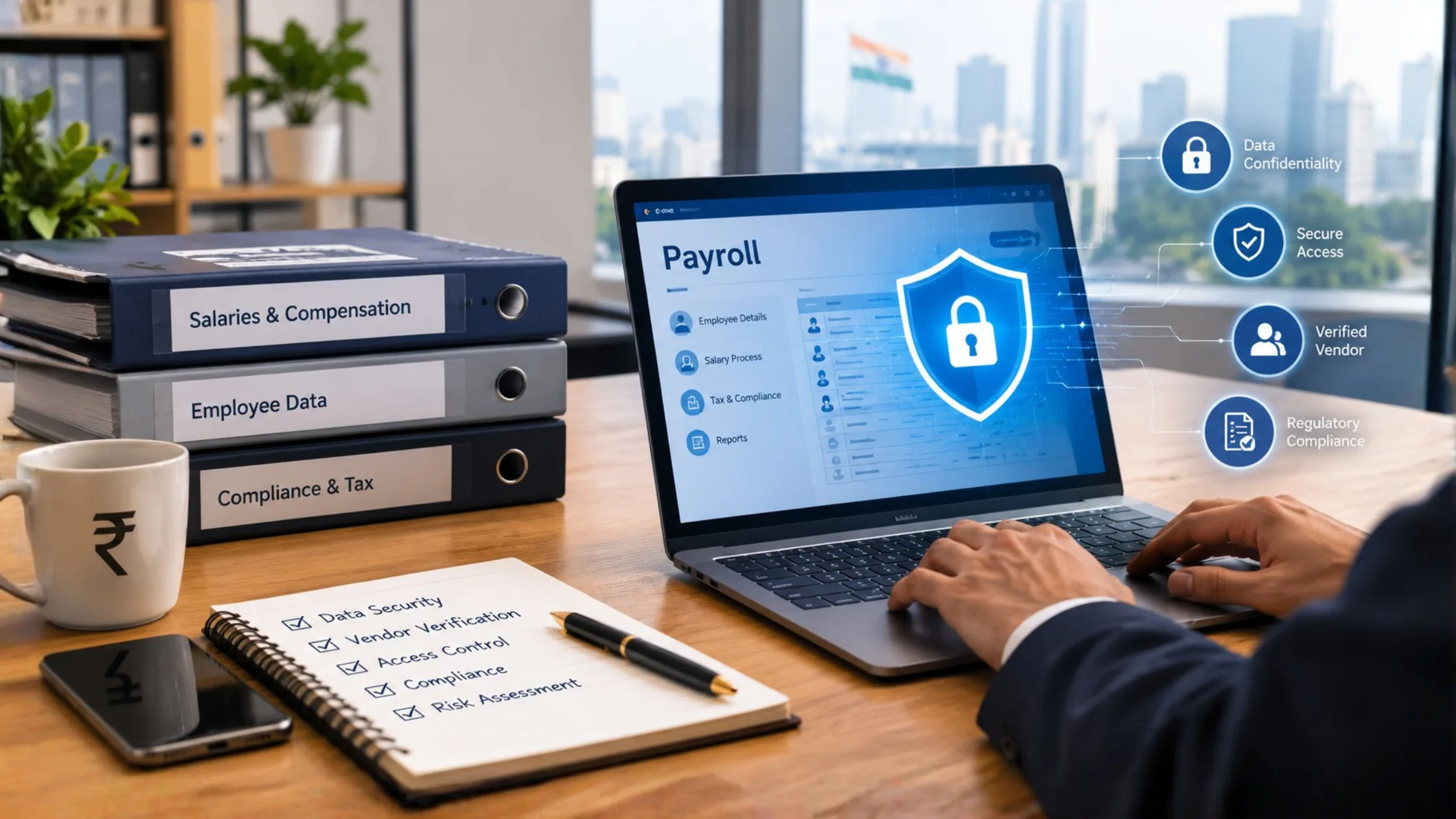
A payroll file looks harmless: a spreadsheet of names, numbers, and bank details. But if that file leaks, the damage is not abstract. Employees get targeted by fraud calls. Salaries land in the wrong accounts. A PF challan gets rejected, and a labour inspector asks for records you cannot produce.
That is why payroll data security should be the first question you ask, not the last, when you evaluate payroll outsourcing services. Price and turnaround time matter, but a cheap vendor with weak controls costs far more than it saves.
This guide is written for HR managers, plant managers, factory owners, procurement heads, and operations leaders who are weighing the decision. It covers what to check, what to ask, which red flags to watch for, and how to hand over salary processing without losing control of your data. It also covers the compliance side: PF and ESI compliance, payroll audit, and payroll reconciliation, because security and compliance fail together.
Before using payroll outsourcing services, check eight things: access controls, maker-checker approvals, secure data storage, audit trails, PF and ESI compliance, contract terms on data ownership and breach notification, staff verification, and an exit plan. Add monthly payroll reconciliation and periodic payroll audit. Under the DPDP Act, 2023, you remain accountable for employee data.
Why Payroll Data Is a Prime Target
Most businesses protect their finished goods and their cash. Fewer protect the file that tells a fraudster exactly where every employee’s money lands each month.
Payroll data is attractive for three reasons:
- It is complete. One file often holds full name, address, date of birth, PAN, Aadhaar, bank account, UAN, ESIC number, and salary.
- It is predictable. Salaries move on a fixed date every month. A single altered bank account can redirect money before anyone notices.
- It is often poorly guarded. In many companies, payroll lives in shared Excel sheets, emailed between HR, accounts, and the contractor, and sits unprotected on personal laptops.
Outsourcing does not remove this risk. It moves it. The question is whether it moves to a place with better controls than yours or worse ones.
What Exactly Is at Risk When You Outsource Salaries?
Think in three layers.
1. Personal data. Identity documents, contact details, bank accounts, and family details used for nominations and insurance.
2. Financial data. Gross and net pay, incentives, loans, advances, deductions, and full-and-final settlements. This is also commercially sensitive. Wage data tells a competitor what you pay for each role.
3. Statutory data. PF and ESI contribution records, TDS workings, and professional tax filings. Errors here create penalties and legal notices, not just embarrassment.
When a vendor processes this data on your behalf, the DPDP Act, 2023 treats you as the one responsible for it. The vendor acts as your processor. The Act provides for penalties of up to ₹250 crore for failing to maintain reasonable security safeguards. Rollout of its rules is phased, so confirm current obligations with your legal advisor. The practical point is simple: you cannot hand over the work and also hand over the accountability.
The 8-Point Security Check Before You Sign
Use this as a due-diligence checklist. Ask the vendor to answer each point in writing.
1. Who can see the data, and how is access controlled?
Ask for a role-based access structure. A payroll executive should not be able to edit bank details and also approve the payment. Look for:
- Unique login for every user, with no shared IDs
- Multi-factor authentication for payroll software
- Access removed within 24 hours when a team member leaves
- A named person accountable for your account
2. Is there a maker-checker process?
Every payroll run should be prepared by one person and verified by another. Changes to bank details, salary heads, or employee status need a second approval with a recorded reason. This one control stops most internal fraud and most honest mistakes.
3. Where is the data stored, and how is it protected?
Ask where servers are located, whether data is encrypted in transit and at rest, and how often backups run. Also ask what happens to files sent by email. A vendor with modern software but a habit of circulating unprotected spreadsheets has not solved the problem.
4. Are there audit trails?
You should be able to see who changed what, when, and why. If the vendor cannot produce a change log for a single employee’s salary record, treat that as a serious gap.
5. How does the vendor handle statutory compliance?
Secure data is useless if filings are wrong. Check how they calculate and deposit PF, ESI, TDS, and professional tax, who signs off, and how they track due dates. More on this below.
6. What does the contract say about data?
Read these clauses closely:
- Confidentiality and non-disclosure obligations covering the vendor and its staff
- A clear statement that you own the data
- Breach notification timelines (hours or days, not “as soon as practicable”)
- Liability and indemnity for errors, penalties, and leaks
- Data return and deletion on exit
7. What are the vendor’s people practices?
Security is mostly human. Ask about background verification of payroll staff, confidentiality undertakings, training, and how often they rotate access. A certified management system helps here. Ardent Facilities is ISO 9001:2015 certified, which means documented processes and internal reviews are part of how we work. Whichever vendor you choose, ask how their certifications apply to the payroll function in particular.
8. What is the exit plan?
You should know, before signing, how you will get your data back, in what format, and how soon. Vendors who are vague about exit are often vague about everything else.
In-House vs Outsourced Payroll: Security Comparison
Many owners assume in-house payroll is automatically safer because “it stays with us.” In practice, it depends on how well it is run.
| Factor | In-House Payroll | Outsourced Payroll (Well-Run Vendor) | Outsourced Payroll (Weak Vendor) |
|---|---|---|---|
| Access control | Often informal; one or two people know everything | Role-based, with documented approvals | Shared logins, no records |
| Maker-checker | Frequently missing in small teams | Built into every cycle | Absent or on paper only |
| Data storage | Local PCs, shared Excel files | Controlled systems with backups | Email attachments, personal devices |
| Statutory compliance | Depends on one employee’s knowledge | Dedicated compliance team and calendar | Missed dates, rejected challans |
| Key-person dependency | High; resignation can disrupt payroll | Low; trained backups exist | Moderate to high |
| Audit trail | Rarely maintained | Available on request | Not available |
| Cost over time | Salaries, software, training, and compliance upkeep | Predictable per-employee or monthly fee | Low fee, high hidden risk |
| Best suited for | Small teams with strong internal controls | Growing, multi-site, or contract-heavy workforces | No one |
The takeaway: outsourcing is safer only when the vendor’s controls are stronger than yours. Verify that rather than assume it.
PF and ESI Compliance: Where Security Meets the Law
For most Gujarat factories and service businesses, the statutory side of payroll is where small mistakes turn into notices.
Provident Fund (PF). The standard contribution is 12% of wages from the employee and 12% from the employer, subject to the rules on wage ceilings and the EPF Scheme. Contributions are due by the 15th of the following month. Wrong UANs, mismatched names, or late deposits cause rejected returns and interest and damages.
Employees’ State Insurance (ESI). ESI applies to employees whose monthly wages are within the notified ceiling (currently ₹21,000). Employer and employee contributions are filed monthly, and a contribution period is locked once closed, so errors are hard to fix later.
TDS and professional tax. TDS on salaries (Section 192) and Gujarat professional tax need correct slab and declaration handling, plus timely deposit.
Labour codes. India’s new labour codes are reshaping wage definitions and compliance, and they change how basic pay, allowances, and contributions are structured. Ask any vendor how they have updated their payroll processing for the latest rules, and confirm the current status with official sources.
A secure vendor is one who treats PF and ESI compliance as a controlled process, with reminders, checkers, and documented proof of filing. Not a favour done at month-end.
Payroll Audit and Payroll Reconciliation: Your Early-Warning System
Even strong vendors make mistakes. The difference is how fast mistakes get caught.
Payroll reconciliation means matching three sets of numbers every month:
- Payroll register vs. attendance and leave records
- Payroll register vs. bank disbursement file
- Statutory liabilities (PF, ESI, TDS) vs. actual challans paid
If any set does not match, you want to know before employees do.
Payroll audit is the deeper check. It looks for ghost employees, duplicate bank accounts, unauthorised salary changes, wrong statutory slabs, and gaps in documentation. Here is a simple cadence:
| Check | Frequency | Owner |
|---|---|---|
| Attendance-to-payroll match | Every month | Vendor, verified by HR |
| Bank file vs. payroll register | Every month | Vendor and Accounts |
| PF/ESI challan vs. liability | Every month | Vendor, reviewed by HR |
| Master data change review | Every month | HR / Admin Manager |
| Sample audit of employee records | Quarterly | Internal audit or independent reviewer |
| Full payroll audit | Annually | Independent reviewer |
A practical example: at a manufacturing unit with contract workers across several shifts, a duplicate bank account on two employee IDs can go unnoticed for months. A monthly check for duplicate account numbers catches it in the first cycle. This is the sort of control to ask your vendor to run, and to show you the output.
Red Flags That Should Make You Walk Away
- They cannot explain how data moves between your team and theirs.
- Payroll files are shared over open email or messaging apps with no controls.
- There is no written process for bank detail changes.
- They resist a clause on breach notification or data return.
- Compliance is described as “we manage it” with no calendar, checklist, or proof of filing.
- They promise unusually low fees without explaining the delivery model.
- References are unavailable, or they will not discuss how past errors were fixed.
- No one is named as accountable for your account.
One or two of these may be fixable. Several together mean you should keep looking.
City-Wise Notes: Ahmedabad, Baroda, Surat, and Gandhidham
Security principles are the same everywhere, but business conditions differ across Gujarat.
Payroll services in Ahmedabad. Ahmedabad’s mix of corporate offices, pharma, textile, and engineering firms usually means multiple pay structures and a high volume of statutory changes. Look for vendors who can handle varied wage components and give clear reporting for finance teams.
Payroll services in Baroda. Vadodara’s industrial belt, with its chemical, engineering, and manufacturing units, often relies on contract labour across plants. Ask how the vendor handles contractor-wise records, so each contractor’s compliance can be audited separately.
Payroll services in Surat. Surat’s textile and diamond sectors involve large, shift-based workforces and frequent worker turnover. Joining and exit processing speed matters, because delayed UAN and ESIC updates cause problems later.
Payroll outsourcing in Gandhidham. Port-linked logistics, warehousing, and industrial operations around Gandhidham often have remote or multi-site teams. Ask how the vendor handles on-site attendance capture, data transfer, and disbursement timing for locations far from head office.
Ardent Facilities supports businesses across all four cities, so payroll can sit alongside manpower supply, housekeeping, and security under one accountable partner. That reduces the number of vendors holding your workforce data.
How to Run a Safe Vendor Transition
Switching payroll providers is where many security gaps appear. A sensible sequence:
- Shortlist and verify. Request written answers to the 8-point check. Speak to at least two existing clients.
- Sign the right contract. Confirm confidentiality, data ownership, breach notification, liability, and exit terms before sharing any data.
- Share the minimum. Send only what is needed, through a controlled channel, not by open email.
- Run a parallel cycle. Process one month with both the old and new systems and reconcile the results.
- Lock down access. Remove old vendor and ex-employee access, and issue named logins on the new side.
- Communicate with employees. Tell staff who will handle payroll queries and how to raise errors.
- Review at 90 days. Check error rates, turnaround, and audit findings before settling into routine.
Planning to outsource payroll, or reviewing your current vendor?
Talk to Ardent Facilities. With 25 years of experience across Gujarat and ISO 9001:2015-certified processes, our team can walk you through a payroll security and compliance review for your business.
📞 Call us or request a free consultation at ardentfacilities.com
FAQs
1. Is it safe to outsource payroll processing?
Yes, if the vendor has stronger controls than your own. Check access controls, maker-checker approvals, encrypted storage, audit trails, and written breach-notification terms. Safety comes from process and contract, not the vendor’s reputation alone.
2. What are the biggest risks of outsourcing payroll?
The main risks are unauthorised access to employee data, bank detail fraud, missed PF and ESI deadlines, calculation errors, and difficulty retrieving data when you leave a vendor. Most are manageable with clear contracts and monthly checks.
3. Who is responsible if a payroll vendor leaks employee data?
Under India’s DPDP Act, 2023, the business that decides the purpose of processing remains accountable, even if a vendor handles the work. Your contract should assign liability and require prompt breach notification, but it does not remove your own responsibility. Take legal advice for your specific case.
4. What is the difference between a payroll audit and payroll reconciliation?
Reconciliation is a routine monthly match between payroll, attendance, bank payments, and statutory challans. A payroll audit is a deeper periodic review of records, approvals, and compliance to find errors, fraud, and gaps.
5. How does a vendor manage PF and ESI compliance?
A reliable vendor maintains a compliance calendar, calculates contributions correctly, files returns and challans before due dates, and shares proof of filing with you. Ask to see sample monthly compliance reports.
6. Can payroll outsourcing work for contract and factory workers?
Yes. Many manufacturers outsource payroll for contract and shift-based workers because attendance, overtime, and statutory deductions are complex. Make sure the vendor can maintain contractor-wise and site-wise records.
7. How much does payroll outsourcing cost in Gujarat?
Pricing usually depends on headcount, number of locations, wage components, and compliance scope. Be wary of quotes that look far below the market without a clear explanation. Ask for a written scope listing exactly what is included.
8. How do I know if my payroll vendor is reliable?
Look for documented processes, named account owners, clean audit trails, on-time statutory filings, and references from similar businesses. A trustworthy vendor will answer security questions openly and put the answers in writing.
9. What should I do if I find a payroll error after outsourcing?
Report it in writing, ask for a root-cause explanation, and check whether it affected statutory filings. Then verify that a control has been added to prevent repeats. Repeated errors with no change in process are a sign to reconsider the vendor.