
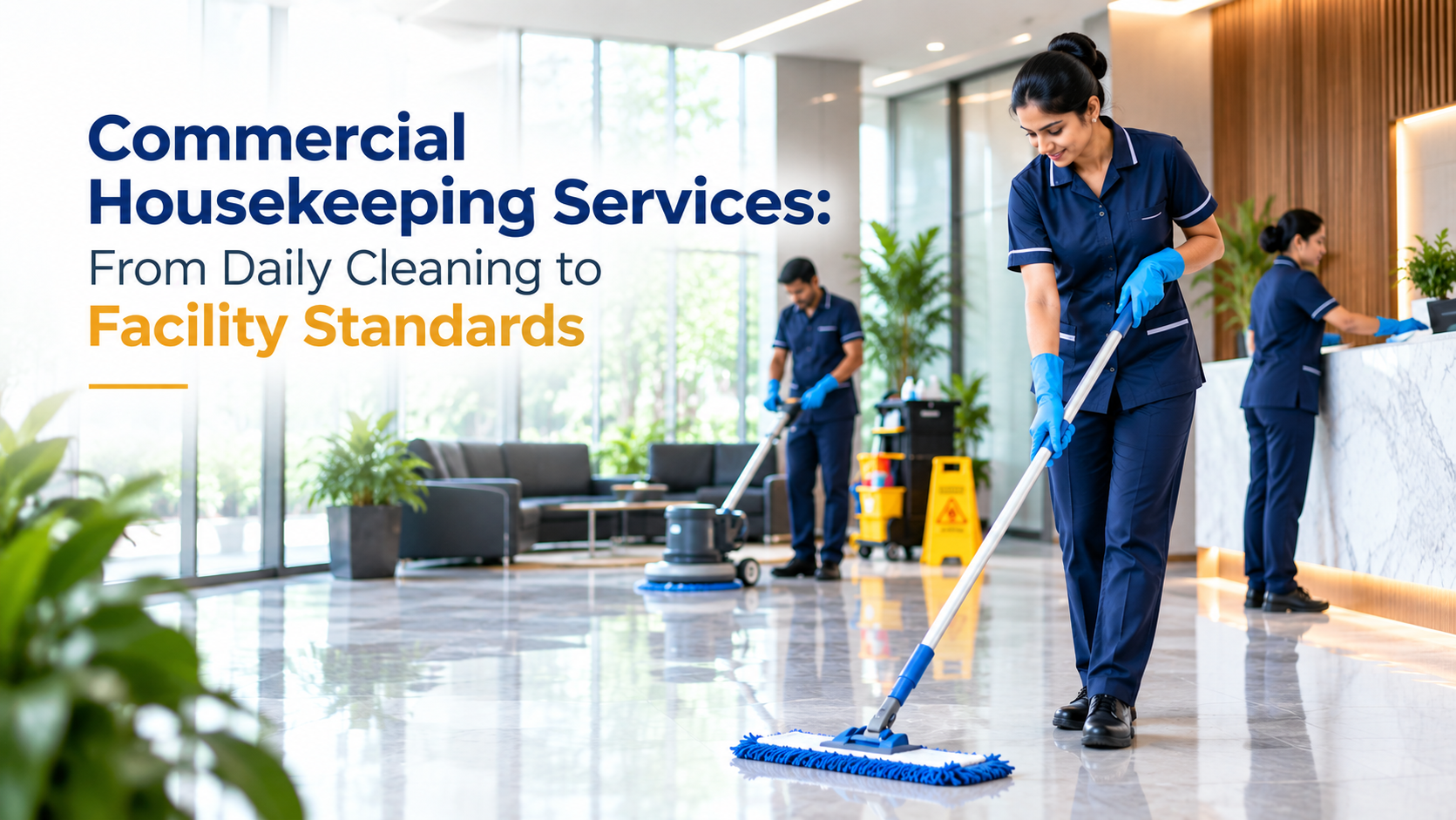
Walk into any well-run factory, corporate office, or warehouse and you’ll notice something before you notice anything else — the place feels clean, ordered, and cared for. That impression isn’t accidental. It’s the output of a structured housekeeping system, not a random person with a mop showing up when things look bad.
For HR managers, admin heads, and facility managers across Gujarat, housekeeping services have quietly become a compliance and reputation issue as much as a hygiene one. Auditors check washroom logs. Clients judge your shop floor before they judge your product. Employees notice whether break rooms are maintained. And with ISO audits, labour inspections, and client site visits becoming routine, “someone cleans the office” is no longer an acceptable answer.
This guide walks through what commercial housekeeping services actually involve, how daily cleaning differs from facility-standard housekeeping, and what businesses in Ahmedabad, Vadodara, Surat, and Gandhidham should look for before signing a housekeeping contract.
Commercial housekeeping is no longer just about mopped floors. It is a structured facility function linked to hygiene compliance, workplace safety, audit standards, and professional image. This guide explains what professional Housekeeping Services actually cover, how daily cleaning differs from facility-standard housekeeping, and what businesses should evaluate when choosing a service provider. It also examines the growing demand for outsourced housekeeping teams across Ahmedabad, Vadodara, Surat, and Gandhidham, with practical guidance for HR, admin, and facility managers comparing in-house teams with professional housekeeping partners.
What Do Commercial Housekeeping Services Actually Include?
Most business owners assume housekeeping means sweeping, mopping, and dusting. That’s the visible 20%. Professional housekeeping services actually cover:
- Floor and surface care — sweeping, mopping, scrubbing, polishing (including specialised floors like epoxy, vitrified tile, or industrial concrete)
- Washroom and sanitation management — deep cleaning, consumable refilling (soap, tissue, sanitizer), odour control systems, and disinfection logging
- Waste management — segregation, collection, and disposal in line with municipal and factory-specific rules
- Pantry and cafeteria hygiene — a growing concern post-2020, now tied directly to food safety compliance in many manufacturing units
- Glass, façade, and high-touch point cleaning — door handles, switches, lift buttons, railings
- Pest control coordination — many housekeeping vendors either provide this directly or coordinate scheduling with a pest control partner
- Housekeeping material and equipment management — inventory of cleaning chemicals, machines (scrubber-dryers, vacuum cleaners), and PPE for staff
The distinction that matters most for decision-makers: cleaning is a task, housekeeping is a system. A task gets done once. A system gets audited, documented, and improved.
Daily Cleaning vs. Facility-Standard Housekeeping: The Real Difference
This is where most businesses underestimate what they’re paying for — or underpay for what they actually need.
Daily cleaning is reactive. Someone comes in, cleans visible dirt, empties bins, and leaves. There’s no documentation, no checklist, and no accountability beyond “does it look clean today.”
Facility-standard housekeeping is a managed function. It includes:
- Zone-wise cleaning schedules (not just “clean the office”)
- Shift-wise checklists with supervisor sign-off
- Chemical usage logs (critical for factories under environmental or safety audits)
- Consumable stock tracking to avoid mid-day washroom shortages
- Periodic deep-cleaning cycles separate from daily maintenance
- A single point of contact (site supervisor) who reports to your facility manager, not a rotating cast of unaccountable staff
If your current housekeeping arrangement can’t produce a cleaning log when an auditor asks for one, you don’t have facility-standard housekeeping — you have daily cleaning with a formal-sounding name.
Why Businesses Are Outsourcing Housekeeping in 2026
A few shifts are driving this, particularly among mid-to-large industrial and corporate setups in Gujarat:
- Attrition is brutal in-house. Housekeeping staff turnover is high, and HR teams don’t want to run recruitment, background verification, and replacement cycles for a non-core function.
- Compliance exposure. PF, ESI, minimum wage, and labour code adherence for housekeeping staff sits with whoever employs them. Outsourcing shifts this statutory burden to the vendor — provided the vendor is genuinely compliant.
- Predictable cost structure. A contracted housekeeping service gives a fixed monthly cost instead of the hidden costs of hiring, training, uniforms, and equipment procurement done piecemeal.
- Faster replacement during absenteeism. A professional vendor has bench strength; an in-house team of 2-3 staff does not. One sick leave shouldn’t mean your washrooms go unattended for a day.
- Standardisation across multiple sites. Businesses with offices or plants in more than one city want the same SOP, the same reporting format, and the same quality — not four different local arrangements.
In-House Team vs. Outsourced Housekeeping Services: A Cost & Quality Comparison
| Factor | In-House Housekeeping Team | Outsourced Housekeeping Services |
|---|---|---|
| Recruitment & Training | HR handles hiring, background checks, training — repeated every time someone leaves | Vendor handles recruitment, verification, and training as part of the contract |
| Statutory Compliance | Company is directly liable for PF, ESI, minimum wage, labour codes | Vendor is liable (verify their compliance record before signing) |
| Absenteeism Coverage | Limited backup; gaps in coverage are common | Vendor provides substitute staff, often within hours |
| Cost Predictability | Variable — includes hidden costs (uniforms, equipment, supervision time) | Fixed monthly service cost, agreed in contract |
| Supervision Overhead | Falls on internal admin/HR staff | Vendor provides a site supervisor as part of the service |
| Scalability Across Cities | Requires rebuilding the process at each location | Vendor can replicate SOPs across multiple sites |
| Documentation & Audit Readiness | Often informal, inconsistent | Typically includes checklists, logs, and reporting as standard practice |
| Best Suited For | Very small single-site setups with minimal turnover | Factories, offices, and facilities managing compliance, scale, or multiple sites |
Neither model is universally “better” — a 10-person office with one loyal housekeeping staff member for years may not need to change anything. But for factories, multi-site operations, or businesses under regular audit scrutiny, outsourced housekeeping services generally close gaps that in-house arrangements struggle to cover consistently.
Industry-Specific Housekeeping Needs
Housekeeping requirements aren’t identical across sectors. A vendor worth hiring should be able to speak to these differences without you having to explain them first.
Manufacturing plants and factories — Housekeeping here overlaps with safety (5S practices, oil-spill response near machinery, dust control) and often needs to align with ISO 9001 or similar certifications the client itself holds.
Corporate offices — Focus shifts to workstation hygiene, pantry sanitation, meeting room turnaround between back-to-back bookings, and washroom upkeep that affects daily employee experience.
Warehouses and logistics hubs — Large open floor areas, dust accumulation, and loading-dock cleanliness are priorities, along with keeping walkways and fire exits clear — a safety compliance point, not just a cleanliness one.
Educational and institutional campuses — Higher frequency cleaning cycles, hygiene around common-use areas, and often stricter parent or regulatory scrutiny.
What a Professional Housekeeping SOP Actually Looks Like
If you’re evaluating a vendor, ask to see a sample SOP before signing anything. A genuine one typically includes:
- Zone mapping — the facility divided into cleaning zones with assigned staff
- Frequency charts — what’s cleaned hourly, daily, weekly, and monthly
- Chemical dilution and usage standards — to avoid surface damage and ensure safety
- Supervisor checklists — signed off at defined intervals, not just “end of day”
- Escalation protocol — who gets contacted if a staff member doesn’t show up, and within what timeframe a replacement arrives
A vendor who can’t produce this on request is likely running manpower supply dressed up as “housekeeping services” — worth knowing before, not after, you sign.
Housekeeping Services Across Gujarat: City-Specific Considerations
Housekeeping Services in Ahmedabad — As Gujarat’s largest commercial and industrial hub, Ahmedabad has dense demand from both corporate offices in SG Highway/Prahladnagar and industrial units in the GIDC belts. Vendors here need staff strength to handle multi-shift industrial cleaning alongside standard office housekeeping.
Housekeeping Services in Vadodara — Home to a significant chemical, engineering, and manufacturing base, Vadodara facilities often need housekeeping teams comfortable working around industrial safety protocols, not just office cleaning routines.
Housekeeping Services in Surat — With its concentration of textile and diamond processing units, Surat’s housekeeping needs often include managing fine dust and particulate matter — a different cleaning discipline than standard office upkeep.
Housekeeping Services in Gandhidham — As a port-adjacent industrial and logistics centre, Gandhidham facilities frequently need housekeeping coordinated with warehouse and cargo-handling schedules, where downtime for cleaning has to be planned around operational hours.
A vendor operating across all four cities — rather than subcontracting locally in each — tends to offer more consistent quality and a single point of accountability for multi-location businesses.
How to Choose a Housekeeping Services Provider
A few practical questions to ask before signing:
- Can they share PF/ESI compliance documentation for their staff?
- Do they provide a dedicated site supervisor, or just a rotating labour pool?
- What’s their staff replacement turnaround time during absenteeism?
- Do they provide their own cleaning equipment and chemicals, or expect the client to procure them?
- Can they show a sample of their reporting format (checklists, logs)?
- Do they have experience in your specific industry (manufacturing vs. corporate vs. warehousing)?
Red Flags to Watch For When Hiring a Housekeeping Vendor
- No written SOP or checklist system — just verbal assurances
- Reluctance to share compliance documents
- No backup staff plan for absenteeism
- Pricing significantly below market rate (usually means staff are underpaid, which drives high turnover and inconsistent service)
- No single point of contact — you’re expected to manage individual staff directly
Conclusion
Commercial housekeeping stops being a background task the moment your business faces an audit, a client site visit, or a workplace safety review — and by then, it’s too late to fix inconsistent cleaning habits overnight. The businesses that get this right treat housekeeping services as a structured, documented function with clear accountability, not a favour done by whoever’s available that day. Whether you’re running a single office or managing facilities across Ahmedabad, Vadodara, Surat, and Gandhidham, the difference between daily cleaning and facility-standard housekeeping usually comes down to one thing: does anyone actually own the process?
Looking for reliable housekeeping services for your factory, office, or facility? Ardent Facilities provides trained housekeeping teams, documented SOPs, and dedicated supervisors across Ahmedabad, Vadodara, Surat, and Gandhidham. Contact us today for a free facility housekeeping audit.
FAQs
Q1. What's included in a standard commercial housekeeping contract?
It typically covers daily floor cleaning, washroom sanitation, waste management, consumable restocking, and periodic deep cleaning, along with a supervisor and documented checklists. Exact scope should always be defined in the contract, not assumed.
Q2. How is housekeeping different from facility management?
Housekeeping is one function within facility management. Facility management is the broader umbrella that can include housekeeping, security, maintenance, and administrative support — housekeeping specifically deals with cleanliness and hygiene.
Q3. Is outsourced housekeeping more expensive than hiring in-house staff?
Not usually, once hidden costs are factored in — recruitment, training, uniforms, equipment, supervision time, and compliance liability. Outsourcing tends to offer a more predictable total cost.
Q4. How often should a factory or office get deep cleaning done, separate from daily housekeeping?
Most facilities benefit from a monthly or quarterly deep-cleaning cycle in addition to daily upkeep, though high-footfall or industrial sites may need it more frequently depending on operations.
Q5. Who is responsible for PF and ESI compliance in outsourced housekeeping?
The vendor, as the employer of record for the housekeeping staff — but businesses should verify this compliance directly rather than assuming it, since liability can extend to the client in cases of vendor non-compliance under Indian labour law.
Q6. Can a housekeeping vendor also provide security and manpower services?
Some facility management companies offer housekeeping alongside security, manpower supply, and payroll outsourcing under one contract, which can simplify vendor management for businesses needing multiple services.