
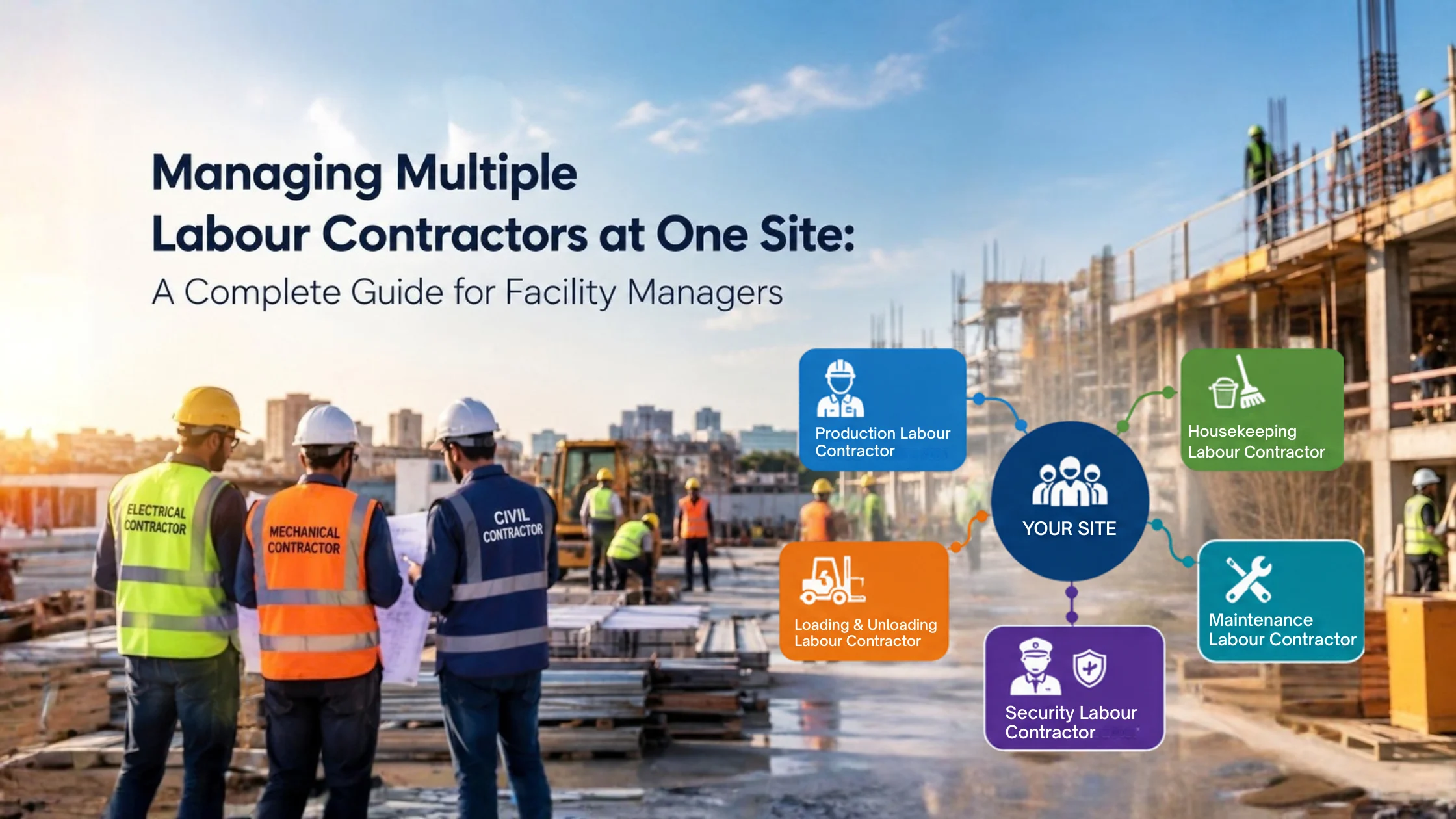
If you’re managing a factory floor, a warehouse, or a large commercial facility, chances are you didn’t set out to work with five different labour contractors. It happened gradually — one contractor for housekeeping, another for loading and unloading, a third brought in during a peak-season crunch, and a fourth who “just knows the local workers” for a specific department. Two years later, you’re the one holding the pieces together, and every audit, every wage query, and every compliance notice lands on your desk first.
This is one of the most common — and most avoidable — operational headaches for HR managers, plant heads, and admin managers across Gujarat’s industrial belt. A single labour contractor with proper systems can usually do what four fragmented contractors do, except with one point of accountability, one invoice, and one person to call when something goes wrong at 6 AM.
In this guide, we’ll walk through why multi-contractor setups happen, what they actually cost you (beyond the invoice), and how facilities across Ahmedabad, Vadodara, Surat, and Gandhidham are simplifying their labour supply chains without losing flexibility.
QUICK SUMMARY
Running one site with three, four, or even six different labour contractors is one of the fastest ways to lose control of compliance, quality, and cost. This guide breaks down why multi-contractor sites go wrong, how a single labour contractor model solves overlapping accountability gaps, and what a structured onboarding, supervision, and compliance framework looks like in practice. It’s written for HR, admin, plant, and operations managers across Ahmedabad, Vadodara, Surat, and Gandhidham who are tired of chasing five different vendors for one attendance report.
Why Sites End Up With Multiple Labour Contractors
Nobody plans a fragmented labour structure on purpose. It usually builds up through a few predictable patterns:
Departmental hiring in silos. The production head hires a labour contractor for line work, housekeeping reports to admin and has its own vendor, and security is managed separately by facility management. Each department solves its own problem without visibility into what others are doing.
Peak-season patchwork. During a festival rush or a sudden order spike, a plant brings in an additional contractor purely for headcount, intending it to be temporary — except temporary arrangements have a habit of becoming permanent because nobody circles back to formalize an exit.
Legacy relationships. A contractor who supplied labour a decade ago is still on the books for a small function, even though the rest of the site has moved to a more organized vendor, simply because “he’s been reliable” and switching feels like unnecessary friction.
Perceived cost savings. Some facility managers believe splitting labour supply across multiple small contractors keeps rates competitive. In practice, it usually does the opposite — smaller unorganized contractors have thinner margins, which often translates into corners cut on PF, ESI, or minimum wage compliance.
None of these reasons are irrational in isolation. The problem is what happens when they stack up on a single site.
The Hidden Costs of Fragmented Labour Contracting
The invoice total from each contractor is the visible cost. The real cost shows up elsewhere:
- Duplicated administrative overhead. Your HR or admin team ends up processing multiple attendance systems, multiple wage registers, and multiple compliance filings for what is functionally one workforce on one site.
- Inconsistent worker quality and training. Each contractor has a different standard for induction, safety briefing, and conduct. One contractor’s workers may be well-trained on machine safety; another’s may not be, and on a shared floor, that inconsistency becomes everyone’s risk.
- Compliance blind spots. When four contractors each maintain separate PF, ESI, and minimum wage records, the probability that at least one is non-compliant rises sharply — and under Indian labour law, the principal employer carries residual liability regardless of whose contractor made the error.
- Accountability gaps during incidents. If there’s a workplace accident, a theft, or a wage dispute, multiple contractors on site make it harder to establish which vendor’s worker was involved and who is responsible for remediation.
- Diluted negotiating power. Splitting your labour spend across several small contractors means you never become a priority client for any single one of them, which shows up in slower replacements, weaker service levels, and less willingness to invest in your account.
Most facility managers underestimate this cost until an audit, a labour inspector visit, or an incident forces a full review — at which point the fragmentation becomes very expensive, very quickly.
Single Labour Contractor vs. Multiple Contractors: A Side-by-Side Look
| Factor | Single Labour Contractor Model | Multiple Contractor Model |
|---|---|---|
| Compliance accountability | One entity, one set of records, easier to audit | Split across vendors, higher risk of gaps |
| Wage and PF/ESI consistency | Standardized across the workforce | Varies by contractor, harder to verify |
| Administrative effort (HR/Admin) | One invoice, one point of contact | Multiple invoices, multiple coordination points |
| Worker training and induction | Uniform safety and conduct standards | Inconsistent, dependent on individual contractor |
| Replacement speed during absenteeism | Faster, backed by a larger bench strength | Slower, limited by each contractor’s own capacity |
| Negotiating leverage | Higher, as a larger consolidated client | Lower, spread thin across smaller vendors |
| Incident accountability | Clear, single point of responsibility | Ambiguous, can lead to finger-pointing |
| Scalability for seasonal demand | Easier, one relationship to scale up or down | Harder, requires coordinating several vendors |
This isn’t to say multiple contractors are never justified — highly specialized trades or geographically split operations sometimes require it. But for most single-site operations, the operational and compliance case for consolidation is strong.
Compliance Risks When Managing Several Contractors Simultaneously
Under the Contract Labour (Regulation and Abolition) Act and the evolving labour codes, the principal employer is not fully insulated just because a third-party contractor is technically the employer of record. If a contractor fails to deposit PF or ESI contributions, or underpays minimum wages, the principal employer can be held liable to make good the shortfall.
With one contractor, verifying compliance means reviewing one set of registers, one PF challan, one ESI filing. With four contractors, it means four separate verification cycles — and in practice, most facility teams don’t have the bandwidth to audit four vendors with the same rigor they’d apply to one. This is precisely where gaps quietly form, often surfacing only when a labour inspector visits or a worker raises a wage grievance.
A practical rule of thumb: your compliance risk doesn’t add up linearly with each additional contractor — it compounds, because oversight capacity stays roughly the same while the number of things that can go wrong multiplies.
A Practical Framework for Managing Multiple Contractors (If You Must)
Some sites genuinely need more than one labour contractor — a large multi-shift facility with distinct functional needs, for instance, or a site split across two physical locations. If consolidation isn’t immediately possible, here’s how to manage the risk:
1. Centralize documentation, even if vendors are separate. Maintain a single master tracker across all contractors covering worker count, PF/ESI status, wage compliance, and contract renewal dates. Don’t let each contractor’s paperwork live in a silo.
2. Standardize induction and safety training. Regardless of which contractor supplies the worker, every individual entering your site should go through the same safety briefing and conduct policy. This removes the “which contractor trained them” ambiguity during incidents.
3. Assign one internal owner for contractor coordination. Even with multiple external vendors, there should be one internal person — typically an admin or HR manager — who owns the relationship end-to-end, rather than different departments dealing with different contractors independently.
4. Run quarterly compliance audits across every contractor. Don’t rely on contractors to self-report. Request PF/ESI challans, wage registers, and licence renewals on a fixed quarterly cycle from each vendor.
5. Set a clear escalation and replacement SLA with every contractor. Absenteeism and turnover are inevitable in contract labour. Define, in writing, how quickly each contractor is expected to provide a replacement — 24 hours, 48 hours — so you’re not caught short-staffed.
6. Review the vendor list annually. Legacy contractors that no longer justify the administrative overhead should be phased out. If two contractors are doing functionally similar work, that’s usually a sign consolidation is overdue.
Why Consolidation Under One Labour Contractor Works Better
For most single-site operations, moving toward one primary labour contractor — even if that contractor manages workers across multiple functions — solves the majority of the problems above at the source:
- One compliance trail. PF, ESI, minimum wage, and statutory registers are unified, making audits faster and gaps easier to catch.
- One escalation point. When a worker doesn’t show up, when there’s a dispute, or when a labour inspector asks a question, there’s exactly one phone number to call.
- Consistent workforce quality. A single contractor with a standardized induction and training process produces more predictable output than a patchwork of vendors each with their own bar.
- Stronger bench strength. An established labour contractor with a broader worker pool can typically replace an absent worker same-day, because they’re not constrained to a small roster built for one client.
- Better long-term pricing. Consolidated volume with one vendor generally results in better rate negotiation than splitting the same spend across smaller contractors.
This is also where a facility management partner with an integrated labour supply function has an advantage over a standalone labour contractor — because workforce coordination sits alongside housekeeping, security, and property management under one operational umbrella, rather than as a disconnected function.
What to Look For in a Labour Supplier Before Consolidating
Before moving your site to a single labour contractor, it’s worth verifying a few non-negotiables:
- Valid licence under the Contract Labour Act, specific to the state and the nature of work.
- Demonstrated PF and ESI compliance history — ask for sample challans from existing clients, not just a verbal assurance.
- Bench strength and replacement capacity, particularly relevant if your site has seasonal demand spikes.
- Documented induction and safety training process for every worker deployed.
- Track record across similar industries — a contractor experienced in manufacturing floor labour may not be the right fit for warehouse or logistics work, and vice versa.
- Transparent wage disbursal mechanism, ideally digital, so workers are paid directly and on time without intermediary deductions.
A labour supplier who can speak fluently and specifically to these points — rather than offering generic assurances — is usually the one worth consolidating with.
City-Specific Considerations Across Gujarat
Labour availability, wage benchmarks, and compliance enforcement intensity vary meaningfully across Gujarat’s industrial hubs, which is why local presence matters when choosing a labour supplier:
- Labour Supplier in Ahmedabad — Ahmedabad’s diverse industrial base (textiles, engineering, pharma, logistics) means labour demand is deep but also competitive; a contractor with strong local sourcing networks is essential to maintain bench strength.
- Labour Supplier in Vadodara — Vadodara’s petrochemical and engineering-heavy industrial zones often require workers with specific safety certifications, making a contractor’s training infrastructure especially important here.
- Labour Supplier in Surat — Surat’s textile and diamond processing industries operate on tight, high-volume production cycles, so replacement speed and shift-flexibility from your labour contractor matter more than almost anywhere else in the state.
- Labour Supplier in Gandhidham — As a port and logistics hub, Gandhidham’s labour needs are often tied to loading, warehousing, and cargo handling, where physical safety compliance and insurance coverage for workers are particularly critical.
A labour contractor with an established presence across all four cities can offer facility managers consistency of process even when operations span multiple locations.
Conclusion
Managing multiple labour contractors at one site rarely starts as a deliberate strategy — it accumulates through departmental hiring, seasonal patches, and legacy relationships that never got cleaned up. The cost isn’t just administrative friction; it’s compliance risk, inconsistent worker quality, and accountability gaps that surface at the worst possible moment, usually during an audit or an incident.
Whether you consolidate fully under a single labour contractor or manage multiple vendors with tighter oversight, the underlying principle is the same: fewer relationships, standardized processes, and centralized compliance tracking consistently outperform fragmented arrangements — for HR managers, plant heads, and facility teams alike.
Call To Action
If your site is juggling multiple labour contractors and you’re ready to simplify, Ardent Facilities can help you consolidate under one accountable labour supply partner across Ahmedabad, Vadodara, Surat, and Gandhidham. Contact Ardent Facilities today for a compliance review and a tailored labour supply plan for your site.
FAQs
Q1. Why shouldn't I use multiple labour contractors for different departments at the same site?
It typically covers daily floor cleaning, washroom sanitation, waste management, consumable restocking, and periodic deep cleaning, along with a supervisor and documented checklists. Exact scope should always be defined in the contract, not assumed.
Q2. Is the principal employer liable if a labour contractor fails to pay PF or ESI?
Yes, in many cases. Under Indian labour law, the principal employer can be held liable to make good statutory shortfalls if a contractor defaults, which is why verifying a labour contractor’s compliance history before engagement — and auditing it periodically — is essential.
Q3. How many labour contractors should a mid-sized facility realistically work with?
Not usually, once hidden costs are factored in — recruitment, training, unFor most single-site operations, one primary labour contractor covering the bulk of workforce needs is ideal, with a maximum of one or two additional specialized vendors only where a genuinely distinct skill set is required.iforms, equipment, supervision time, and compliance liability. Outsourcing tends to offer a more predictable total cost.
Q4. What documents should I request before finalizing a labour contractor?
At minimum: a valid Contract Labour Act licence, recent PF and ESI compliance proof, sample wage registers, and references from existing clients in a similar industry.
Q5. How quickly should a labour contractor replace an absent worker?
Most well-organized labour contractors can provide a same-day or next-day replacement, provided they maintain adequate bench strength. This should be defined as a clear SLA in your contract rather than left informal.