
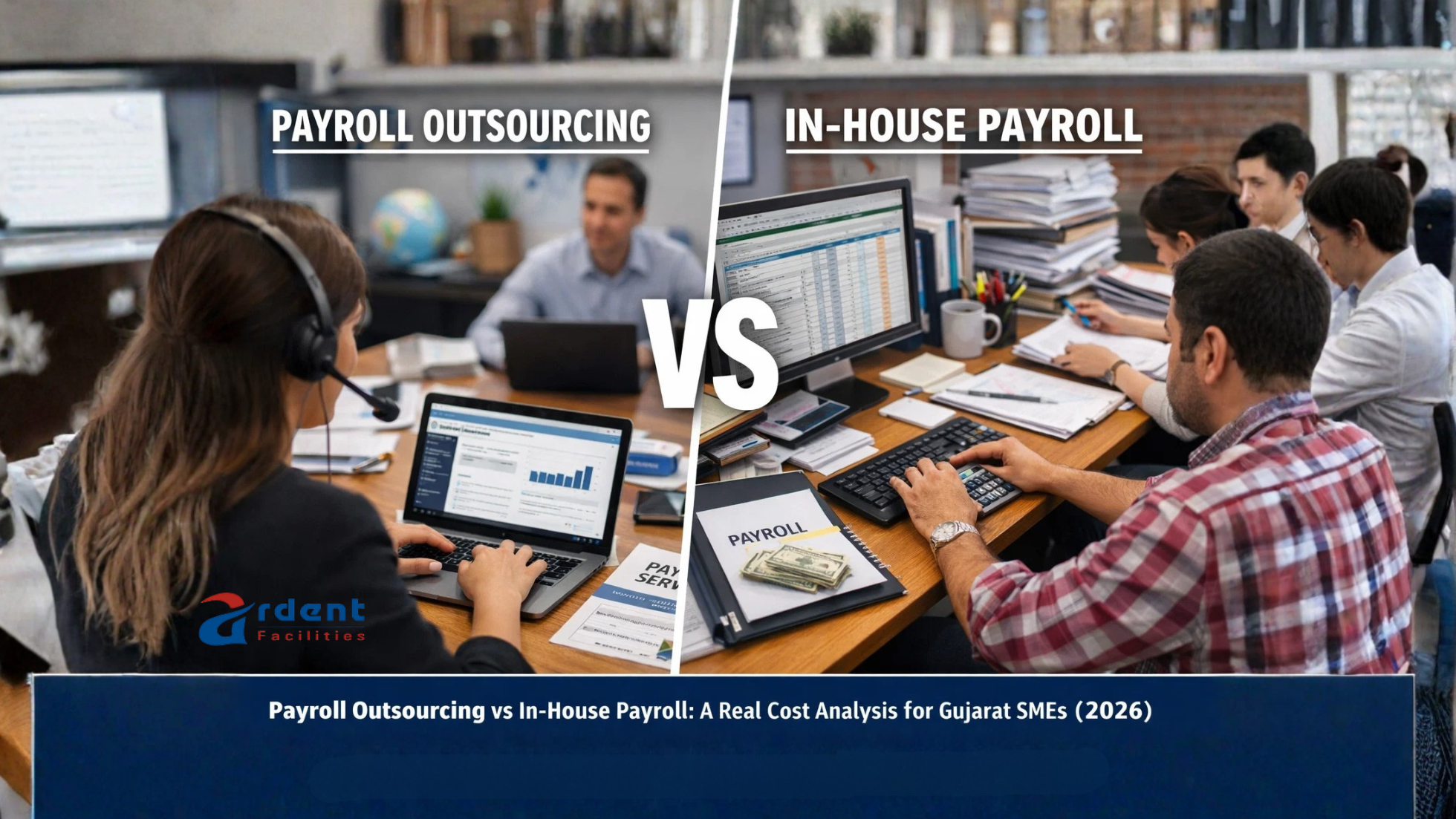
Most Gujarat SMEs assume in-house payroll is cheaper because they only count the software cost. They forget the time cost of HR staff managing it, the penalty risk of one wrong PF filing, and the 8–12 hours per month their finance team loses to salary processing. This analysis compares both options honestly — using Gujarat business realities, not national generalisations.
What In-House Payroll Actually Costs a Gujarat SME — Beyond the Software Bill
In-house payroll costs far more than just software because HR time, compliance tracking, and penalty exposure add significant hidden burden. Most SMEs underestimate these factors, leading to higher operational strain and compliance risk over time.
Real Cost Components (Qualitative)
| Cost Component | In-House Reality | Notes |
|---|---|---|
| HR staff time | 15–25% of one executive monthly | Often underestimated |
| Payroll software | Annual subscription required | Varies by vendor |
| PF/ESI compliance | Manual tracking each month | Error-prone without system |
| Gujarat Prof. Tax filing | Separate slab calculation | Commonly missed |
| Penalty risk exposure | 12% p.a. PF, 25% ESI late fee | One error = significant cost |
| Year-end Form 16 prep | High time burden in March–April | Often causes HR overload |
Beyond these visible components, in-house payroll carries a hidden compliance burden — keeping attendance registers, PF challan records, and ESI returns ready for an unannounced labour inspection. Factories in Vatva and Naroda GIDC face this regularly. Most in-house teams account for salary processing time but not inspection readiness.
What Payroll Outsourcing Covers — and What In-House Teams Must Do Themselves
Payroll outsourcing covers salary processing, statutory filings, and compliance tracking end-to-end, while in-house teams must manage these manually. The difference lies not in tasks, but in accountability and execution accuracy.
What Outsourcing Typically Includes
- Salary processing and payslip generation
- PF, ESI, and Gujarat Professional Tax filing
- TDS calculation and Form 16 issuance
- Compliance updates aligned with new laws
- New Labour Code calculations and adjustments
What In-House Teams Handle Themselves
- Tracking statutory changes and deadlines
- Managing penalties or notices
- Maintaining inspection registers and documentation
What May Not Be Included
- Full & final settlement processing
- Backdated payroll corrections
- Custom MIS or analytics reports
- Retrenchment calculations
The key difference is operational ownership — outsourcing providers take responsibility for compliance execution, while in-house teams carry full risk.
Side-by-Side Comparison — In-House vs Outsourced Payroll for a Gujarat Business
| Factor | In-House Payroll | Payroll Outsourcing |
|---|---|---|
| Overall cost efficiency | Higher when all hidden costs counted | Lower for 25+ employee businesses |
| PF/ESI compliance risk | High — internal error exposure | Low — provider’s guarantee |
| Gujarat Prof. Tax handling | Manual — frequently missed | Included as standard |
| Scalability during hiring | Slow — HR team gets overloaded | Immediate — same engagement |
| Data security | Depends on internal systems | Provider’s contractual responsibility |
| Monthly HR time required | 8–15 hours (your team) | Near zero (your team) |
| Form 16 and year-end filing | Manual, error-prone | Automated, accurate |
| New Labour Code readiness | Requires team retraining | Provider auto-updates |
| Labour inspection readiness | Registers — manual upkeep | Provider maintains records |
| Best suited for | Under 20 employees, stable team | 25+ employees, growing business |
For most growing SMEs, payroll outsourcing provides better operational efficiency and significantly lower compliance risk. In-house payroll works only when complexity is minimal and stable. For businesses in Gandhidham and Surat with seasonal or fluctuating headcount — a variable engagement model from outsourcing makes more operational sense than a fixed in-house HR salary paid during slow months.
When In-House Payroll Still Makes Sense — An Honest Answer
In-house payroll is still practical for very small, stable businesses with minimal compliance complexity. It works best when payroll does not change month to month.
- Businesses under 20 employees
- No contract labour or variable wages
- Simple salary structure with no compliance gaps
- Strong internal HR capability
If your payroll headcount is stable, you have no contract labour, and your HR team has no compliance gaps — in-house payroll with good software may serve you adequately for now.
New Labour Codes 2026 — Why Every Gujarat SME’s Payroll Needs to Change
The New Labour Codes 2026 redefine how wages are structured and directly impact PF contributions for all businesses. They require immediate payroll restructuring to stay compliant with the new statutory framework.
India’s four labour codes — Code on Wages, Industrial Relations Code, Social Security Code, and Occupational Safety Code — replace 29 existing laws and standardise payroll definitions.
The biggest change is the new wage definition, where Basic + DA must be at least 50% of total CTC.
Example:
Under the new definition, a business that structured CTC with low basic to reduce PF contribution will now face a higher employer PF obligation — requiring payroll system recalculation for every affected employee.
This creates a major shift for:
- Textile manufacturers in Ahmedabad
- Diamond industry businesses in Surat
- Companies using manpower on contract with varied salary structures
In-house HR teams must retrain and update systems, while outsourcing providers implement these changes automatically across payroll cycles.
Payroll Challenges by City — Why Gujarat Businesses Need Local Expertise
Gujarat’s four major business cities each have distinct payroll challenges shaped by their dominant industries, workforce types, and compliance environments. A payroll provider without local expertise typically misses the specifics that matter most.
Ahmedabad: Textile and pharmaceutical companies on SG Highway and Naroda GIDC face high contract labour turnover — headcount changes every month, making payroll volume unpredictable. Managing payroll services in Ahmedabad requires a provider that can handle variable headcount without delays in PF registration for new joiners or timely exit processing for departures.
Surat: Diamond polishing units and synthetic textile manufacturers employ large workforces on piece-rate or weekly payment structures. ESI calculation for piece-rate workers is a recurring compliance error in Surat — because the wage definition for ESI purposes must account for the actual weekly earnings averaged across the month, not a fixed monthly figure. Businesses using payroll services in Surat need a provider that understands this calculation, not one applying a standard template.
Vadodara (Baroda): Petrochemical and engineering companies near Savli GIDC frequently have both permanent employees and contract workers deployed on the same site — each category with different PF contribution structures, different leave policies, and different statutory applicability. Reliable payroll services in Baroda means managing parallel payroll streams without mixing statutory obligations between the two categories.
Gandhidham: Port-adjacent trading companies and logistics firms in Gandhidham experience seasonal hiring surges during peak import/export periods — followed by headcount reductions in slower months. This makes fixed in-house HR overhead operationally inefficient. Both payroll outsourcing in Gandhidham and broader payroll services in Gandhidham require a provider who can scale up and scale down quickly without compliance gaps during the transitions.
6 Things to Check Before Choosing a Payroll Outsourcing Company in Gujarat
- Statutory compliance guarantee — is it in writing with penalty coverage clause?
- Gujarat Professional Tax slab knowledge — do they know PT slabs and filing dates specific to Gujarat?
- PF/ESI filing track record — ask for proof of on-time filing history
- Data security — where is employee data stored and who can access it?
- New Labour Code readiness — are their calculations already updated for 2026?
- Local presence in Gujarat — can they support a compliance notice or labour inspection on short notice?
Payroll Outsourcing with Ardent Facilities — What Gujarat SMEs Get
Ardent Facilities Private Limited (ISO 9001:2015 certified) delivers end-to-end payroll staffing and outsourcing solutions across Ahmedabad, Surat, Vadodara, and Gandhidham. Services include salary processing, PF/ESI filing, Gujarat Professional Tax compliance, TDS, Form 16, payslips, statutory updates, and full alignment with New Labour Codes.
Pricing is customised for each business based on headcount, city, and scope of services required. Ardent offers a free payroll assessment — reviewing your current payroll setup, identifying compliance gaps, and showing exactly what outsourcing would cover for your business. No obligation, no commitment required.
To request your free payroll assessment — call +91 98254 00349, email info@ardentfacilities.com, or visit ardentfacilities.com/payroll-services/
Making the Right Decision for Your Gujarat Business
If your payroll is stable, headcount is under 20, and you have no contract labour — in-house with good software works for now. If your headcount changes monthly, you use contract labour, or one compliance error has already cost you — outsourcing removes the risk and typically costs less than the full in-house picture once hidden costs are counted. A free assessment from Ardent Facilities will show you your specific numbers — no commitment required.
FAQs - Payroll Outsourcing
Q1: Is payroll outsourcing cheaper than in-house payroll for Gujarat SMEs?
A: For most Gujarat SMEs with 25+ employees, yes — once hidden in-house costs like HR staff time, software, PF penalty risk, and PT filing burden are counted alongside the software cost, outsourcing is typically the more cost-efficient option. The gap widens further when contract labour is involved or headcount fluctuates seasonally.
Q2: What does payroll outsourcing include for businesses in Gujarat?
A: A standard payroll outsourcing engagement in Gujarat covers salary processing, PF and ESI filing, Professional Tax calculation under Gujarat slabs, TDS computation, monthly payslips, Form 16 preparation, and statutory compliance updates including New Labour Code calculations. What falls outside standard scope — such as full and final settlements or custom MIS reports — varies by provider and should be confirmed before signing.
Q3: How do I know if payroll outsourcing is right for my Gujarat business?
A: If your business has more than 25 employees, uses contract labour, or has experienced even one PF or ESI compliance error in the past two years — outsourcing is likely the more reliable option. Businesses with fluctuating headcount benefit most. Ardent Facilities offers a free payroll assessment for Gujarat businesses — call +91 98254 00349 to get a specific recommendation for your situation.
Q4: How does payroll outsourcing handle PF and ESI compliance in Gujarat?
A: The outsourcing provider prepares monthly PF and ESI challans based on your salary data, submits them before the statutory due dates, and maintains proof of remittance. They also handle PF registration for new joiners, exit processing for leavers, and keep the employer’s statutory registers updated — so your business is inspection-ready at all times without your HR team managing these tasks manually.
Q5: How do New Labour Codes 2026 change payroll for Gujarat businesses?
A: Under the New Labour Codes, the definition of “wages” now requires Basic pay plus DA to be at least 50% of total CTC — increasing the PF contribution base for businesses that previously kept basic pay low. Any business with a CTC structure that does not meet this threshold must recalculate PF obligations for every affected employee, making payroll system updates mandatory, not optional.